
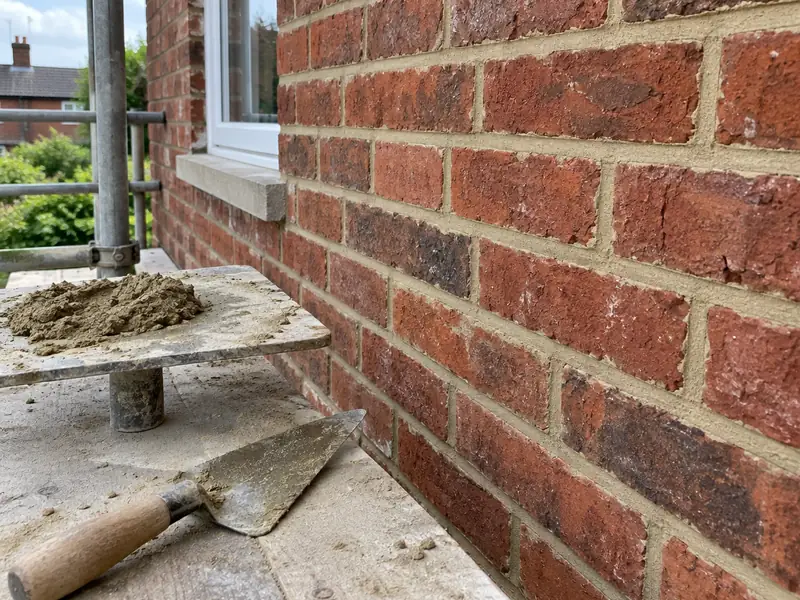
Repointing is raking out old, crumbling mortar from between bricks and replacing it with fresh mortar, sealing the joints against rain and protecting the wall; brickwork repairs replace spalled or cracked bricks and rebuild damaged sections.
Lower Earley sits within our coverage for brickwork and repointing, as do neighbouring Reading, Wokingham and Crowthorne. Before giving a price we want to see the property: the condition of what's there now, the access, and anything that might need extra work. The guide range for the South East is £2,800–£6,700 including VAT, and your written quote will spell out exactly what that covers.
- Guide price
- £2,800–£6,700 inc VAT
- Time on site
- 3–10 days for a typical house
- Postcodes
- RG2, RG5 and RG6
- Planning rules
- England
- Local area
- Wokingham
- Survey
- Free, with a written quote
How much does brickwork and repointing cost in Lower Earley?
Prices for brickwork and repointing vary from house to house, but in Lower Earley most projects fall within £2,800–£6,700 including VAT. That reflects costs in the South East, about 12% above the national guide. Treat the table as a budgeting aid; the written figure follows a survey we carry out for free.
| Type of job | What it usually involves | Guide in Lower Earley |
|---|---|---|
| Chimney or small area | Repointing a chimney stack, gable or single wall, including access. | £650–£2,000 |
| Typical semi-detached | Repointing the main elevations of a 3-bed semi, including scaffolding. | £2,800–£6,700 |
| Detached or lime work | Larger houses, or period homes repointed in lime with brick repairs. | £5,600–£11,000 |
What moves the price up or down:
- Wall area to repoint and the height of the house
- Mortar type: cement or lime, and joint style
- Number of bricks to replace and how well they match
- Condition of the existing mortar and how hard it is to remove
Scope of the work
- Scaffolding or access towers where needed
- Raking out old mortar to the correct depth
- Colour and joint style matched as closely as possible
- Replacement of spalled or cracked bricks
- Clean-down of brick faces after pointing
- Waste removal and a tidy site
Homes in Berkshire
Reading's Victorian terraces often show the town's patterned red and silver-grey brickwork, while Windsor, Maidenhead and Newbury mix Georgian, Victorian and Edwardian houses. Bracknell grew as a post-war new town with planned estates, Slough has a great deal of interwar and post-war housing, and newer developments sit on the edge of most towns.
Much of the Thames Valley is low-lying, so flood risk and clay ground near the river can influence foundations and drainage for extensions.
In Lower Earley, as elsewhere in Berkshire, we take the building's age and construction into account before recommending anything, because both can change what is involved in brickwork and repointing.
Do you need permission in Lower Earley?
Lower Earley is in England, so the planning and building rules set out below are the ones that apply. We confirm the details with the council before we quote.
Repointing and repairing brickwork with matching materials is maintenance, so it does not need planning permission in England. On a listed building, work that affects its character, including a change of mortar or brick, may need listed building consent.
Building Regulations do not normally apply to repointing or brick repairs, but rebuilding a wall, chimney or structural section can need building control involvement.
Rules change and every property is different, so we check the planning history and constraints for your address before we quote.
The four stages
We look at the job
We begin by looking at the job in person. During the free survey we discuss options, materials and budget for brickwork and repointing, and photograph or measure anything the quote needs to reflect.
Written quote
We turn the survey notes into a written quote. The price is fixed for the specification we agree, and the document sets out materials, scope and payment stages in plain language.
Dates and permissions
With the quote agreed, we book the work in and handle preparation: permissions where needed, building control notifications, material orders and access arrangements for your Lower Earley property.
The work itself
On site, the agreed plan is followed and any change is put in writing first. At completion we do a final clean, go through the snagging list with you and leave you with the relevant documents.
How we work
Frequently asked questions
What happens at the survey?
We visit your home at a time that suits you, look at the area involved, take measurements and check access, condition and any services that might be affected. We talk through what you want from brickwork and repointing, explain the options and answer questions. There is no charge and no obligation; afterwards we send a written quote.
How much does repointing a house cost?
Repointing a typical 3-bed semi costs £2,800–£6,700, including scaffolding. As a guide, allow roughly £25–£55 per square metre of wall plus fixed costs for access and set-up. Chimney stacks, lime mortar and brick replacement add cost, while repointing a single elevation costs less. We confirm a fixed price after inspecting your walls.
Can you combine brickwork and repointing with other work?
Yes. Because we manage several trades under one contract, we can plan brickwork and repointing alongside other work on your Lower Earley home, such as new windows with rendering, or a kitchen refit with an extension. Combining jobs can reduce repeat set-up such as scaffolding, skips and access, and every element is listed and priced in the same written quote.
Should my house be repointed with lime or cement?
Houses built before about the 1920s were usually built with soft bricks and lime mortar, and should normally be repointed in lime. Hard cement mortar in these walls traps moisture and can cause the brick faces to crumble. Newer homes built with cement mortar are usually repointed in a similar mix. We check your wall construction before recommending a mortar.
How do I know if my house needs repointing?
A house needs repointing when the mortar between bricks is crumbling, recessed well behind the brick face, cracked or missing. You may be able to scrape it out with a key. Damp patches inside, especially on exposed walls, and plants growing in joints are other signs. Patches of failed mortar can be repointed on their own, but widespread decay usually means a full elevation.
Also covering areas around Lower Earley
If your address falls within RG2, RG5 and RG6, we cover it. The same goes for neighbouring Reading, Wokingham and Crowthorne, which we include alongside Lower Earley when arranging surveys and quotes.