
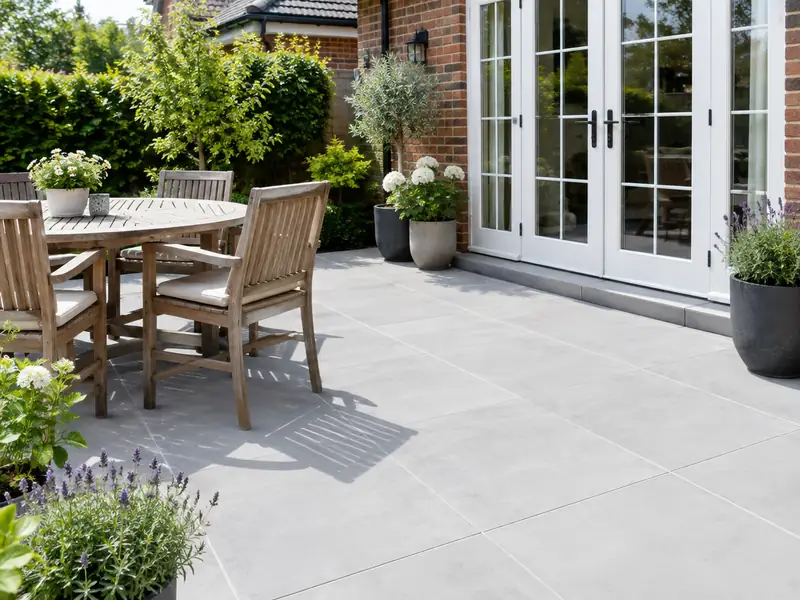
A patio is a paved outdoor area next to the house or in the garden, laid in porcelain, natural stone or concrete slabs on a compacted sub-base and mortar bed, with falls that direct rainwater away from the house.
We lay patios, garden paths and paved areas in porcelain, Indian sandstone, slate, granite and concrete slabs. Our free site survey and written quote measures the area, checks ground levels against your damp-proof course and doors, looks at drainage and access, and talks through slab type, size, colour and laying pattern. A new patio suits gardens where you want space for seating and dining, where old paving has sunk or cracked, or where a new extension needs a matching terrace. We excavate, lay a compacted sub-base, bed slabs on a full mortar bed, set falls away from the house and point the joints for a clean finish.
What’s included?
- Survey of levels, damp-proof course, drainage and access
- Excavation and removal of turf, soil or old paving
- Compacted MOT Type 1 sub-base
- Slabs laid on a full mortar bed with falls away from the house
- Primer on porcelain slabs for a strong bond
- Jointing with mortar or a brush-in compound
- Edging and neat cuts around drains and walls
- Site cleared, waste removed and paving cleaned
Which options can you choose from?
How much does a new patio cost?
Most jobs fall between £2,500–£5,500 for a typical 20m² patio in sandstone or porcelain, including groundworks, including VAT at 20%. The table shows three typical levels of work; the figures are national guides, confirmed in writing after a free site survey.
| Type of job | What it usually involves | Guide price |
|---|---|---|
| Small patio or path | Around 10m² of concrete slabs or a garden path. | £1,000–£2,500 |
| Typical 20m² patio | Sandstone or porcelain on a full sub-base with jointing and edging. | £2,500–£5,500 |
| Large or multi-level patio | Bigger areas, steps, retaining walls or premium stone. | £5,500–£12,000 |
What affects the price?
- Patio area and the amount of excavation
- Slab material, size and laying pattern
- Ground levels, slopes, steps and retaining walls
- Drainage needed to keep water away from the house
- Access for materials and removing spoil
How do prices vary across the UK?
| Region | Guide price |
|---|---|
| London | £3,200–£7,200 |
| The South East | £2,800–£6,200 |
| The East of England | £2,600–£5,800 |
| The South West | £2,600–£5,600 |
| The West Midlands | £2,400–£5,400 |
| The East Midlands | £2,400–£5,300 |
| The North West | £2,400–£5,200 |
| Yorkshire and the Humber | £2,400–£5,200 |
| The North East | £2,200–£5,000 |
| Wales | £2,300–£5,100 |
| Scotland | £2,400–£5,300 |
| Northern Ireland | £2,200–£4,700 |
Regional figures apply typical labour and material cost differences to the national guide. They are not quotes.
Do you need planning permission for a new patio?
Patios do not usually need building regulations approval. The finished level should normally sit at least 150mm below the damp-proof course, and water must drain away from the house rather than towards it.
England
A ground-level patio in a back garden does not usually need planning permission in England. Raised decks or platforms more than 30 cm high do.
Building Regulations do not normally apply to patios, but levels must stay below the damp-proof course and drain away from the house.
Wales
A ground-level patio does not usually need planning permission in Wales; raised platforms are more restricted.
Building Regulations do not normally apply, but levels and drainage must protect the house walls.
Scotland
A ground-level patio does not usually need planning permission in Scotland; raised decking is limited in height under permitted development.
A building warrant is not normally needed for a patio.
Northern Ireland
A ground-level patio does not usually need planning permission in Northern Ireland; raised platforms are more restricted.
Building control approval is not normally needed for a patio.
Rules change and every property is different, so we check the planning history and constraints for your address before we quote.
How long does it take?
Typical time on site: 3–7 days on site. Lead times for materials, drawings and approvals come before that and are set out in your written quote.
How does the job run?
Free site survey
We visit, measure up, look at access and the condition of what’s there, and talk through options and budget with you.
Written quote
You get a written quote with a fixed price for the agreed specification, what’s included, the payment stages and a likely start window.
Plan and prepare
We sort drawings, approvals and materials, agree dates with you and explain what to expect each week before work starts.
Build and hand over
The work is carried out, checked and cleared away. We walk round it with you and pass on certificates and product details.
Patios and paving: frequently asked questions
How much does a new patio cost?
A typical 20m² patio in sandstone or porcelain costs £2,500–£5,500, including excavation, sub-base, laying and jointing. As a guide, allow roughly £100–£220 per square metre plus fixed costs for set-up and waste. Concrete slabs cost less, while slate, granite and large-format porcelain cost more. Steps, walls and drainage add to the total. We confirm a fixed price after the survey.
Is porcelain or sandstone better for a patio?
Porcelain is dense, stain-resistant and stays looking clean with little care, making it a good choice if you want a modern, low-maintenance patio. Indian sandstone has natural colour variation and a softer, traditional look, and costs a little less, but it can stain and weather over time and benefits from sealing. Both make durable patios when properly laid. We bring samples to the survey.
Does a patio need planning permission?
Most patios do not need planning permission, but it depends on the size, height and location, your home's position, whether it is listed or in a conservation area, and which UK nation you are in. Raised patios or decking more than a small height above the ground may need permission because of overlooking. We check the position for your garden before quoting.
How long does it take to lay a patio?
Laying a typical 20m² patio takes around three to five days, from excavation and sub-base to laying, jointing and cleaning. Larger or multi-level patios with steps and walls take longer. The mortar bed needs time to set, so light foot traffic is usually fine after a day or two and furniture can go on after about a week. We confirm timings with your quote.
How do you make sure water drains away from the house?
A patio needs a gentle fall, usually a little over 1 in 80, so rainwater runs away from the house towards the garden, a drain or a soakaway. The surface should also sit well below the damp-proof course. If the patio meets a door threshold, a channel drain may be needed. We set levels with string lines and check falls as we lay each section.
How do I clean and look after my patio?
Most patios just need regular sweeping and an occasional wash with water and a mild patio cleaner. Porcelain is the easiest to keep clean. Natural stone benefits from a sealant to reduce staining and from prompt cleaning of spills like oil or wine. Re-point any joints that crack or wash out. Avoid high-pressure jet washing close to joints, which can damage them.
What happens if my garden slopes?
A sloping garden can still have a level patio by cutting into the slope, building up with retaining walls, or creating terraces with steps between them. Retaining walls must be built to hold back the soil and allow drainage behind them. This adds cost but creates usable, level space. We look at the slope during the survey and suggest the most practical design.
What should I do before the work starts?
Before work starts, clear garden furniture, pots and ornaments from the area and agree where materials will be delivered and stored. We need a route for wheelbarrows and, on larger jobs, a small digger, so let us know about side gates, narrow passages or access through the house. Tell us about any known drains, cables or pipes in the area.