
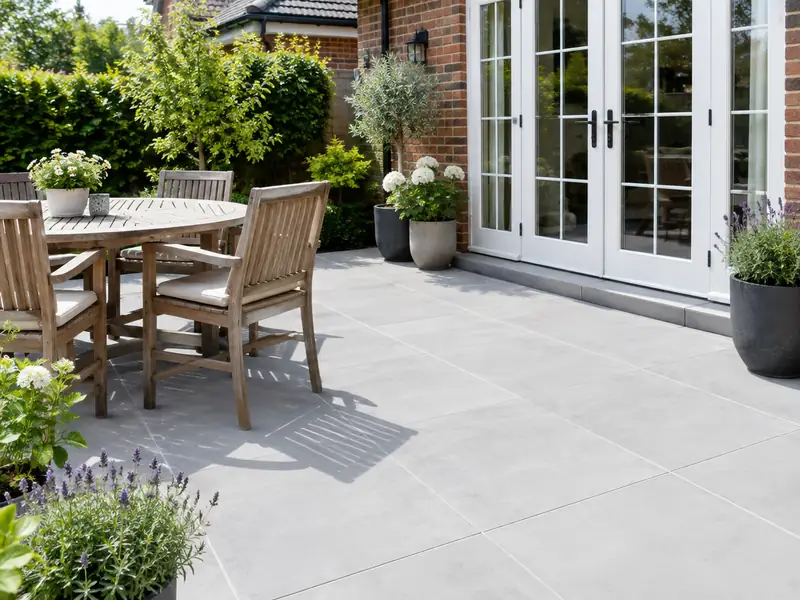
A patio is a paved outdoor area next to the house or in the garden, laid in porcelain, natural stone or concrete slabs on a compacted sub-base and mortar bed, with falls that direct rainwater away from the house.
Cost is usually the first question about a new patio, so here is the guide for the South East: £2,800–£6,200 including VAT. We cover the whole of Isle of Wight, with Newport, Isle of Wight, Ryde, Cowes and Sandown among the main centres. Because each UK nation sets its own rules, we check the requirements in England for your property, then put a firm price on paper following a free survey.
- Guide price
- £2,800–£6,200 inc VAT
- Time on site
- 3–7 days on site
- Planning rules
- England
- Price level
- About 12% above the national guide
- Towns listed
- 4
- Survey
- Free, with a written quote
Patios and paving prices in Isle of Wight
The table below shows guide prices for a new patio in Isle of Wight. They are based on rates in the South East, which run about 12% above the national guide, giving an overall range of £2,800–£6,200. All figures include VAT and are firmed up after a free site survey.
| Type of job | What it usually involves | Guide in Isle of Wight |
|---|---|---|
| Small patio or path | Around 10m² of concrete slabs or a garden path. | £1,100–£2,800 |
| Typical 20m² patio | Sandstone or porcelain on a full sub-base with jointing and edging. | £2,800–£6,200 |
| Large or multi-level patio | Bigger areas, steps, retaining walls or premium stone. | £6,200–£13,500 |
Your price depends mostly on:
- Patio area and the amount of excavation
- Slab material, size and laying pattern
- Ground levels, slopes, steps and retaining walls
- Access for materials and removing spoil
Scope of the work
- Excavation and removal of turf, soil or old paving
- Compacted MOT Type 1 sub-base
- Slabs laid on a full mortar bed with falls away from the house
- Primer on porcelain slabs for a strong bond
- Jointing with mortar or a brush-in compound
- Edging and neat cuts around drains and walls
Housing across Isle of Wight
The island has Victorian seaside villas and terraces in Ryde, Ventnor, Shanklin and Cowes, older cottages in island sandstone and limestone, and thatched roofs in some villages. Post-war bungalows, chalets and newer estates are common around Newport and the larger towns.
Victorian villas often need sash-style windows, render repairs and roof work. Bungalows suit loft conversions and extensions, while coastal properties commonly need roofline, fencing and external decorating renewed more often.
Salt and wind exposure is high on most coasts, and parts of the south, such as the Undercliff near Ventnor, are known for ground movement.
Do you need permission in Isle of Wight?
Isle of Wight is in England, so the planning and building rules set out below are the ones that apply. We confirm the details with the council before we quote.
A ground-level patio in a back garden does not usually need planning permission in England. Raised decks or platforms more than 30 cm high do.
Building Regulations do not normally apply to patios, but levels must stay below the damp-proof course and drain away from the house.
Rules change and every property is different, so we check the planning history and constraints for your address before we quote.
From survey to handover
We look at the job
We begin by looking at the job in person. During the free survey we discuss options, materials and budget for a new patio, and photograph or measure anything the quote needs to reflect.
Your fixed price
The quote arrives in writing, not over the phone. It covers the full scope, the finishes you've chosen, any exclusions and the payment schedule, with a fixed price tied to that specification.
Plan and prepare
Once you accept, we agree start dates, order materials and deal with any planning, building control or neighbour notices the job needs. You'll know who is coming and when before work begins.
Build and hand over
The job proceeds in the order set out in the programme, with dust and debris kept under control. Finally we tidy away, inspect the work together and pass the finished project over to you with its paperwork.
How we work
Questions about a new patio in Isle of Wight
How much will a new patio cost in Isle of Wight?
As a guide, expect to pay £2,800–£6,200 including VAT for a new patio in Isle of Wight. That range is adjusted for the South East, which runs about 12% above the national guide. Where your project lands depends on size, materials, access and the condition of what is already there. We confirm a fixed price in writing after a free survey of your home.
What happens at the survey?
We visit your home at a time that suits you, look at the area involved, take measurements and check access, condition and any services that might be affected. We talk through what you want from a new patio, explain the options and answer questions. There is no charge and no obligation; afterwards we send a written quote.
How do I clean and look after my patio?
Most patios just need regular sweeping and an occasional wash with water and a mild patio cleaner. Porcelain is the easiest to keep clean. Natural stone benefits from a sealant to reduce staining and from prompt cleaning of spills like oil or wine. Re-point any joints that crack or wash out. Avoid high-pressure jet washing close to joints, which can damage them.
How do you make sure water drains away from the house?
A patio needs a gentle fall, usually a little over 1 in 80, so rainwater runs away from the house towards the garden, a drain or a soakaway. The surface should also sit well below the damp-proof course. If the patio meets a door threshold, a channel drain may be needed. We set levels with string lines and check falls as we lay each section.
What happens if my garden slopes?
A sloping garden can still have a level patio by cutting into the slope, building up with retaining walls, or creating terraces with steps between them. Retaining walls must be built to hold back the soil and allow drainage behind them. This adds cost but creates usable, level space. We look at the slope during the survey and suggest the most practical design.
Towns in Isle of Wight
Homes in all of the following Isle of Wight towns can get a written quote for a new patio. Open a town page to see prices and the postcodes we cover.