
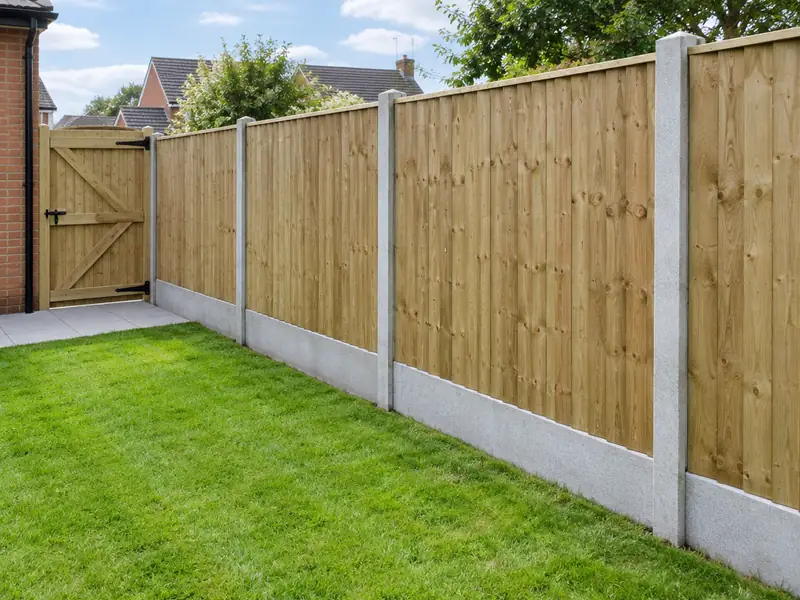
Fencing installation is setting fence posts into the ground, usually in concrete, and fixing panels or boards between them to mark a boundary, add privacy or keep children and pets in, with gates fitted where access is needed.
From Newport, Isle of Wight, Ryde, Cowes and Sandown to the quieter corners of Isle of Wight, homeowners can book a free survey for new fencing and gates. We look at the building, agree the scope, then send a quote in writing that fixes the cost of that scope. Work follows the rules for England, and our published range for the South East, £1,350–£3,400 with VAT, gives you a sense of budget before we visit.
- Guide price
- £1,350–£3,400 inc VAT
- Time on site
- 1–3 days for a typical garden
- Planning rules
- England
- Price level
- About 12% above the national guide
- Towns listed
- 4
- Survey
- Free, with a written quote
Fencing and gates prices in Isle of Wight
Budgeting for new fencing and gates in Isle of Wight? The numbers below include VAT and are adjusted for the South East, where costs are about 12% above the national guide. The headline range is £1,350–£3,400. Nothing is final until we have measured up at a free survey and agreed the specification with you.
| Type of job | What it usually involves | Guide in Isle of Wight |
|---|---|---|
| Repairs or a short run | Replacing a few panels and posts, or a short run of up to about 6m. | £350–£1,000 |
| Typical garden boundary | About 20m of panel or closeboard fencing with concrete posts and gravel boards. | £1,350–£3,400 |
| Composite or long runs with gates | Composite or premium fencing, longer runs, or a driveway gate. | £3,400–£7,800 |
What moves the price up or down:
- Total length and height of fencing
- Fence style and material: panels, closeboard or composite
- Ground conditions, slopes and removal of the old fence
- Number, size and type of gates
What do you get?
- Measured survey of each fence run, levels and slopes
- Removal and disposal of the old fence and posts
- Concrete or timber posts set in concrete
- Panels or boards fixed level or stepped to follow the ground
- Gates hung with hinges, latches and locks
- Site cleared and waste removed
Housing across Isle of Wight
The island has Victorian seaside villas and terraces in Ryde, Ventnor, Shanklin and Cowes, older cottages in island sandstone and limestone, and thatched roofs in some villages. Post-war bungalows, chalets and newer estates are common around Newport and the larger towns.
Victorian villas often need sash-style windows, render repairs and roof work. Bungalows suit loft conversions and extensions, while coastal properties commonly need roofline, fencing and external decorating renewed more often.
Salt and wind exposure is high on most coasts, and parts of the south, such as the Undercliff near Ventnor, are known for ground movement.
Do you need permission in Isle of Wight?
As Isle of Wight is in England, read the following with that system of planning and building control in mind. We check what applies to your house with the council before you receive a quote.
In England, fences, walls and gates up to 2 m high are usually permitted development, or up to 1 m where they are next to a road used by vehicles or its footpath. Listed buildings, conservation areas and estates with planning conditions can be stricter.
Building Regulations do not apply to ordinary garden fences, but boundary lines should be agreed with your neighbour first.
Rules change and every property is different, so we check the planning history and constraints for your address before we quote.
How does the job run?
Free site survey
First, someone visits your home in Isle of Wight to see the space, take measurements and note anything that could affect the work, such as access or the condition of what is there. There is no charge for this visit.
Written quote
We turn the survey notes into a written quote. The price is fixed for the specification we agree, and the document sets out materials, scope and payment stages in plain language.
Booking the work
Before anyone starts, we confirm the programme in writing, check whether consents are required and arrange deliveries. If a skip or scaffolding on the road needs a permit, we apply for it.
The work itself
The work is carried out to the agreed specification, with floors and furniture protected and the site kept tidy. At the end we clean up, walk through the finished job with you and hand over any certificates.
How we work
Frequently asked questions
Can I stay at home during the work?
In most cases, yes. Most people can live at home throughout, and we plan the work to keep disruption down by protecting floors, agreeing working hours and keeping access routes clear. Bigger jobs affecting kitchens, bathrooms or heating may mean a short spell with reduced facilities, and we talk this through with you at the survey.
How do I make my fence last longer?
A fence lasts longer when timber is kept off the soil and protected from moisture. Gravel boards beneath the panels, concrete posts and keeping plants and soil away from the fence all help. Treat timber with a preservative or stain every few years, and replace damaged boards promptly. Composite fencing needs only occasional washing.
Are concrete posts better than timber?
Concrete posts do not rot and are the most durable choice for panel fences, especially on exposed sites. They are heavier and more utilitarian in appearance. Timber posts look more natural and suit closeboard and featheredge fences, but they eventually rot at ground level, even when treated. Aluminium posts suit composite systems. We recommend posts based on your fence style and exposure.
Is the price fixed?
Yes, for the specification we agree. Your written quote sets out exactly what is included at a fixed price. It only changes if you ask for something different, or if a problem the survey could not reasonably reveal later needs extra work. In either case we explain the change and confirm it in writing before going ahead.
How high can my fence be?
Fence height limits depend on planning rules, your home's location, whether it is listed or in a conservation area, and which UK nation you live in. In England, fences up to 2m high are usually permitted development, reduced to 1m next to a road used by vehicles. Higher fences need planning permission. We check the rules for your boundary before quoting.
Towns in Isle of Wight
These are the towns in Isle of Wight where you can book a free survey for new fencing and gates. Each has its own page with guide prices and coverage details.