
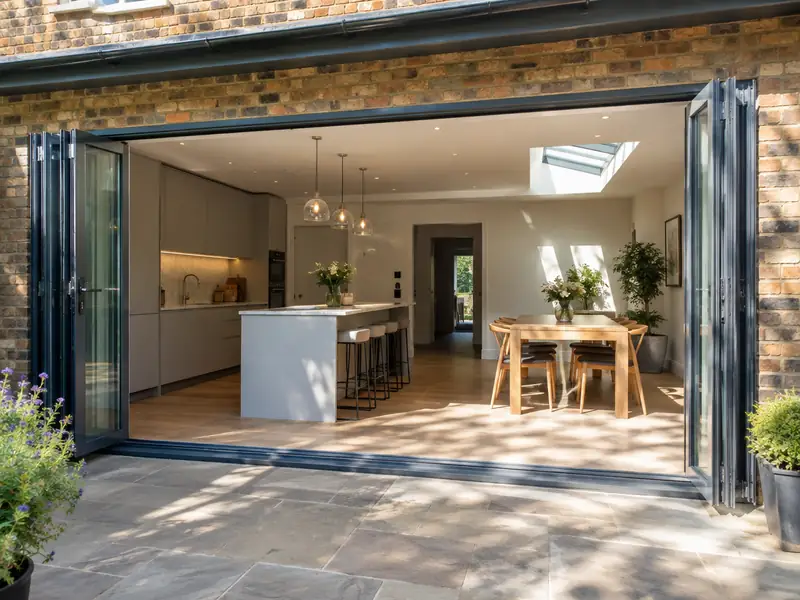
Bifold doors are glazed panels that fold and stack to one side to open up a wide gap, while sliding doors glide past each other on tracks; both connect a living space to the garden and bring in more daylight.
We fit bifold doors, sliding patio doors and French doors into existing openings, new extensions and widened walls. Our free site survey and written quote covers measuring the opening, checking the lintel or steel above, and looking at floor levels inside and out so the threshold works with your patio. We explain the trade-offs between bifolds and sliders, frame materials, panel numbers and glazing, and whether a wider opening needs a new steel beam. These doors suit kitchens, dining rooms and extensions where you want more light and a strong link to the garden. Doors are made to measure and fitted with the frame squared, sealed and finished inside.
What’s included?
- Measured survey of the opening, lintel and floor levels
- Made-to-measure bifold, sliding or French doors in your chosen colour
- Toughened double glazing as standard, with solar control options
- Removal of existing doors or windows and disposal of waste
- Level or low threshold options to suit your patio
- Opening widened with a new lintel or steel where agreed
- Weather seals, cills and internal trims finished neatly
- Building regulations sign-off arranged for the new doors
Which options can you choose from?
How much do bifold or sliding doors cost?
Most jobs fall between £3,000–£8,000 for a supplied and fitted 3m bifold or sliding door into a ready opening, including VAT at 20%. The table shows three typical levels of work; the figures are national guides, confirmed in writing after a free site survey.
| Type of job | What it usually involves | Guide price |
|---|---|---|
| uPVC sliding or French doors | Standard uPVC doors fitted into an existing opening of up to about 2m. | £1,500–£3,000 |
| 3m aluminium bifold | A three-panel aluminium bifold in a standard colour, fitted into a ready opening. | £3,500–£7,000 |
| Wide bifold or slimline slider | Openings of 4m or more and slim-frame doors, often with a new steel above. | £7,000–£14,000 |
What affects the price?
- Width and height of the opening and number of panels
- Frame material: uPVC, standard aluminium or slimline aluminium
- Glazing upgrades such as solar control or triple glazing
- Widening the opening with a new steel beam
- Threshold type, colour choice and built-in blinds
How do prices vary across the UK?
| Region | Guide price |
|---|---|
| London | £3,900–£10,500 |
| The South East | £3,400–£9,000 |
| The East of England | £3,200–£8,400 |
| The South West | £3,100–£8,200 |
| The West Midlands | £2,900–£7,800 |
| The East Midlands | £2,900–£7,700 |
| The North West | £2,800–£7,600 |
| Yorkshire and the Humber | £2,800–£7,500 |
| The North East | £2,700–£7,200 |
| Wales | £2,800–£7,400 |
| Scotland | £2,900–£7,700 |
| Northern Ireland | £2,600–£6,900 |
Regional figures apply typical labour and material cost differences to the national guide. They are not quotes.
Do you need planning permission for bifold or sliding doors?
New external doors must meet building regulations for energy efficiency and safety glazing. Widening an opening is structural work that needs building control approval, and in Scotland a building warrant; large glazed areas can also affect heat-loss calculations for extensions.
England
Replacing windows and doors on a house is usually permitted development in England when the new ones look broadly similar to the old. Flats, listed buildings and homes covered by an Article 4 direction can need consent, and conservation areas may limit materials or styles.
Replacement windows and external doors must meet Building Regulations for energy efficiency, ventilation and, on upper floors, escape. The work is either self-certified by an installer registered with a competent person scheme or signed off by building control.
Wales
In Wales, replacing windows and doors on a house usually needs no planning permission if the new ones are similar in appearance. Listed buildings, flats and some conservation areas are controlled, so the council should be asked first.
Building Regulations in Wales apply to replacement windows and doors, covering energy performance, ventilation and escape routes. A registered competent person can self-certify the work, or building control inspects it.
Scotland
In Scotland, replacing windows and doors on a house generally needs no planning permission when the style is similar, but listed buildings and conservation areas are closely controlled and often need consent for any change of material or pattern.
A building warrant is not usually needed for like-for-like replacement windows, but the new units must still meet the Scottish building standards, including energy performance and, where relevant, escape from upper floors.
Northern Ireland
In Northern Ireland, like-for-like replacement windows and doors on a house rarely need planning permission. Listed buildings and conservation areas are the main exceptions, so check with the council before changing style or material.
The Building Regulations (Northern Ireland) apply to replacement windows, so the work needs building control approval or sign-off through an approved competent person route.
Rules change and every property is different, so we check the planning history and constraints for your address before we quote.
How long does it take?
Typical time on site: 1–2 days to fit into a ready opening. Lead times for materials, drawings and approvals come before that and are set out in your written quote.
How does the job run?
Free site survey
We visit, measure up, look at access and the condition of what’s there, and talk through options and budget with you.
Written quote
You get a written quote with a fixed price for the agreed specification, what’s included, the payment stages and a likely start window.
Plan and prepare
We sort drawings, approvals and materials, agree dates with you and explain what to expect each week before work starts.
Build and hand over
The work is carried out, checked and cleared away. We walk round it with you and pass on certificates and product details.
Bifold and sliding doors: frequently asked questions
How much do bifold doors cost?
Bifold doors cost £3,000–£8,000 for a typical 3m opening, supplied and fitted. As a rough guide, allow around £900–£2,000 per metre of width plus the fixed costs of fitting, depending on frame material and glass. uPVC sits at the lower end and slimline aluminium at the top. Widening the opening with a new steel adds to the price. We confirm a fixed figure after measuring.
Should I choose bifold or sliding doors?
Bifold doors suit you if you want to open the whole width to the garden, because the panels fold and stack to one side. Sliding doors suit you if you mainly want the view, because they have fewer, larger panes and slimmer frames, though only part of the width opens. Sliding doors also take up no room when open. We help you weigh up how you will use the space in summer and winter.
Can you fit bifold doors where I have a window now?
Bifold doors can usually replace a window by cutting the wall down to floor level and, if the opening is being widened, fitting a new lintel or steel beam. A structural engineer sizes the beam, and building control approval is needed. Radiators, pipes and cables under the window may need moving. We check all of this at the survey and include it in a single written quote.
How long do bifold doors take to make and fit?
Aluminium bifold and sliding doors usually take several weeks to manufacture after the survey, depending on the supplier and colour. Fitting into a ready opening normally takes one to two days, including sealing and finishing trims. If we are widening the opening, allow a few extra days for the structural work and making good before the doors arrive. We give you the expected timeline with your quote.
Can I have a level threshold?
A level threshold means the door track sits flush with the floor, so there is no step between inside and out. Most aluminium bifolds and sliders can be fitted this way, but the outside paving must sit just below the track with a drainage channel to keep rain out. Rebated thresholds give stronger weather protection with only a small step. We check floor and patio levels before recommending either.
Are bifold doors secure?
Modern bifold and sliding doors are designed to be secure, with multi-point locks, shoot bolts into the frame, internally beaded glass and toughened or laminated glazing. The traffic door, which you use day to day, has a cylinder lock that can take an anti-snap barrel. Sliding doors also have anti-lift features. We explain the locking on each option so you can compare like for like.
Will large glass doors make my room cold?
Large glass doors lose more heat than an insulated wall, but modern double glazing with thermally broken frames performs far better than older patio doors. Solar control glass helps stop south-facing rooms overheating in summer. In extensions, building control looks at the total glazed area, so heat-loss calculations may be needed. We can suggest glass specifications that balance light, warmth and cost.
How do I maintain bifold doors?
Bifold doors need simple, regular care to keep them running smoothly. Vacuum or brush grit out of the bottom track every few weeks, wipe the frames with warm soapy water and avoid abrasive cleaners. Once or twice a year, lubricate the rollers, hinges and locks with a silicone spray. If the panels start to drop or catch, the hinges can usually be adjusted rather than replaced.