
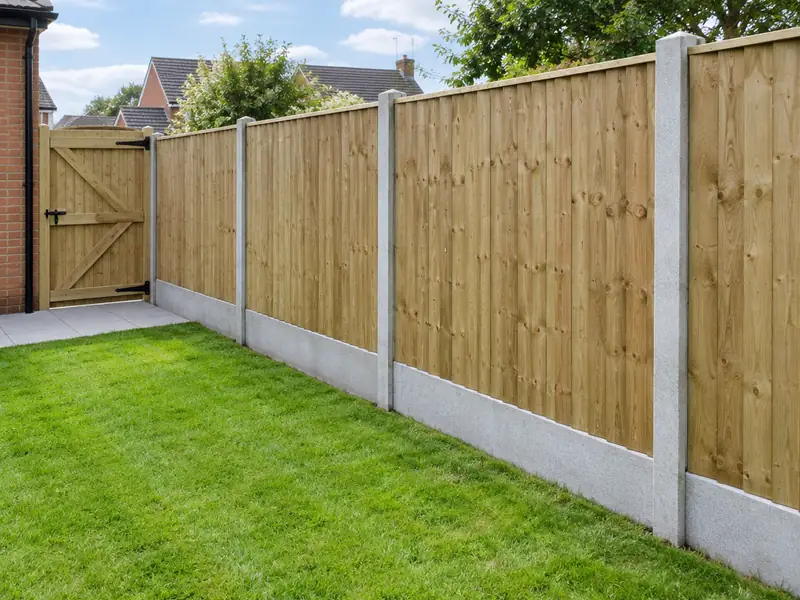
Fencing installation is setting fence posts into the ground, usually in concrete, and fixing panels or boards between them to mark a boundary, add privacy or keep children and pets in, with gates fitted where access is needed.
We install and replace garden fences and gates, from a few storm-damaged panels to full boundary runs. Our free site survey and written quote measures each run, checks ground levels and slopes, looks at the condition of existing posts and gravel boards, and talks through fence styles, heights and post types. We also discuss boundary ownership and any height limits. New fencing suits gardens with rotten or leaning fences, panels that blow out in storms, or where you want more privacy or security. We remove the old fence, set new posts in concrete, fit gravel boards and panels or boards, and hang gates so they open smoothly and latch securely.
What’s included?
- Measured survey of each fence run, levels and slopes
- Removal and disposal of the old fence and posts
- Concrete or timber posts set in concrete
- Concrete or timber gravel boards to keep panels off the soil
- Panels or boards fixed level or stepped to follow the ground
- Post caps and capping rails where specified
- Gates hung with hinges, latches and locks
- Site cleared and waste removed
Which options can you choose from?
How much do new fencing and gates cost?
Most jobs fall between £1,200–£3,000 for about 20m of new panel or closeboard fencing with concrete posts, including VAT at 20%. The table shows three typical levels of work; the figures are national guides, confirmed in writing after a free site survey.
| Type of job | What it usually involves | Guide price |
|---|---|---|
| Repairs or a short run | Replacing a few panels and posts, or a short run of up to about 6m. | £300–£900 |
| Typical garden boundary | About 20m of panel or closeboard fencing with concrete posts and gravel boards. | £1,200–£3,000 |
| Composite or long runs with gates | Composite or premium fencing, longer runs, or a driveway gate. | £3,000–£7,000 |
What affects the price?
- Total length and height of fencing
- Fence style and material: panels, closeboard or composite
- Post type: concrete, timber or aluminium
- Ground conditions, slopes and removal of the old fence
- Number, size and type of gates
How do prices vary across the UK?
| Region | Guide price |
|---|---|
| London | £1,550–£3,900 |
| The South East | £1,350–£3,400 |
| The East of England | £1,250–£3,200 |
| The South West | £1,200–£3,100 |
| The West Midlands | £1,200–£2,900 |
| The East Midlands | £1,150–£2,900 |
| The North West | £1,150–£2,800 |
| Yorkshire and the Humber | £1,150–£2,800 |
| The North East | £1,100–£2,700 |
| Wales | £1,100–£2,800 |
| Scotland | £1,150–£2,900 |
| Northern Ireland | £1,050–£2,600 |
Regional figures apply typical labour and material cost differences to the national guide. They are not quotes.
Do you need planning permission for new fencing and gates?
Fences and gates do not need building regulations approval. Height limits are set by planning rules, which differ between the UK nations, and boundary positions should be agreed with neighbours before work starts.
England
In England, fences, walls and gates up to 2 m high are usually permitted development, or up to 1 m where they are next to a road used by vehicles or its footpath. Listed buildings, conservation areas and estates with planning conditions can be stricter.
Building Regulations do not apply to ordinary garden fences, but boundary lines should be agreed with your neighbour first.
Wales
In Wales, fences, walls and gates up to 2 m high (1 m next to a road) are usually permitted development.
Building Regulations do not apply to ordinary fences.
Scotland
In Scotland, gates, fences and walls up to 2 m high are usually permitted development, with a 1 m limit in front of the house or next to a road.
A building warrant is not needed for ordinary garden fences.
Northern Ireland
In Northern Ireland, fences, walls and gates have similar height limits under permitted development, lower next to a road.
Building control approval is not needed for ordinary fences.
Rules change and every property is different, so we check the planning history and constraints for your address before we quote.
How long does it take?
Typical time on site: 1–3 days for a typical garden. Lead times for materials, drawings and approvals come before that and are set out in your written quote.
How does the job run?
Free site survey
We visit, measure up, look at access and the condition of what’s there, and talk through options and budget with you.
Written quote
You get a written quote with a fixed price for the agreed specification, what’s included, the payment stages and a likely start window.
Plan and prepare
We sort drawings, approvals and materials, agree dates with you and explain what to expect each week before work starts.
Build and hand over
The work is carried out, checked and cleared away. We walk round it with you and pass on certificates and product details.
Fencing and gates: frequently asked questions
How much does a new fence cost?
About 20m of new panel or closeboard fencing with concrete posts costs £1,200–£3,000, including removal of the old fence. As a guide, allow roughly £55–£130 per metre plus a small fixed cost for removal and waste. Lap panels sit at the lower end, while closeboard, slatted and composite fencing cost more. Gates, slopes and hard ground add to the price. We confirm a fixed price after measuring.
How high can my fence be?
Fence height limits depend on planning rules, your home's location, whether it is listed or in a conservation area, and which UK nation you live in. In England, fences up to 2m high are usually permitted development, reduced to 1m next to a road used by vehicles. Higher fences need planning permission. We check the rules for your boundary before quoting.
Who owns the fence between me and my neighbour?
Fence ownership is usually shown on the title plan or deeds, sometimes with a T mark on the side of the owner. If it is unclear, it may be shared. Even on your own boundary, it is sensible to talk to neighbours before replacing a fence, agree access and confirm the line. We fit the fence on the line you confirm and can face the good side outwards if you wish.
Are concrete posts better than timber?
Concrete posts do not rot and are the most durable choice for panel fences, especially on exposed sites. They are heavier and more utilitarian in appearance. Timber posts look more natural and suit closeboard and featheredge fences, but they eventually rot at ground level, even when treated. Aluminium posts suit composite systems. We recommend posts based on your fence style and exposure.
How long does it take to replace a fence?
Replacing a typical 20m garden fence usually takes one to two days, including taking down the old fence, setting posts in concrete and fitting panels or boards. Longer runs, slopes, hard ground and gates take longer. Post concrete needs time to set before panels are fully loaded. We give you an expected timeline with your quote.
How do you fence a sloping garden?
On a sloping garden, fence panels are usually stepped, so each panel is level and set slightly higher or lower than the one before, with the gap below filled by a gravel board. Closeboard fences can instead follow the slope, giving a smooth top line. The choice depends on how steep the slope is and the look you want. We discuss both at the survey.
How do I make my fence last longer?
A fence lasts longer when timber is kept off the soil and protected from moisture. Gravel boards beneath the panels, concrete posts and keeping plants and soil away from the fence all help. Treat timber with a preservative or stain every few years, and replace damaged boards promptly. Composite fencing needs only occasional washing.
What kind of gate do I need?
The right gate depends on its job. A side gate for access to the back garden is usually timber or metal, around 0.9m to 1m wide, with a secure lock. Driveway gates are wider, often in pairs, and need strong posts. Composite and metal gates resist warping. We measure the opening, check posts and suggest hinges, latches and locks for security.