
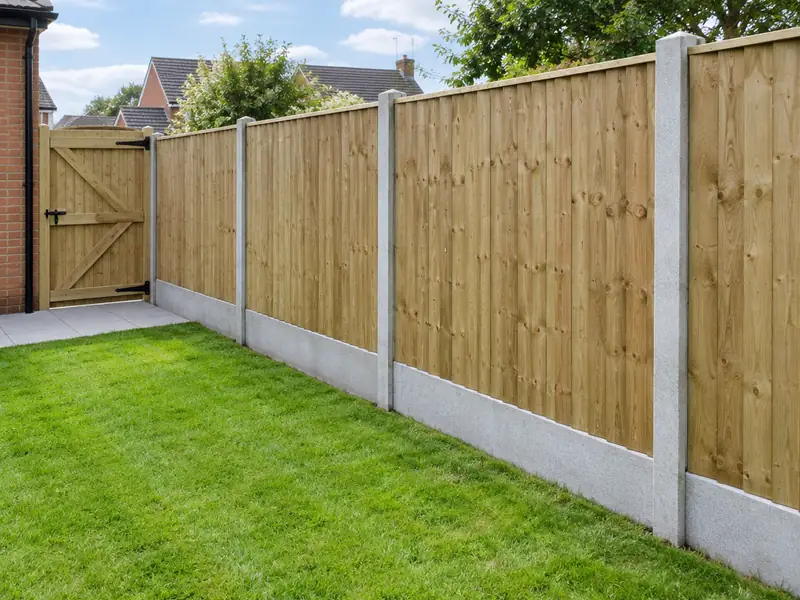
Fencing installation is setting fence posts into the ground, usually in concrete, and fixing panels or boards between them to mark a boundary, add privacy or keep children and pets in, with gates fitted where access is needed.
We offer new fencing and gates throughout Dorset, from Bournemouth, Poole, Weymouth and Christchurch to the smaller places in between. Each project starts with a free survey at your home and ends with a written figure, fixed for the work you choose. Because Dorset is in England, we work to the planning system and building standards used there, and guide prices for the South West run at £1,200–£3,100 including VAT.
- Guide price
- £1,200–£3,100 inc VAT
- Time on site
- 1–3 days for a typical garden
- Planning rules
- England
- Price level
- About 2% above the national guide
- Towns listed
- 4
- Survey
- Free, with a written quote
How much do new fencing and gates cost in Dorset?
Use the table to gauge the cost of new fencing and gates in Dorset before we visit. Figures include VAT and are scaled for the South West, coming out about 2% above the national guide, which gives £1,200–£3,100 overall. After a free survey, you receive a fixed written price.
| Type of job | What it usually involves | Guide in Dorset |
|---|---|---|
| Repairs or a short run | Replacing a few panels and posts, or a short run of up to about 6m. | £300–£900 |
| Typical garden boundary | About 20m of panel or closeboard fencing with concrete posts and gravel boards. | £1,200–£3,100 |
| Composite or long runs with gates | Composite or premium fencing, longer runs, or a driveway gate. | £3,100–£7,100 |
The main things that change the figure:
- Total length and height of fencing
- Fence style and material: panels, closeboard or composite
- Post type: concrete, timber or aluminium
- Ground conditions, slopes and removal of the old fence
What’s included?
- Measured survey of each fence run, levels and slopes
- Removal and disposal of the old fence and posts
- Concrete or timber posts set in concrete
- Panels or boards fixed level or stepped to follow the ground
- Post caps and capping rails where specified
- Site cleared and waste removed
Housing across Dorset
Dorset's older villages use Purbeck and Portland stone, chalk and flint, and thatch on cob or brick cottages. Bournemouth and Poole have Victorian and Edwardian villas, large interwar suburbs and plenty of bungalows and flats, while Weymouth, Dorchester and Bridport mix Georgian and Victorian streets with newer estates.
Stone and thatched cottages may need lime repairs and conservation-area window choices. Bungalows around Bournemouth and Poole commonly suit loft conversions, and coastal homes often need roofline, rendering and window renewal.
Salt spray and south-westerly winds affect coastal homes, so external finishes and fixings need to cope with marine exposure.
Planning and building rules in Dorset
For anyone in Dorset, the relevant framework is England's. The summary below is general, so we always contact the council about your address before putting a price in writing.
In England, fences, walls and gates up to 2 m high are usually permitted development, or up to 1 m where they are next to a road used by vehicles or its footpath. Listed buildings, conservation areas and estates with planning conditions can be stricter.
Building Regulations do not apply to ordinary garden fences, but boundary lines should be agreed with your neighbour first.
Rules change and every property is different, so we check the planning history and constraints for your address before we quote.
How does the job run?
We look at the job
Book a visit and we'll come to you. The survey covers measurements, the state of what's there now and any obvious constraints, so the price that follows is based on your actual home, not an average.
Your fixed price
The quote arrives in writing, not over the phone. It covers the full scope, the finishes you've chosen, any exclusions and the payment schedule, with a fixed price tied to that specification.
Dates and permissions
Next comes planning the work itself. We set a start date that suits you, line up the right trades, and make sure any approvals for new fencing and gates are in place before the first day on site.
The work itself
During the work we protect the areas around it and tidy up at the end of each day. Once complete, we check the finish, remove our materials and hand over paperwork such as building control sign-off where it applies.
What you can expect from us
Frequently asked questions
How do I make my fence last longer?
A fence lasts longer when timber is kept off the soil and protected from moisture. Gravel boards beneath the panels, concrete posts and keeping plants and soil away from the fence all help. Treat timber with a preservative or stain every few years, and replace damaged boards promptly. Composite fencing needs only occasional washing.
Who owns the fence between me and my neighbour?
Fence ownership is usually shown on the title plan or deeds, sometimes with a T mark on the side of the owner. If it is unclear, it may be shared. Even on your own boundary, it is sensible to talk to neighbours before replacing a fence, agree access and confirm the line. We fit the fence on the line you confirm and can face the good side outwards if you wish.
How do you fence a sloping garden?
On a sloping garden, fence panels are usually stepped, so each panel is level and set slightly higher or lower than the one before, with the gap below filled by a gravel board. Closeboard fences can instead follow the slope, giving a smooth top line. The choice depends on how steep the slope is and the look you want. We discuss both at the survey.
Can I stay at home during the work?
In most cases, yes. Most people can live at home throughout, and we plan the work to keep disruption down by protecting floors, agreeing working hours and keeping access routes clear. Bigger jobs affecting kitchens, bathrooms or heating may mean a short spell with reduced facilities, and we talk this through with you at the survey.
Do I need planning permission in Dorset?
It depends on the work, the size of the project, your property type and whether the building is listed or in a conservation area. Dorset is in England, so England's rules apply. Many smaller jobs need no planning application, but some still need building control approval. We check what applies to your address before quoting.
Towns in Dorset
Find your town below. Every place listed in Dorset is covered for new fencing and gates, with the same survey, written quote and fixed-price process.