
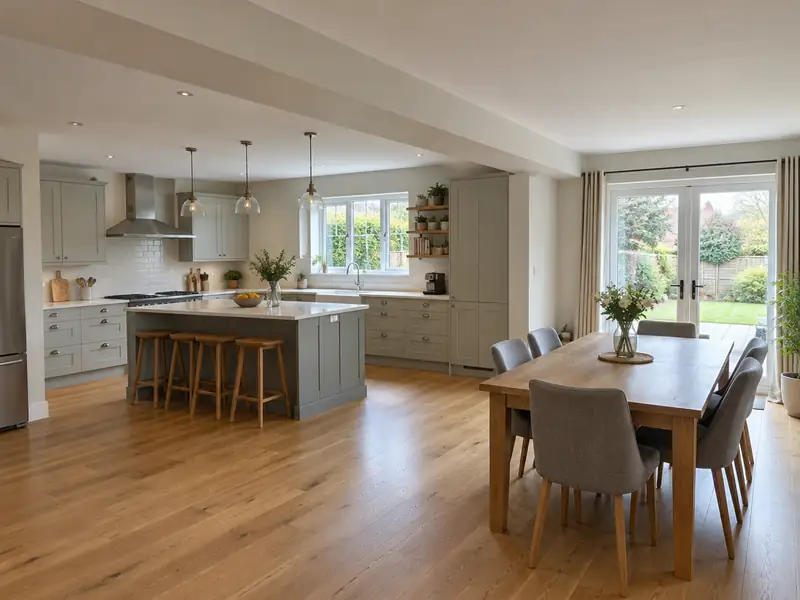
Wall removal is taking out an internal wall to open up rooms; where the wall is load-bearing, a steel beam sized by a structural engineer is installed on padstones to carry the weight above, with the work approved by building control.
Across Dorset, people look into removing a wall to replace something worn out, to make the house work better for them, or to get it ready for a sale. We cover Bournemouth, Poole, Weymouth and Christchurch and the smaller towns around them, working to the rules that apply in England. Expect a guide of £3,100–£8,200, VAT included, in the South West, and every quote follows a free visit.
- Guide price
- £3,100–£8,200 inc VAT
- Time on site
- 1–3 weeks including making good
- Planning rules
- England
- Price level
- About 2% above the national guide
- Towns listed
- 4
- Survey
- Free, with a written quote
How much does removing a wall cost in Dorset?
Use the table to gauge the cost of removing a wall in Dorset before we visit. Figures include VAT and are scaled for the South West, coming out about 2% above the national guide, which gives £3,100–£8,200 overall. After a free survey, you receive a fixed written price.
| Type of job | What it usually involves | Guide in Dorset |
|---|---|---|
| Non-load-bearing wall | Removing a stud or block partition and making good walls, ceiling and floor. | £800–£2,000 |
| Load-bearing wall up to 4m | A typical kitchen-diner knock-through with one steel beam, calculations and building control. | £3,100–£8,200 |
| Wide or complex opening | Openings over 4m, posts, flush beams or chimney breast removal. | £8,200–£16,500 |
What moves the price up or down:
- Opening width and the load the wall carries
- Beam size, posts, flush fixing and padstone details
- Services in the wall that need rerouting
- Engineer, building control and any party wall costs
What’s included?
- Survey to establish what the wall supports and where loads go
- Building control application and inspections
- Temporary propping and dust protection during the work
- Steel beam installed on padstones and packed tight
- Beam boarded or treated for fire protection
- Plastering, flooring repairs and making good ready for decorating
Housing across Dorset
Dorset's older villages use Purbeck and Portland stone, chalk and flint, and thatch on cob or brick cottages. Bournemouth and Poole have Victorian and Edwardian villas, large interwar suburbs and plenty of bungalows and flats, while Weymouth, Dorchester and Bridport mix Georgian and Victorian streets with newer estates.
Stone and thatched cottages may need lime repairs and conservation-area window choices. Bungalows around Bournemouth and Poole commonly suit loft conversions, and coastal homes often need roofline, rendering and window renewal.
Salt spray and south-westerly winds affect coastal homes, so external finishes and fixings need to cope with marine exposure.
Planning and building rules in Dorset
Dorset is in England, so the planning and building rules set out below are the ones that apply. We confirm the details with the council before we quote.
Removing an internal wall does not need planning permission in England unless the house is listed.
If the wall is load-bearing, Building Regulations approval is needed, with a structural engineer’s calculations for the steel beam and padstones. Where the beam bears on a shared wall, the Party Wall etc. Act 1996 applies.
Rules change and every property is different, so we check the planning history and constraints for your address before we quote.
From survey to handover
We look at the job
A free survey comes first. It gives us what we need to price removing a wall properly, including dimensions, existing materials and access for deliveries, and gives you the chance to ask anything you like.
Quote in writing
We put everything into a written, fixed-price quote: the specification, what's excluded, staged payments and the expected time on site. Take whatever time you need to decide; there's no pressure to commit.
Plan and prepare
Next comes planning the work itself. We set a start date that suits you, line up the right trades, and make sure any approvals for removing a wall are in place before the first day on site.
The work itself
During the work we protect the areas around it and tidy up at the end of each day. Once complete, we check the finish, remove our materials and hand over paperwork such as building control sign-off where it applies.
What you can expect from us
Questions about removing a wall in Dorset
Can I stay at home during the work?
In most cases, yes. Most people can live at home throughout, and we plan the work to keep disruption down by protecting floors, agreeing working hours and keeping access routes clear. Bigger jobs affecting kitchens, bathrooms or heating may mean a short spell with reduced facilities, and we talk this through with you at the survey.
Who do I deal with during the job?
One point of contact manages your project from survey to handover. They schedule the trades working under our contract, keep you updated on progress, and are the person to call with any question. You don't need to coordinate builders, electricians or decorators separately, because that is part of what we do.
How disruptive is removing a wall?
Removing a wall is dusty and noisy, but the most disruptive part is short, usually one to three days for propping, demolition and installing the steel. We seal doorways with dust screens, protect floors and keep a safe route through the house. Making good, plastering and floor repairs follow over the next week or two. Most people stay at home throughout.
What is a steel beam and why is it needed?
A steel beam, often called an RSJ, is a strong steel section installed where a load-bearing wall used to be, so the weight above is carried across the opening to the walls at each end. It sits on padstones that spread the load. The size depends on the span and the load, which a structural engineer calculates. The beam is then boxed in or plastered.
How much does it cost to remove a load-bearing wall?
Removing a load-bearing wall of about 3–4m with a steel beam typically costs £3,100–£8,200, including structural calculations, building control and making good. A non-load-bearing partition costs much less. As a rough guide, allow around £600–£1,600 per metre of opening plus fixed costs for the engineer, approvals and propping. Wider openings, posts and flush beams cost more. We confirm a fixed price after the survey.
Towns in Dorset
Find your town below. Every place listed in Dorset is covered for removing a wall, with the same survey, written quote and fixed-price process.