
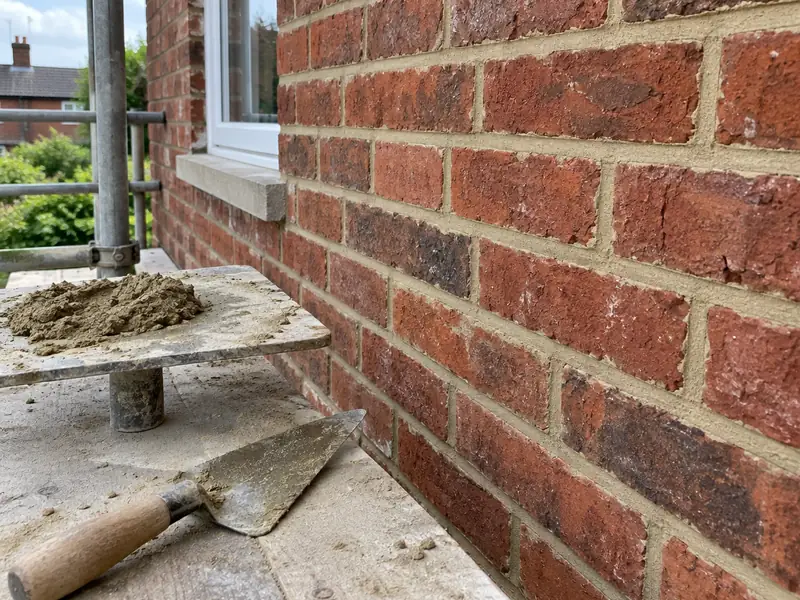
Repointing is raking out old, crumbling mortar from between bricks and replacing it with fresh mortar, sealing the joints against rain and protecting the wall; brickwork repairs replace spalled or cracked bricks and rebuild damaged sections.
We repoint houses, chimneys and garden walls, replace damaged bricks and carry out small brickwork jobs such as garden walls and piers. Our free site survey and written quote checks the condition of the mortar and bricks, the age of the house and whether lime or cement mortar is right, and looks for cracks, bulges or damp patches that point to other problems. Repointing suits homes where mortar is crumbling, recessed or washing out, or where rain is getting into the walls. We rake out joints to the right depth, match mortar colour and style as closely as possible, and finish joints neatly so the wall looks tidy and weathers well.
What’s included?
- Survey of mortar, bricks, cracks and the cause of any damp
- Scaffolding or access towers where needed
- Raking out old mortar to the correct depth
- Mortar mixed to suit the wall, in lime or cement
- Colour and joint style matched as closely as possible
- Replacement of spalled or cracked bricks
- Clean-down of brick faces after pointing
- Waste removal and a tidy site
Which options can you choose from?
How much does brickwork and repointing cost?
Most jobs fall between £2,500–£6,000 for repointing a typical 3-bed semi, including scaffolding, including VAT at 20%. The table shows three typical levels of work; the figures are national guides, confirmed in writing after a free site survey.
| Type of job | What it usually involves | Guide price |
|---|---|---|
| Chimney or small area | Repointing a chimney stack, gable or single wall, including access. | £600–£1,800 |
| Typical semi-detached | Repointing the main elevations of a 3-bed semi, including scaffolding. | £2,500–£6,000 |
| Detached or lime work | Larger houses, or period homes repointed in lime with brick repairs. | £5,000–£10,000 |
What affects the price?
- Wall area to repoint and the height of the house
- Mortar type: cement or lime, and joint style
- Number of bricks to replace and how well they match
- Scaffolding and access, including chimneys
- Condition of the existing mortar and how hard it is to remove
How do prices vary across the UK?
| Region | Guide price |
|---|---|
| London | £3,200–£7,800 |
| The South East | £2,800–£6,700 |
| The East of England | £2,600–£6,300 |
| The South West | £2,600–£6,100 |
| The West Midlands | £2,400–£5,900 |
| The East Midlands | £2,400–£5,800 |
| The North West | £2,400–£5,700 |
| Yorkshire and the Humber | £2,400–£5,600 |
| The North East | £2,200–£5,400 |
| Wales | £2,300–£5,500 |
| Scotland | £2,400–£5,800 |
| Northern Ireland | £2,200–£5,200 |
Regional figures apply typical labour and material cost differences to the national guide. They are not quotes.
Do you need planning permission for brickwork and repointing?
Repointing and like-for-like brick repairs do not usually need building regulations approval. Listed buildings need consent before repointing, and rebuilding structural walls may need building control involvement.
England
Repointing and repairing brickwork with matching materials is maintenance, so it does not need planning permission in England. On a listed building, work that affects its character, including a change of mortar or brick, may need listed building consent.
Building Regulations do not normally apply to repointing or brick repairs, but rebuilding a wall, chimney or structural section can need building control involvement.
Wales
In Wales, repointing and like-for-like brick repairs are maintenance and do not need planning permission; listed buildings may need consent for changes in materials.
Building Regulations do not normally apply to repointing, though structural rebuilding can.
Scotland
In Scotland, repointing and like-for-like masonry repairs are maintenance; listed buildings and conservation areas may need consent if materials or appearance change.
A building warrant is not normally needed for repointing; structural rebuilding of walls or chimneys can need one.
Northern Ireland
In Northern Ireland, repointing and like-for-like brick repairs are maintenance; listed buildings may need consent for changes in materials.
Building control approval is not normally needed for repointing, but structural rebuilding can need it.
Rules change and every property is different, so we check the planning history and constraints for your address before we quote.
How long does it take?
Typical time on site: 3–10 days for a typical house. Lead times for materials, drawings and approvals come before that and are set out in your written quote.
How does the job run?
Free site survey
We visit, measure up, look at access and the condition of what’s there, and talk through options and budget with you.
Written quote
You get a written quote with a fixed price for the agreed specification, what’s included, the payment stages and a likely start window.
Plan and prepare
We sort drawings, approvals and materials, agree dates with you and explain what to expect each week before work starts.
Build and hand over
The work is carried out, checked and cleared away. We walk round it with you and pass on certificates and product details.
Brickwork and repointing: frequently asked questions
How much does repointing a house cost?
Repointing a typical 3-bed semi costs £2,500–£6,000, including scaffolding. As a guide, allow roughly £25–£55 per square metre of wall plus fixed costs for access and set-up. Chimney stacks, lime mortar and brick replacement add cost, while repointing a single elevation costs less. We confirm a fixed price after inspecting your walls.
How do I know if my house needs repointing?
A house needs repointing when the mortar between bricks is crumbling, recessed well behind the brick face, cracked or missing. You may be able to scrape it out with a key. Damp patches inside, especially on exposed walls, and plants growing in joints are other signs. Patches of failed mortar can be repointed on their own, but widespread decay usually means a full elevation.
Should my house be repointed with lime or cement?
Houses built before about the 1920s were usually built with soft bricks and lime mortar, and should normally be repointed in lime. Hard cement mortar in these walls traps moisture and can cause the brick faces to crumble. Newer homes built with cement mortar are usually repointed in a similar mix. We check your wall construction before recommending a mortar.
Can you match the colour of my existing mortar?
Matching mortar colour is done by choosing the right sand and, where needed, adding pigment or using a coloured lime. We make test panels and let them dry, because mortar looks darker when wet. The joint style, such as flush, bucket handle or weatherstruck, also affects the look. An exact match is not always possible on old walls, but a careful match blends in well.
Will repointing cure damp?
Repointing can stop damp caused by rain getting through failed mortar joints, which is common on exposed walls. It will not fix damp from leaking gutters, a bridged damp-proof course, condensation or high ground levels against the wall. We look for the cause during the survey and recommend fixing that, so repointing is not done for the wrong reason.
When is the right time of year to repoint?
Repointing should be done in mild, dry weather, usually spring to early autumn. Fresh mortar must be kept from frost while it cures, and lime mortar in particular needs protection from frost, rain and strong sun for several days. We cover fresh work with hessian or sheeting where needed and plan the job around the forecast.
Is repointing messy or noisy?
Raking out old mortar is noisy and dusty, especially when power tools are used on hard mortar. We sheet scaffolding to contain dust, keep windows closed nearby and clear up at the end of each day. The noisy phase moves around the house elevation by elevation. Inside, you may notice some dust on windowsills, so it helps to keep windows shut.
What causes bricks to crumble?
Bricks usually crumble, or spall, when water gets into them and turns to ice, pushing the face off. This is often caused by hard cement mortar or impermeable paint trapping moisture in soft bricks, or by leaking gutters soaking the wall. Damaged bricks can be cut out and replaced with matching ones, or turned round if the back face is sound. We fix the cause at the same time.