
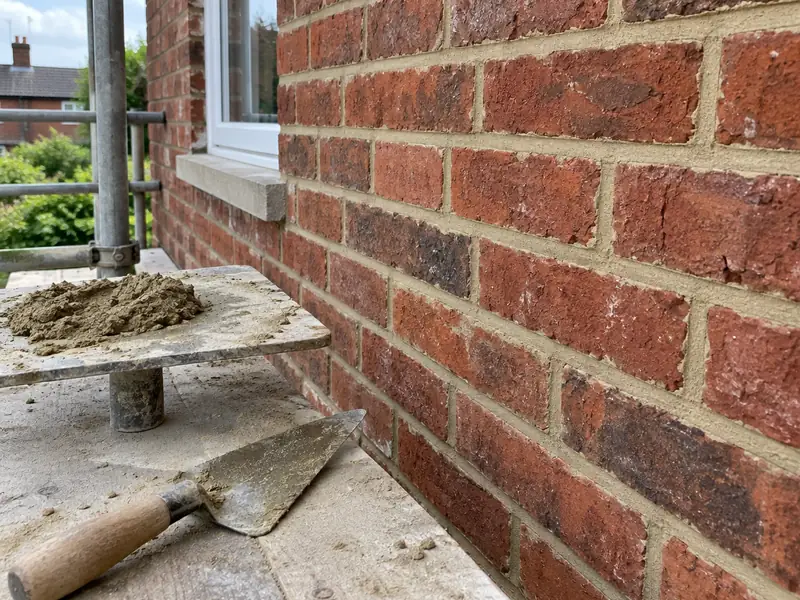
Repointing is raking out old, crumbling mortar from between bricks and replacing it with fresh mortar, sealing the joints against rain and protecting the wall; brickwork repairs replace spalled or cracked bricks and rebuild damaged sections.
East Sussex is part of our UK-wide coverage for brickwork and repointing. Places we cover include Brighton, Eastbourne, Hastings and Hove, and we travel to smaller communities across the area as well. Since your property is in England, the relevant planning and building rules are the ones set there. In the South East, budget around £2,800–£6,700 with VAT; the figure is confirmed after a survey that costs you nothing.
- Guide price
- £2,800–£6,700 inc VAT
- Time on site
- 3–10 days for a typical house
- Planning rules
- England
- Price level
- About 12% above the national guide
- Towns listed
- 12
- Survey
- Free, with a written quote
How much does brickwork and repointing cost in East Sussex?
Every figure below is a guide for brickwork and repointing in East Sussex, inclusive of VAT. Regional pricing for the South East works out about 12% above the national guide, and the overall span is £2,800–£6,700. The survey costs you nothing, and after it we commit to a firm price for your specification in writing.
| Type of job | What it usually involves | Guide in East Sussex |
|---|---|---|
| Chimney or small area | Repointing a chimney stack, gable or single wall, including access. | £650–£2,000 |
| Typical semi-detached | Repointing the main elevations of a 3-bed semi, including scaffolding. | £2,800–£6,700 |
| Detached or lime work | Larger houses, or period homes repointed in lime with brick repairs. | £5,600–£11,000 |
What moves the price up or down:
- Mortar type: cement or lime, and joint style
- Number of bricks to replace and how well they match
- Scaffolding and access, including chimneys
- Condition of the existing mortar and how hard it is to remove
Scope of the work
- Scaffolding or access towers where needed
- Raking out old mortar to the correct depth
- Mortar mixed to suit the wall, in lime or cement
- Colour and joint style matched as closely as possible
- Replacement of spalled or cracked bricks
- Waste removal and a tidy site
Housing across East Sussex
Brighton and Hove are known for Regency stucco terraces and bow-fronted houses, alongside Victorian terraces climbing the hills. Lewes and Brighton have mathematical tiles and flint walls, Eastbourne has large Victorian and Edwardian villas, and Wealden villages use tile-hanging, weatherboarding and timber frames. Interwar suburbs and newer estates fill out most towns.
Regency and Victorian houses often need sash-style windows, stucco or render repair and careful decorating. Hillside terraces suit loft conversions, and flint or brick walls commonly need repointing in lime mortar.
Seafront homes face salt-laden south-westerly winds and driving rain, while Wealden clay can shrink and swell, affecting extension foundations.
Planning and building rules in East Sussex
Planning law differs across the UK. For a home in East Sussex, it is the England rules below that count, and we check them with the council ahead of any quote.
Repointing and repairing brickwork with matching materials is maintenance, so it does not need planning permission in England. On a listed building, work that affects its character, including a change of mortar or brick, may need listed building consent.
Building Regulations do not normally apply to repointing or brick repairs, but rebuilding a wall, chimney or structural section can need building control involvement.
Rules change and every property is different, so we check the planning history and constraints for your address before we quote.
The four stages
Survey and measure
We begin by looking at the job in person. During the free survey we discuss options, materials and budget for brickwork and repointing, and photograph or measure anything the quote needs to reflect.
Price and scope agreed
We put everything into a written, fixed-price quote: the specification, what's excluded, staged payments and the expected time on site. Take whatever time you need to decide; there's no pressure to commit.
Plan and prepare
Preparation matters as much as the build. We agree access, parking and working hours with you, order materials in good time, and confirm any permissions so the job isn't held up once it starts.
The work itself
The work is carried out to the agreed specification, with floors and furniture protected and the site kept tidy. At the end we clean up, walk through the finished job with you and hand over any certificates.
How we work
Frequently asked questions
What causes bricks to crumble?
Bricks usually crumble, or spall, when water gets into them and turns to ice, pushing the face off. This is often caused by hard cement mortar or impermeable paint trapping moisture in soft bricks, or by leaking gutters soaking the wall. Damaged bricks can be cut out and replaced with matching ones, or turned round if the back face is sound. We fix the cause at the same time.
Is the price fixed?
Yes, for the specification we agree. Your written quote sets out exactly what is included at a fixed price. It only changes if you ask for something different, or if a problem the survey could not reasonably reveal later needs extra work. In either case we explain the change and confirm it in writing before going ahead.
Should my house be repointed with lime or cement?
Houses built before about the 1920s were usually built with soft bricks and lime mortar, and should normally be repointed in lime. Hard cement mortar in these walls traps moisture and can cause the brick faces to crumble. Newer homes built with cement mortar are usually repointed in a similar mix. We check your wall construction before recommending a mortar.
Is repointing messy or noisy?
Raking out old mortar is noisy and dusty, especially when power tools are used on hard mortar. We sheet scaffolding to contain dust, keep windows closed nearby and clear up at the end of each day. The noisy phase moves around the house elevation by elevation. Inside, you may notice some dust on windowsills, so it helps to keep windows shut.
Do I need planning permission in East Sussex?
It depends on the work, the size of the project, your property type and whether the building is listed or in a conservation area. East Sussex is in England, so England's rules apply. Many smaller jobs need no planning application, but some still need building control approval. We check what applies to your address before quoting.
Towns in East Sussex
These are the towns in East Sussex where you can book a free survey for brickwork and repointing. Each has its own page with guide prices and coverage details.