
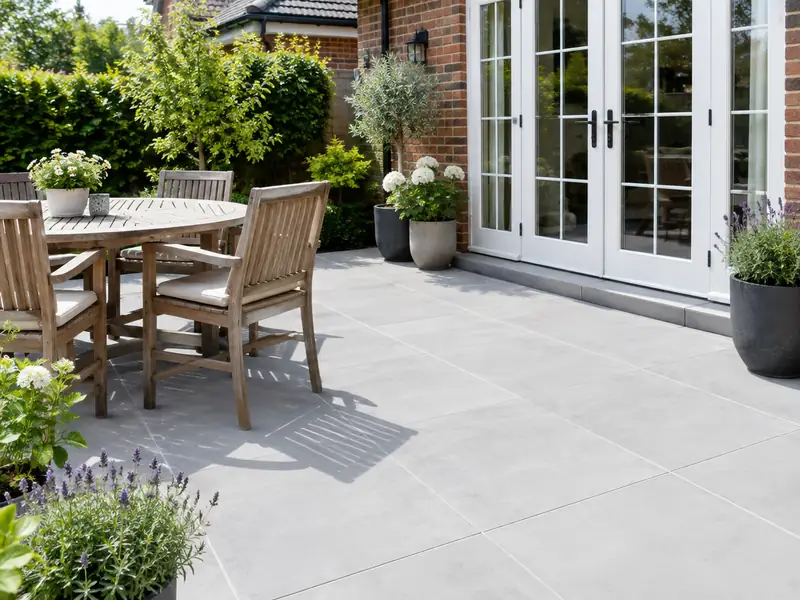
A patio is a paved outdoor area next to the house or in the garden, laid in porcelain, natural stone or concrete slabs on a compacted sub-base and mortar bed, with falls that direct rainwater away from the house.
Looking for a new patio in East Sussex? We organise the whole job, bringing in the trades it needs under one agreement, and you have a single contact. We cover Brighton, Eastbourne, Hastings and Hove, along with villages and suburbs nearby. The rules in England decide what consents are needed, and our guide range of £2,800–£6,200 including VAT gives you a realistic starting point for a budget.
- Guide price
- £2,800–£6,200 inc VAT
- Time on site
- 3–7 days on site
- Planning rules
- England
- Price level
- About 12% above the national guide
- Towns listed
- 12
- Survey
- Free, with a written quote
How much does a new patio cost in East Sussex?
What should you budget for a new patio in East Sussex? Use the figures below as a starting point. Prices in the South East sit about 12% above the national guide, so the range here is £2,800–£6,200 including VAT. Your fixed price comes in writing once we've surveyed the property, at no charge.
| Type of job | What it usually involves | Guide in East Sussex |
|---|---|---|
| Small patio or path | Around 10m² of concrete slabs or a garden path. | £1,100–£2,800 |
| Typical 20m² patio | Sandstone or porcelain on a full sub-base with jointing and edging. | £2,800–£6,200 |
| Large or multi-level patio | Bigger areas, steps, retaining walls or premium stone. | £6,200–£13,500 |
Your price depends mostly on:
- Patio area and the amount of excavation
- Slab material, size and laying pattern
- Drainage needed to keep water away from the house
- Access for materials and removing spoil
Scope of the work
- Survey of levels, damp-proof course, drainage and access
- Excavation and removal of turf, soil or old paving
- Slabs laid on a full mortar bed with falls away from the house
- Primer on porcelain slabs for a strong bond
- Jointing with mortar or a brush-in compound
- Site cleared, waste removed and paving cleaned
Homes in East Sussex
Brighton and Hove are known for Regency stucco terraces and bow-fronted houses, alongside Victorian terraces climbing the hills. Lewes and Brighton have mathematical tiles and flint walls, Eastbourne has large Victorian and Edwardian villas, and Wealden villages use tile-hanging, weatherboarding and timber frames. Interwar suburbs and newer estates fill out most towns.
Regency and Victorian houses often need sash-style windows, stucco or render repair and careful decorating. Hillside terraces suit loft conversions, and flint or brick walls commonly need repointing in lime mortar.
Seafront homes face salt-laden south-westerly winds and driving rain, while Wealden clay can shrink and swell, affecting extension foundations.
Do you need permission in East Sussex?
The notes below cover England, which is where East Sussex sits. Rules change and every property is different, so we speak to the council before pricing your job.
A ground-level patio in a back garden does not usually need planning permission in England. Raised decks or platforms more than 30 cm high do.
Building Regulations do not normally apply to patios, but levels must stay below the damp-proof course and drain away from the house.
Rules change and every property is different, so we check the planning history and constraints for your address before we quote.
The four stages
Survey and measure
A free survey comes first. It gives us what we need to price a new patio properly, including dimensions, existing materials and access for deliveries, and gives you the chance to ask anything you like.
Quote in writing
You get the price in writing, itemised so you can see where the money goes. As long as the specification stays the same, that is the price you pay for a new patio.
Booking the work
We handle the paperwork side: checking whether planning permission or building control approval is needed, submitting applications where they are, and scheduling the trades and materials around your dates.
On site to finish
Work goes ahead as scheduled and you deal with one contact throughout. When the last trade leaves, we clear and clean the site, talk you through what has been done and pass on any certificates and care instructions.
How we work
Questions about a new patio in East Sussex
Do I need planning permission in East Sussex?
It depends on the work, the size of the project, your property type and whether the building is listed or in a conservation area. East Sussex is in England, so England's rules apply. Many smaller jobs need no planning application, but some still need building control approval. We check what applies to your address before quoting.
Is porcelain or sandstone better for a patio?
Porcelain is dense, stain-resistant and stays looking clean with little care, making it a good choice if you want a modern, low-maintenance patio. Indian sandstone has natural colour variation and a softer, traditional look, and costs a little less, but it can stain and weather over time and benefits from sealing. Both make durable patios when properly laid. We bring samples to the survey.
Which postcodes in East Sussex do you cover?
We cover BN1, BN20, TN34 and BN1, along with the rest of East Sussex. If your postcode is not listed, get in touch anyway: our coverage is UK-wide, and we can usually arrange a survey wherever you live. Enter your postcode in the guide-price tool or contact form and we will confirm.
How much does a new patio cost?
A typical 20m² patio in sandstone or porcelain costs £2,800–£6,200, including excavation, sub-base, laying and jointing. As a guide, allow roughly £100–£220 per square metre plus fixed costs for set-up and waste. Concrete slabs cost less, while slate, granite and large-format porcelain cost more. Steps, walls and drainage add to the total. We confirm a fixed price after the survey.
What happens if my garden slopes?
A sloping garden can still have a level patio by cutting into the slope, building up with retaining walls, or creating terraces with steps between them. Retaining walls must be built to hold back the soil and allow drainage behind them. This adds cost but creates usable, level space. We look at the slope during the survey and suggest the most practical design.
Towns in East Sussex
Our coverage for a new patio in East Sussex includes the towns listed here. Each page explains guide costs, typical timings and the neighbouring places we also serve.