
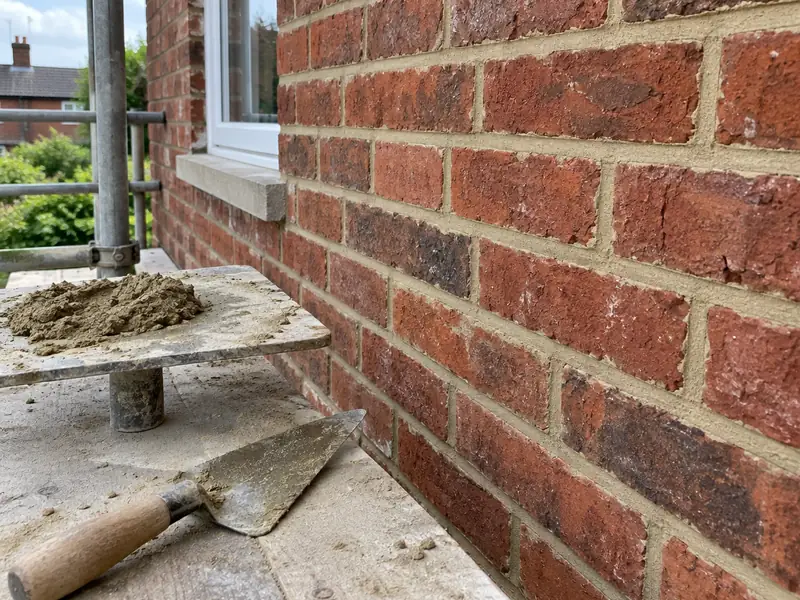
Repointing is raking out old, crumbling mortar from between bricks and replacing it with fresh mortar, sealing the joints against rain and protecting the wall; brickwork repairs replace spalled or cracked bricks and rebuild damaged sections.
Cost is usually the first question about brickwork and repointing, so here is the guide for Yorkshire and the Humber: £2,400–£5,600 including VAT. We cover the whole of West Yorkshire, with Leeds, Bradford, Huddersfield and Wakefield among the main centres. Because each UK nation sets its own rules, we check the requirements in England for your property, then put a firm price on paper following a free survey.
- Guide price
- £2,400–£5,600 inc VAT
- Time on site
- 3–10 days for a typical house
- Planning rules
- England
- Price level
- About 6% below the national guide
- Towns listed
- 26
- Survey
- Free, with a written quote
How much does brickwork and repointing cost in West Yorkshire?
The table below shows guide prices for brickwork and repointing in West Yorkshire. They are based on rates in Yorkshire and the Humber, which run about 6% below the national guide, giving an overall range of £2,400–£5,600. All figures include VAT and are firmed up after a free site survey.
| Type of job | What it usually involves | Guide in West Yorkshire |
|---|---|---|
| Chimney or small area | Repointing a chimney stack, gable or single wall, including access. | £550–£1,700 |
| Typical semi-detached | Repointing the main elevations of a 3-bed semi, including scaffolding. | £2,400–£5,600 |
| Detached or lime work | Larger houses, or period homes repointed in lime with brick repairs. | £4,700–£9,400 |
What moves the price up or down:
- Wall area to repoint and the height of the house
- Number of bricks to replace and how well they match
- Scaffolding and access, including chimneys
- Condition of the existing mortar and how hard it is to remove
What do you get?
- Survey of mortar, bricks, cracks and the cause of any damp
- Scaffolding or access towers where needed
- Mortar mixed to suit the wall, in lime or cement
- Replacement of spalled or cracked bricks
- Clean-down of brick faces after pointing
- Waste removal and a tidy site
Homes in West Yorkshire
Leeds and Bradford are known for back-to-back and through terraces, many in sandstone or millstone grit, with stone-slate roofs on older properties. Halifax, Huddersfield and the Calder valley have mill-town stone terraces climbing steep hillsides, and interwar semis, post-war estates and newer housing surround the larger towns.
Back-to-backs and through terraces often suit dormer loft conversions and careful kitchen layouts. Stone properties commonly need repointing with suitable mortar, roof repairs and window replacement, and hillside plots can need retaining walls.
The Pennine hills bring high rainfall, wind and frost, and the Calder valley has a history of serious flooding.
Planning and building rules in West Yorkshire
Homes in West Yorkshire come under the regulations for England, summarised below. We don't rely on general rules alone: we confirm the position for your address with the council before a quote goes out.
Repointing and repairing brickwork with matching materials is maintenance, so it does not need planning permission in England. On a listed building, work that affects its character, including a change of mortar or brick, may need listed building consent.
Building Regulations do not normally apply to repointing or brick repairs, but rebuilding a wall, chimney or structural section can need building control involvement.
Rules change and every property is different, so we check the planning history and constraints for your address before we quote.
The four stages
Survey and measure
It starts with a survey at the property, free of charge. We check condition, access and services, ask how you want the finished result to look, and answer any questions you have about brickwork and repointing.
Written quote
After the survey we send a quote for brickwork and repointing that fixes the price for the scope we've agreed. If you want to change materials or scope, we revise it in writing before anything is booked.
Dates and permissions
Before anyone starts, we confirm the programme in writing, check whether consents are required and arrange deliveries. If a skip or scaffolding on the road needs a permit, we apply for it.
The work itself
The work is carried out to the agreed specification, with floors and furniture protected and the site kept tidy. At the end we clean up, walk through the finished job with you and hand over any certificates.
What you can expect from us
Questions about brickwork and repointing in West Yorkshire
What happens at the survey?
We visit your home at a time that suits you, look at the area involved, take measurements and check access, condition and any services that might be affected. We talk through what you want from brickwork and repointing, explain the options and answer questions. There is no charge and no obligation; afterwards we send a written quote.
How long will brickwork and repointing take?
On a typical home, allow 3–10 days for a typical house. Larger projects, older buildings and extra work found once things are opened up can extend that, while simpler jobs may be shorter. Your quote includes an estimate of time on site, and your point of contact keeps you updated on the programme as the work progresses.
Will repointing cure damp?
Repointing can stop damp caused by rain getting through failed mortar joints, which is common on exposed walls. It will not fix damp from leaking gutters, a bridged damp-proof course, condensation or high ground levels against the wall. We look for the cause during the survey and recommend fixing that, so repointing is not done for the wrong reason.
Can you match the colour of my existing mortar?
Matching mortar colour is done by choosing the right sand and, where needed, adding pigment or using a coloured lime. We make test panels and let them dry, because mortar looks darker when wet. The joint style, such as flush, bucket handle or weatherstruck, also affects the look. An exact match is not always possible on old walls, but a careful match blends in well.
Should my house be repointed with lime or cement?
Houses built before about the 1920s were usually built with soft bricks and lime mortar, and should normally be repointed in lime. Hard cement mortar in these walls traps moisture and can cause the brick faces to crumble. Newer homes built with cement mortar are usually repointed in a similar mix. We check your wall construction before recommending a mortar.
Towns in West Yorkshire
We offer brickwork and repointing in each of the towns below, all within West Yorkshire. Select yours for guide prices, postcodes covered and nearby places.