
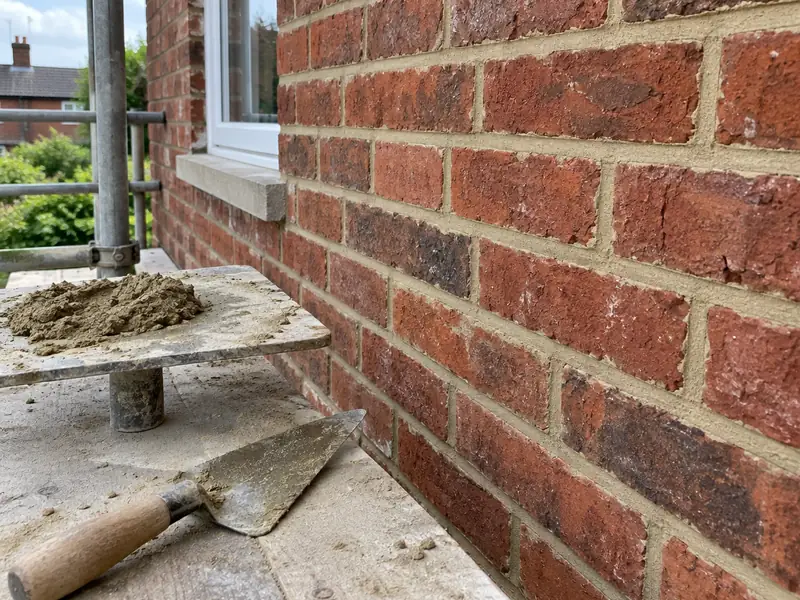
Repointing is raking out old, crumbling mortar from between bricks and replacing it with fresh mortar, sealing the joints against rain and protecting the wall; brickwork repairs replace spalled or cracked bricks and rebuild damaged sections.
Looking for brickwork and repointing in Lancashire? We organise the whole job, bringing in the trades it needs under one agreement, and you have a single contact. We cover Preston, Burnley, Blackburn and Blackpool, along with villages and suburbs nearby. The rules in England decide what consents are needed, and our guide range of £2,400–£5,700 including VAT gives you a realistic starting point for a budget.
- Guide price
- £2,400–£5,700 inc VAT
- Time on site
- 3–10 days for a typical house
- Planning rules
- England
- Price level
- About 5% below the national guide
- Towns listed
- 19
- Survey
- Free, with a written quote
How much does brickwork and repointing cost in Lancashire?
Every figure below is a guide for brickwork and repointing in Lancashire, inclusive of VAT. Regional pricing for the North West works out about 5% below the national guide, and the overall span is £2,400–£5,700. The survey costs you nothing, and after it we commit to a firm price for your specification in writing.
| Type of job | What it usually involves | Guide in Lancashire |
|---|---|---|
| Chimney or small area | Repointing a chimney stack, gable or single wall, including access. | £550–£1,700 |
| Typical semi-detached | Repointing the main elevations of a 3-bed semi, including scaffolding. | £2,400–£5,700 |
| Detached or lime work | Larger houses, or period homes repointed in lime with brick repairs. | £4,800–£9,500 |
Your price depends mostly on:
- Wall area to repoint and the height of the house
- Mortar type: cement or lime, and joint style
- Number of bricks to replace and how well they match
- Scaffolding and access, including chimneys
What do you get?
- Survey of mortar, bricks, cracks and the cause of any damp
- Scaffolding or access towers where needed
- Raking out old mortar to the correct depth
- Mortar mixed to suit the wall, in lime or cement
- Colour and joint style matched as closely as possible
- Clean-down of brick faces after pointing
Homes in Lancashire
East Lancashire mill towns such as Burnley, Blackburn and Accrington have long rows of stone and brick terraces, while Preston is mostly red brick. Lancaster uses sandstone for its Georgian centre, Blackpool and the Fylde coast have guest-house terraces and many bungalows, and interwar and newer estates surround most towns.
Mill-town terraces commonly suit attic conversions, kitchen extensions and repointing. Bungalows on the coast often take loft rooms and porches, and stone properties may need lime pointing and roof repairs.
Westerly winds and high rainfall are the norm, with gales on the Fylde coast and wetter, colder conditions on the Pennine side.
Do you need permission in Lancashire?
Lancashire is in England, so the planning and building rules set out below are the ones that apply. We confirm the details with the council before we quote.
Repointing and repairing brickwork with matching materials is maintenance, so it does not need planning permission in England. On a listed building, work that affects its character, including a change of mortar or brick, may need listed building consent.
Building Regulations do not normally apply to repointing or brick repairs, but rebuilding a wall, chimney or structural section can need building control involvement.
Rules change and every property is different, so we check the planning history and constraints for your address before we quote.
How does the job run?
We look at the job
Book a visit and we'll come to you. The survey covers measurements, the state of what's there now and any obvious constraints, so the price that follows is based on your actual home, not an average.
Written quote
The quote arrives in writing, not over the phone. It covers the full scope, the finishes you've chosen, any exclusions and the payment schedule, with a fixed price tied to that specification.
Plan and prepare
With the quote agreed, we book the work in and handle preparation: permissions where needed, building control notifications, material orders and access arrangements for your Lancashire property.
Finish and handover
On site, the agreed plan is followed and any change is put in writing first. At completion we do a final clean, go through the snagging list with you and leave you with the relevant documents.
What you can expect from us
Questions about brickwork and repointing in Lancashire
Which postcodes in Lancashire do you cover?
We cover PR1, BB10, BB1 and FY1, along with the rest of Lancashire. If your postcode is not listed, get in touch anyway: our coverage is UK-wide, and we can usually arrange a survey wherever you live. Enter your postcode in the guide-price tool or contact form and we will confirm.
Can you combine brickwork and repointing with other work?
Yes. Because we manage several trades under one contract, we can plan brickwork and repointing alongside other work on your Lancashire home, such as new windows with rendering, or a kitchen refit with an extension. Combining jobs can reduce repeat set-up such as scaffolding, skips and access, and every element is listed and priced in the same written quote.
How much does repointing a house cost?
Repointing a typical 3-bed semi costs £2,400–£5,700, including scaffolding. As a guide, allow roughly £25–£55 per square metre of wall plus fixed costs for access and set-up. Chimney stacks, lime mortar and brick replacement add cost, while repointing a single elevation costs less. We confirm a fixed price after inspecting your walls.
Can you match the colour of my existing mortar?
Matching mortar colour is done by choosing the right sand and, where needed, adding pigment or using a coloured lime. We make test panels and let them dry, because mortar looks darker when wet. The joint style, such as flush, bucket handle or weatherstruck, also affects the look. An exact match is not always possible on old walls, but a careful match blends in well.
What causes bricks to crumble?
Bricks usually crumble, or spall, when water gets into them and turns to ice, pushing the face off. This is often caused by hard cement mortar or impermeable paint trapping moisture in soft bricks, or by leaking gutters soaking the wall. Damaged bricks can be cut out and replaced with matching ones, or turned round if the back face is sound. We fix the cause at the same time.
Towns in Lancashire
Our coverage for brickwork and repointing in Lancashire includes the towns listed here. Each page explains guide costs, typical timings and the neighbouring places we also serve.