
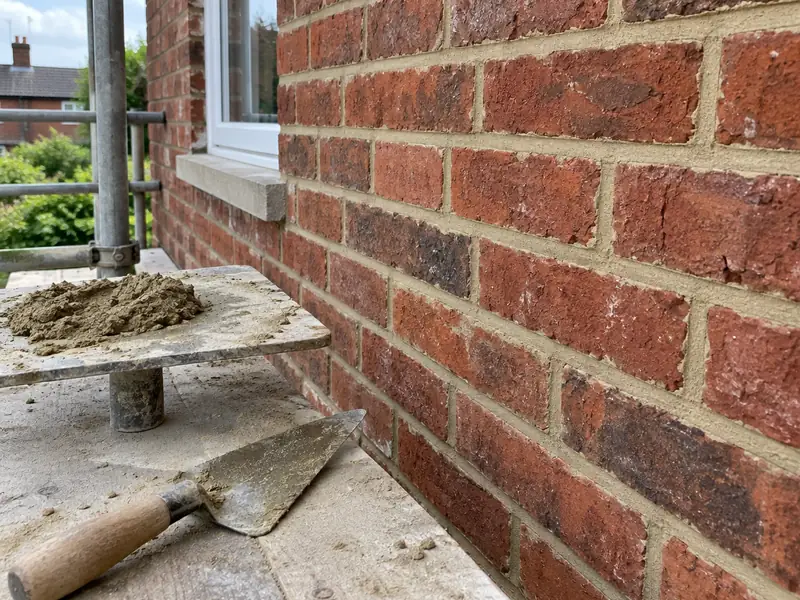
Repointing is raking out old, crumbling mortar from between bricks and replacing it with fresh mortar, sealing the joints against rain and protecting the wall; brickwork repairs replace spalled or cracked bricks and rebuild damaged sections.
If you are planning brickwork and repointing anywhere in County Antrim, including Belfast, Lisburn, Newtownabbey and Carrickfergus, we can visit, measure up and talk through the options. The planning and building regulations we work to are those for Northern Ireland, and we check them for your address before quoting. Prices remain guide figures for Northern Ireland, at £2,200–£5,200 including VAT, until the survey is done.
- Guide price
- £2,200–£5,200 inc VAT
- Time on site
- 3–10 days for a typical house
- Planning rules
- Northern Ireland
- Price level
- About 14% below the national guide
- Towns listed
- 7
- Survey
- Free, with a written quote
Brickwork and repointing prices in County Antrim
Prices for brickwork and repointing vary from house to house, but in County Antrim most projects fall within £2,200–£5,200 including VAT. That reflects costs in Northern Ireland, about 14% below the national guide. Treat the table as a budgeting aid; the written figure follows a survey we carry out for free.
| Type of job | What it usually involves | Guide in County Antrim |
|---|---|---|
| Chimney or small area | Repointing a chimney stack, gable or single wall, including access. | £500–£1,550 |
| Typical semi-detached | Repointing the main elevations of a 3-bed semi, including scaffolding. | £2,200–£5,200 |
| Detached or lime work | Larger houses, or period homes repointed in lime with brick repairs. | £4,300–£8,600 |
What moves the price up or down:
- Mortar type: cement or lime, and joint style
- Number of bricks to replace and how well they match
- Scaffolding and access, including chimneys
- Condition of the existing mortar and how hard it is to remove
What’s included?
- Scaffolding or access towers where needed
- Raking out old mortar to the correct depth
- Mortar mixed to suit the wall, in lime or cement
- Replacement of spalled or cracked bricks
- Clean-down of brick faces after pointing
- Waste removal and a tidy site
Housing across County Antrim
Belfast has long rows of red-brick Victorian terraces, Edwardian villas in the north and south of the city and large post-war estates, while towns such as Ballymena, Antrim, Larne and Carrickfergus mix terraces, semis and newer developments. Dark basalt appears in older rural buildings, and pebbledash or roughcast is a very common finish.
Terraces suit loft conversions and rear extensions, and many need window and roof renewal. Pebbledashed homes commonly need re-rendering, and detached rural houses often take extensions, porches and driveways.
The north coast and glens are exposed to strong winds, salt and frequent rain, which affects render, roofline and outdoor work.
Planning and building rules in County Antrim
County Antrim is in Northern Ireland, so the planning and building rules set out below are the ones that apply. We confirm the details with the council before we quote.
In Northern Ireland, repointing and like-for-like brick repairs are maintenance; listed buildings may need consent for changes in materials.
Building control approval is not normally needed for repointing, but structural rebuilding can need it.
Rules change and every property is different, so we check the planning history and constraints for your address before we quote.
The four stages
We look at the job
It starts with a survey at the property, free of charge. We check condition, access and services, ask how you want the finished result to look, and answer any questions you have about brickwork and repointing.
Written quote
Next you receive a written quote with a fixed price for the agreed specification. It lists what is included, what is not, and how payments are staged, so you can compare it properly.
Plan and prepare
Preparation matters as much as the build. We agree access, parking and working hours with you, order materials in good time, and confirm any permissions so the job isn't held up once it starts.
On site to finish
Our trades complete brickwork and repointing while your point of contact keeps you updated. When everything is finished, we clear the site, take away waste and go through the result with you before handover.
How we work
Frequently asked questions
Should my house be repointed with lime or cement?
Houses built before about the 1920s were usually built with soft bricks and lime mortar, and should normally be repointed in lime. Hard cement mortar in these walls traps moisture and can cause the brick faces to crumble. Newer homes built with cement mortar are usually repointed in a similar mix. We check your wall construction before recommending a mortar.
What happens at the survey?
We visit your home at a time that suits you, look at the area involved, take measurements and check access, condition and any services that might be affected. We talk through what you want from brickwork and repointing, explain the options and answer questions. There is no charge and no obligation; afterwards we send a written quote.
Will repointing cure damp?
Repointing can stop damp caused by rain getting through failed mortar joints, which is common on exposed walls. It will not fix damp from leaking gutters, a bridged damp-proof course, condensation or high ground levels against the wall. We look for the cause during the survey and recommend fixing that, so repointing is not done for the wrong reason.
Which postcodes in County Antrim do you cover?
We cover BT1, BT17, BT36 and BT38, along with the rest of County Antrim. If your postcode is not listed, get in touch anyway: our coverage is UK-wide, and we can usually arrange a survey wherever you live. Enter your postcode in the guide-price tool or contact form and we will confirm.
When is the right time of year to repoint?
Repointing should be done in mild, dry weather, usually spring to early autumn. Fresh mortar must be kept from frost while it cures, and lime mortar in particular needs protection from frost, rain and strong sun for several days. We cover fresh work with hessian or sheeting where needed and plan the job around the forecast.
Towns in County Antrim
These are the towns in County Antrim where you can book a free survey for brickwork and repointing. Each has its own page with guide prices and coverage details.