
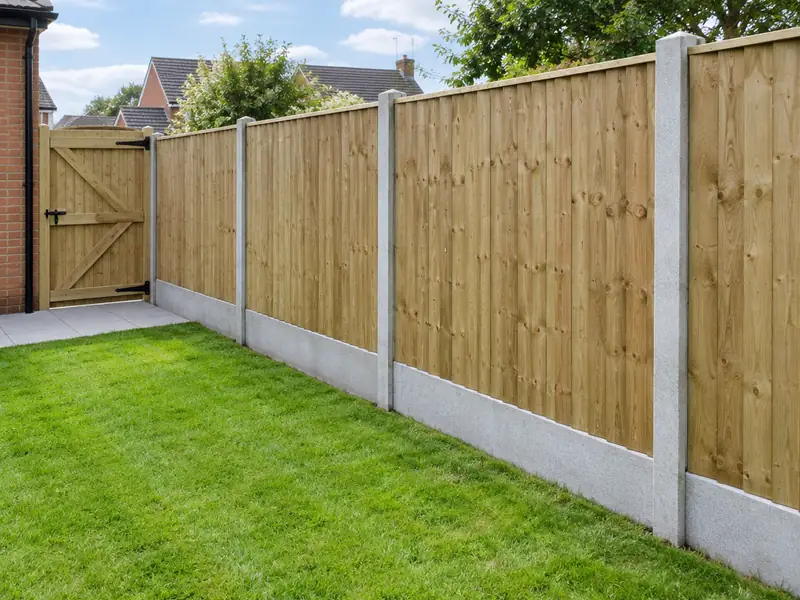
Fencing installation is setting fence posts into the ground, usually in concrete, and fixing panels or boards between them to mark a boundary, add privacy or keep children and pets in, with gates fitted where access is needed.
Across West Glamorgan, people look into new fencing and gates to replace something worn out, to make the house work better for them, or to get it ready for a sale. We cover Swansea, Neath, Briton Ferry and Gorseinon and the smaller towns around them, working to the rules that apply in Wales. Expect a guide of £1,100–£2,800, VAT included, in Wales, and every quote follows a free visit.
- Guide price
- £1,100–£2,800 inc VAT
- Time on site
- 1–3 days for a typical garden
- Planning rules
- Wales
- Price level
- About 8% below the national guide
- Towns listed
- 5
- Survey
- Free, with a written quote
How much do new fencing and gates cost in West Glamorgan?
Every figure below is a guide for new fencing and gates in West Glamorgan, inclusive of VAT. Regional pricing for Wales works out about 8% below the national guide, and the overall span is £1,100–£2,800. The survey costs you nothing, and after it we commit to a firm price for your specification in writing.
| Type of job | What it usually involves | Guide in West Glamorgan |
|---|---|---|
| Repairs or a short run | Replacing a few panels and posts, or a short run of up to about 6m. | £300–£850 |
| Typical garden boundary | About 20m of panel or closeboard fencing with concrete posts and gravel boards. | £1,100–£2,800 |
| Composite or long runs with gates | Composite or premium fencing, longer runs, or a driveway gate. | £2,800–£6,400 |
Your price depends mostly on:
- Total length and height of fencing
- Post type: concrete, timber or aluminium
- Ground conditions, slopes and removal of the old fence
- Number, size and type of gates
Scope of the work
- Concrete or timber posts set in concrete
- Concrete or timber gravel boards to keep panels off the soil
- Panels or boards fixed level or stepped to follow the ground
- Post caps and capping rails where specified
- Gates hung with hinges, latches and locks
- Site cleared and waste removed
Housing across West Glamorgan
Swansea's Victorian terraces climb its hillsides, its centre was largely rebuilt after wartime bombing, and Neath and Port Talbot have industrial terraces and post-war estates. Gower villages have stone cottages, and Pennant sandstone is common in older walls. Newer estates have grown on the edges of the main towns.
Hillside terraces often need repointing, rendering, roof repairs and window replacement, and loft conversions can work well. Gower stone cottages call for lime-based repairs, and estate homes commonly take extensions and driveways.
Swansea Bay and Gower face wet westerly weather and salt, and steep streets can affect access and scaffolding.
Planning and building rules in West Glamorgan
Which rules apply depends on where you live. For West Glamorgan, the answer is Wales, and the points below reflect that; we verify them with the council before quoting.
In Wales, fences, walls and gates up to 2 m high (1 m next to a road) are usually permitted development.
Building Regulations do not apply to ordinary fences.
Rules change and every property is different, so we check the planning history and constraints for your address before we quote.
The four stages
A visit to your home
We arrange a free site survey on a date convenient to you. We measure up, look at the existing structure and access, and discuss your plans for new fencing and gates so the price reflects your home.
Price and scope agreed
After the survey we send a quote for new fencing and gates that fixes the price for the scope we've agreed. If you want to change materials or scope, we revise it in writing before anything is booked.
Plan and prepare
Preparation matters as much as the build. We agree access, parking and working hours with you, order materials in good time, and confirm any permissions so the job isn't held up once it starts.
Build and hand over
Our trades complete new fencing and gates while your point of contact keeps you updated. When everything is finished, we clear the site, take away waste and go through the result with you before handover.
How we work
Frequently asked questions
How do you fence a sloping garden?
On a sloping garden, fence panels are usually stepped, so each panel is level and set slightly higher or lower than the one before, with the gap below filled by a gravel board. Closeboard fences can instead follow the slope, giving a smooth top line. The choice depends on how steep the slope is and the look you want. We discuss both at the survey.
How long will new fencing and gates take?
On a typical home, allow 1–3 days for a typical garden. Larger projects, older buildings and extra work found once things are opened up can extend that, while simpler jobs may be shorter. Your quote includes an estimate of time on site, and your point of contact keeps you updated on the programme as the work progresses.
How long does it take to replace a fence?
Replacing a typical 20m garden fence usually takes one to two days, including taking down the old fence, setting posts in concrete and fitting panels or boards. Longer runs, slopes, hard ground and gates take longer. Post concrete needs time to set before panels are fully loaded. We give you an expected timeline with your quote.
Who owns the fence between me and my neighbour?
Fence ownership is usually shown on the title plan or deeds, sometimes with a T mark on the side of the owner. If it is unclear, it may be shared. Even on your own boundary, it is sensible to talk to neighbours before replacing a fence, agree access and confirm the line. We fit the fence on the line you confirm and can face the good side outwards if you wish.
Which postcodes in West Glamorgan do you cover?
We cover SA1, SA10, SA12 and SA4, along with the rest of West Glamorgan. If your postcode is not listed, get in touch anyway: our coverage is UK-wide, and we can usually arrange a survey wherever you live. Enter your postcode in the guide-price tool or contact form and we will confirm.
Towns in West Glamorgan
Below is our list of West Glamorgan towns for new fencing and gates. If yours isn't shown, we may still cover it, so it is worth asking us directly.