
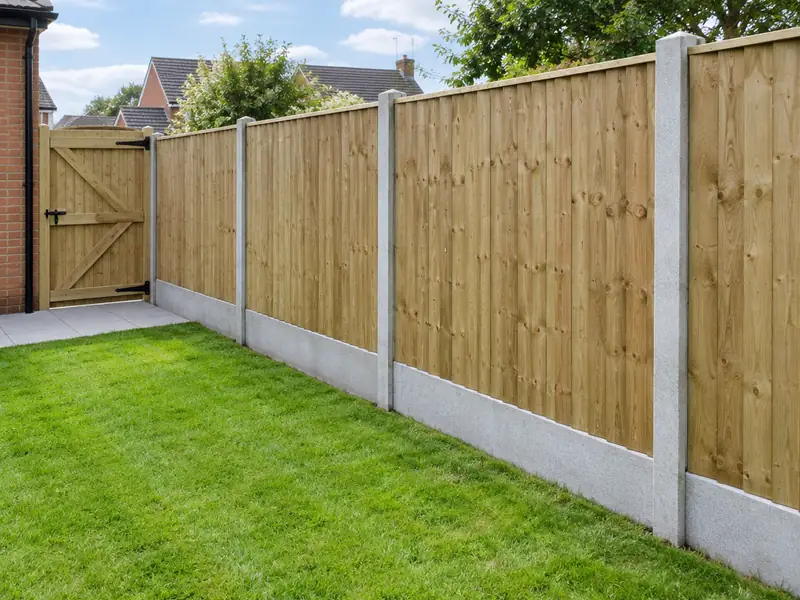
Fencing installation is setting fence posts into the ground, usually in concrete, and fixing panels or boards between them to mark a boundary, add privacy or keep children and pets in, with gates fitted where access is needed.
From a first conversation about new fencing and gates to the day the site is cleared, homeowners in Clydach deal with us directly. We come out to measure up at no cost, explain the choices in plain terms and send a written quote. For context, comparable work in Wales usually falls within £1,100–£2,800 including VAT, and it is available across SA6 and SA7.
- Guide price
- £1,100–£2,800 inc VAT
- Time on site
- 1–3 days for a typical garden
- Postcodes
- SA6 and SA7
- Planning rules
- Wales
- Local area
- Swansea
- Survey
- Free, with a written quote
How much do new fencing and gates cost in Clydach?
The costs listed here are typical for new fencing and gates around Clydach and include VAT. They reflect labour and material costs in Wales, about 8% below the national guide, giving a range of £1,100–£2,800. Exact pricing depends on your home, so we only fix it once a free site survey is done.
| Type of job | What it usually involves | Guide in Clydach |
|---|---|---|
| Repairs or a short run | Replacing a few panels and posts, or a short run of up to about 6m. | £300–£850 |
| Typical garden boundary | About 20m of panel or closeboard fencing with concrete posts and gravel boards. | £1,100–£2,800 |
| Composite or long runs with gates | Composite or premium fencing, longer runs, or a driveway gate. | £2,800–£6,400 |
Your price depends mostly on:
- Total length and height of fencing
- Post type: concrete, timber or aluminium
- Ground conditions, slopes and removal of the old fence
- Number, size and type of gates
What do you get?
- Removal and disposal of the old fence and posts
- Concrete or timber posts set in concrete
- Concrete or timber gravel boards to keep panels off the soil
- Panels or boards fixed level or stepped to follow the ground
- Post caps and capping rails where specified
- Gates hung with hinges, latches and locks
Local housing and new fencing and gates
Swansea's Victorian terraces climb its hillsides, its centre was largely rebuilt after wartime bombing, and Neath and Port Talbot have industrial terraces and post-war estates. Gower villages have stone cottages, and Pennant sandstone is common in older walls. Newer estates have grown on the edges of the main towns.
Swansea Bay and Gower face wet westerly weather and salt, and steep streets can affect access and scaffolding.
That mix of housing shapes how we approach new fencing and gates in Clydach: the age and construction of your home affect the materials, the method and, in the end, the price.
Do you need permission in Clydach?
England, Wales, Scotland and Northern Ireland each handle planning a little differently. Clydach comes under Wales, covered below, and we raise any questions with the council before your quote is finalised.
In Wales, fences, walls and gates up to 2 m high (1 m next to a road) are usually permitted development.
Building Regulations do not apply to ordinary fences.
Rules change and every property is different, so we check the planning history and constraints for your address before we quote.
How does the job run?
Survey and measure
First, someone visits your home in Clydach to see the space, take measurements and note anything that could affect the work, such as access or the condition of what is there. There is no charge for this visit.
Quote in writing
Next you receive a written quote with a fixed price for the agreed specification. It lists what is included, what is not, and how payments are staged, so you can compare it properly.
Plan and prepare
Once you accept, we agree start dates, order materials and deal with any planning, building control or neighbour notices the job needs. You'll know who is coming and when before work begins.
Build and hand over
Work goes ahead as scheduled and you deal with one contact throughout. When the last trade leaves, we clear and clean the site, talk you through what has been done and pass on any certificates and care instructions.
Why homeowners choose us
Common questions
Can you combine new fencing and gates with other work?
Yes. Because we manage several trades under one contract, we can plan new fencing and gates alongside other work on your Clydach home, such as new windows with rendering, or a kitchen refit with an extension. Combining jobs can reduce repeat set-up such as scaffolding, skips and access, and every element is listed and priced in the same written quote.
How do I make my fence last longer?
A fence lasts longer when timber is kept off the soil and protected from moisture. Gravel boards beneath the panels, concrete posts and keeping plants and soil away from the fence all help. Treat timber with a preservative or stain every few years, and replace damaged boards promptly. Composite fencing needs only occasional washing.
Are concrete posts better than timber?
Concrete posts do not rot and are the most durable choice for panel fences, especially on exposed sites. They are heavier and more utilitarian in appearance. Timber posts look more natural and suit closeboard and featheredge fences, but they eventually rot at ground level, even when treated. Aluminium posts suit composite systems. We recommend posts based on your fence style and exposure.
How much does a new fence cost?
About 20m of new panel or closeboard fencing with concrete posts costs £1,100–£2,800, including removal of the old fence. As a guide, allow roughly £55–£130 per metre plus a small fixed cost for removal and waste. Lap panels sit at the lower end, while closeboard, slatted and composite fencing cost more. Gates, slopes and hard ground add to the price. We confirm a fixed price after measuring.
Do you cover Neath, Swansea and Briton Ferry?
Yes. As well as Clydach, we cover Neath, Swansea and Briton Ferry and the rest of West Glamorgan. Our coverage is UK-wide, so the process is the same wherever you are: a free site survey, a quote in writing that fixes the price for the agreed scope, and one point of contact while the work is planned and carried out.
Nearby towns
We cover every part of Clydach, including SA6 and SA7, and nearby Neath, Swansea and Briton Ferry. Wherever you are within that patch, the survey is free and the quote comes to you in writing.