
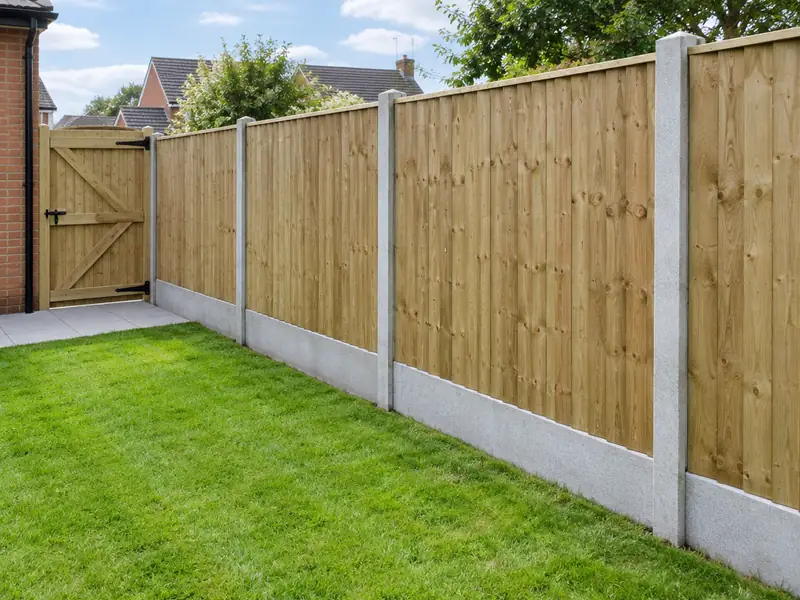
Fencing installation is setting fence posts into the ground, usually in concrete, and fixing panels or boards between them to mark a boundary, add privacy or keep children and pets in, with gates fitted where access is needed.
We handle new fencing and gates as a managed project across County Down: one contract, one contact, and trades working to an agreed specification. Coverage includes Bangor, County Down, Castlereagh, Newtownards and Newry and their surroundings. In Northern Ireland the consent rules have their own details, which we check for you. Typical prices in Northern Ireland fall within £1,050–£2,600, VAT included, and are fixed in writing after a survey.
- Guide price
- £1,050–£2,600 inc VAT
- Time on site
- 1–3 days for a typical garden
- Planning rules
- Northern Ireland
- Price level
- About 14% below the national guide
- Towns listed
- 5
- Survey
- Free, with a written quote
How much do new fencing and gates cost in County Down?
The table below shows guide prices for new fencing and gates in County Down. They are based on rates in Northern Ireland, which run about 14% below the national guide, giving an overall range of £1,050–£2,600. All figures include VAT and are firmed up after a free site survey.
| Type of job | What it usually involves | Guide in County Down |
|---|---|---|
| Repairs or a short run | Replacing a few panels and posts, or a short run of up to about 6m. | £250–£750 |
| Typical garden boundary | About 20m of panel or closeboard fencing with concrete posts and gravel boards. | £1,050–£2,600 |
| Composite or long runs with gates | Composite or premium fencing, longer runs, or a driveway gate. | £2,600–£6,000 |
The main things that change the figure:
- Total length and height of fencing
- Fence style and material: panels, closeboard or composite
- Post type: concrete, timber or aluminium
- Number, size and type of gates
Scope of the work
- Measured survey of each fence run, levels and slopes
- Concrete or timber posts set in concrete
- Concrete or timber gravel boards to keep panels off the soil
- Panels or boards fixed level or stepped to follow the ground
- Gates hung with hinges, latches and locks
- Site cleared and waste removed
Housing across County Down
County Down takes in suburbs of Belfast, Bangor and Holywood with Victorian and Edwardian villas, and Newry, Downpatrick and Banbridge with older town centres and newer estates. Mourne granite appears in buildings around the mountains, and detached rural homes and bungalows are common across the county, often rendered or pebbledashed.
Villas and semis suit kitchen extensions, loft conversions and garden landscaping. Rural detached homes commonly take extensions and driveways, and rendered houses often need re-rendering, roofline renewal and window replacement.
Coastal areas such as the Ards Peninsula face salt and wind, and the Mournes bring heavier rain and colder conditions.
Planning and building rules in County Down
Homes in County Down come under the regulations for Northern Ireland, summarised below. We don't rely on general rules alone: we confirm the position for your address with the council before a quote goes out.
In Northern Ireland, fences, walls and gates have similar height limits under permitted development, lower next to a road.
Building control approval is not needed for ordinary fences.
Rules change and every property is different, so we check the planning history and constraints for your address before we quote.
How does the job run?
Survey and measure
First, someone visits your home in County Down to see the space, take measurements and note anything that could affect the work, such as access or the condition of what is there. There is no charge for this visit.
Quote in writing
You get the price in writing, itemised so you can see where the money goes. As long as the specification stays the same, that is the price you pay for new fencing and gates.
Getting ready
Once you accept, we agree start dates, order materials and deal with any planning, building control or neighbour notices the job needs. You'll know who is coming and when before work begins.
The work itself
The work is carried out to the agreed specification, with floors and furniture protected and the site kept tidy. At the end we clean up, walk through the finished job with you and hand over any certificates.
What you can expect from us
Questions about new fencing and gates in County Down
Do I need planning permission in County Down?
It depends on the work, the size of the project, your property type and whether the building is listed or in a conservation area. County Down is in Northern Ireland, so Northern Ireland's rules apply. Many smaller jobs need no planning application, but some still need building control approval. We check what applies to your address before quoting.
What happens at the survey?
We visit your home at a time that suits you, look at the area involved, take measurements and check access, condition and any services that might be affected. We talk through what you want from new fencing and gates, explain the options and answer questions. There is no charge and no obligation; afterwards we send a written quote.
How long does it take to replace a fence?
Replacing a typical 20m garden fence usually takes one to two days, including taking down the old fence, setting posts in concrete and fitting panels or boards. Longer runs, slopes, hard ground and gates take longer. Post concrete needs time to set before panels are fully loaded. We give you an expected timeline with your quote.
How do I make my fence last longer?
A fence lasts longer when timber is kept off the soil and protected from moisture. Gravel boards beneath the panels, concrete posts and keeping plants and soil away from the fence all help. Treat timber with a preservative or stain every few years, and replace damaged boards promptly. Composite fencing needs only occasional washing.
How much does a new fence cost?
About 20m of new panel or closeboard fencing with concrete posts costs £1,050–£2,600, including removal of the old fence. As a guide, allow roughly £55–£130 per metre plus a small fixed cost for removal and waste. Lap panels sit at the lower end, while closeboard, slatted and composite fencing cost more. Gates, slopes and hard ground add to the price. We confirm a fixed price after measuring.
Towns in County Down
These are the towns in County Down where you can book a free survey for new fencing and gates. Each has its own page with guide prices and coverage details.