
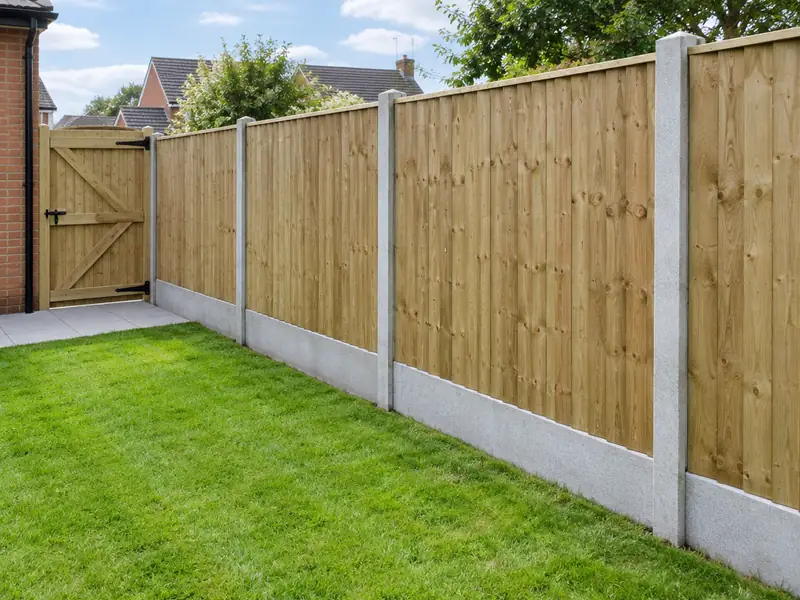
Fencing installation is setting fence posts into the ground, usually in concrete, and fixing panels or boards between them to mark a boundary, add privacy or keep children and pets in, with gates fitted where access is needed.
If you live in Banbridge and are weighing up new fencing and gates, the starting point is a visit to measure up and talk through what you want, which costs nothing. We cover homes across BT32, and a typical project of this kind in Northern Ireland lands somewhere in the £1,050–£2,600 bracket, including VAT. The exact figure depends on size, access and the finish you choose.
- Guide price
- £1,050–£2,600 inc VAT
- Time on site
- 1–3 days for a typical garden
- Postcodes
- BT32
- Planning rules
- Northern Ireland
- Local area
- County Down
- Survey
- Free, with a written quote
Fencing and gates prices in Banbridge
Prices for new fencing and gates vary from house to house, but in Banbridge most projects fall within £1,050–£2,600 including VAT. That reflects costs in Northern Ireland, about 14% below the national guide. Treat the table as a budgeting aid; the written figure follows a survey we carry out for free.
| Type of job | What it usually involves | Guide in Banbridge |
|---|---|---|
| Repairs or a short run | Replacing a few panels and posts, or a short run of up to about 6m. | £250–£750 |
| Typical garden boundary | About 20m of panel or closeboard fencing with concrete posts and gravel boards. | £1,050–£2,600 |
| Composite or long runs with gates | Composite or premium fencing, longer runs, or a driveway gate. | £2,600–£6,000 |
The main things that change the figure:
- Fence style and material: panels, closeboard or composite
- Post type: concrete, timber or aluminium
- Ground conditions, slopes and removal of the old fence
- Number, size and type of gates
Scope of the work
- Removal and disposal of the old fence and posts
- Concrete or timber posts set in concrete
- Concrete or timber gravel boards to keep panels off the soil
- Panels or boards fixed level or stepped to follow the ground
- Post caps and capping rails where specified
- Site cleared and waste removed
Building in Banbridge
County Down takes in suburbs of Belfast, Bangor and Holywood with Victorian and Edwardian villas, and Newry, Downpatrick and Banbridge with older town centres and newer estates. Mourne granite appears in buildings around the mountains, and detached rural homes and bungalows are common across the county, often rendered or pebbledashed.
Villas and semis suit kitchen extensions, loft conversions and garden landscaping. Rural detached homes commonly take extensions and driveways, and rendered houses often need re-rendering, roofline renewal and window replacement.
In Banbridge, as elsewhere in County Down, we take the building's age and construction into account before recommending anything, because both can change what is involved in new fencing and gates.
Planning and building rules in Banbridge
The notes below cover Northern Ireland, which is where Banbridge sits. Rules change and every property is different, so we speak to the council before pricing your job.
In Northern Ireland, fences, walls and gates have similar height limits under permitted development, lower next to a road.
Building control approval is not needed for ordinary fences.
Rules change and every property is different, so we check the planning history and constraints for your address before we quote.
What happens after you get in touch?
A visit to your home
We arrange a free site survey on a date convenient to you. We measure up, look at the existing structure and access, and discuss your plans for new fencing and gates so the price reflects your home.
Price and scope agreed
You get the price in writing, itemised so you can see where the money goes. As long as the specification stays the same, that is the price you pay for new fencing and gates.
Plan and prepare
Preparation matters as much as the build. We agree access, parking and working hours with you, order materials in good time, and confirm any permissions so the job isn't held up once it starts.
On site to finish
On site, the agreed plan is followed and any change is put in writing first. At completion we do a final clean, go through the snagging list with you and leave you with the relevant documents.
How we work
Common questions
How high can my fence be?
Fence height limits depend on planning rules, your home's location, whether it is listed or in a conservation area, and which UK nation you live in. In England, fences up to 2m high are usually permitted development, reduced to 1m next to a road used by vehicles. Higher fences need planning permission. We check the rules for your boundary before quoting.
Can I stay at home during the work?
In most cases, yes. Most people can live at home throughout, and we plan the work to keep disruption down by protecting floors, agreeing working hours and keeping access routes clear. Bigger jobs affecting kitchens, bathrooms or heating may mean a short spell with reduced facilities, and we talk this through with you at the survey.
How do I make my fence last longer?
A fence lasts longer when timber is kept off the soil and protected from moisture. Gravel boards beneath the panels, concrete posts and keeping plants and soil away from the fence all help. Treat timber with a preservative or stain every few years, and replace damaged boards promptly. Composite fencing needs only occasional washing.
How much does a new fence cost?
About 20m of new panel or closeboard fencing with concrete posts costs £1,050–£2,600, including removal of the old fence. As a guide, allow roughly £55–£130 per metre plus a small fixed cost for removal and waste. Lap panels sit at the lower end, while closeboard, slatted and composite fencing cost more. Gates, slopes and hard ground add to the price. We confirm a fixed price after measuring.
How much will new fencing and gates cost in Banbridge?
As a guide, expect to pay £1,050–£2,600 including VAT for new fencing and gates in Banbridge. That range is adjusted for Northern Ireland, which runs about 14% below the national guide. Where your project lands depends on size, materials, access and the condition of what is already there. We confirm a fixed price in writing after a free survey of your home.
Near Banbridge
Homes across BT32 in Banbridge are within our coverage, as are those in Craigavon, Portadown and Newry. If you are just outside these areas, ask anyway, because we work right across the UK.