
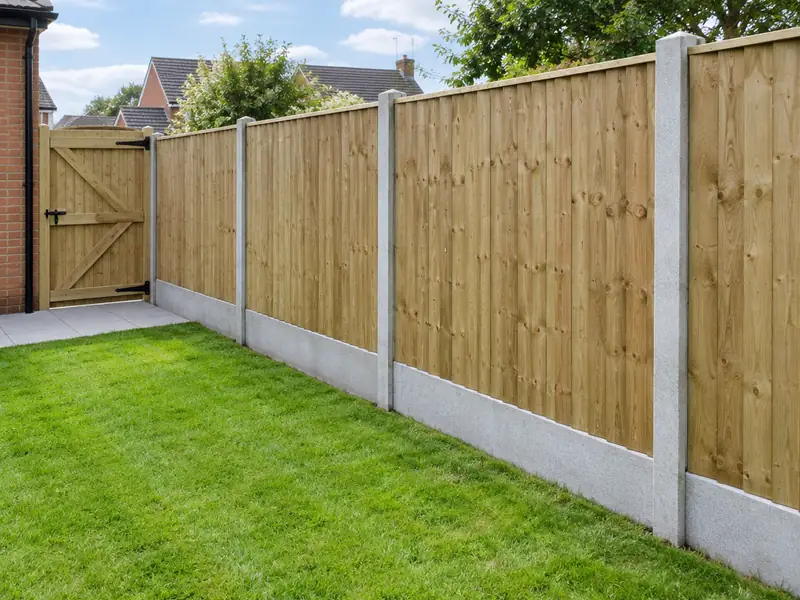
Fencing installation is setting fence posts into the ground, usually in concrete, and fixing panels or boards between them to mark a boundary, add privacy or keep children and pets in, with gates fitted where access is needed.
We offer new fencing and gates throughout Hampshire, from Southampton, Portsmouth, Basingstoke and Gosport to the smaller places in between. Each project starts with a free survey at your home and ends with a written figure, fixed for the work you choose. Because Hampshire is in England, we work to the planning system and building standards used there, and guide prices for the South East run at £1,350–£3,400 including VAT.
- Guide price
- £1,350–£3,400 inc VAT
- Time on site
- 1–3 days for a typical garden
- Planning rules
- England
- Price level
- About 12% above the national guide
- Towns listed
- 20
- Survey
- Free, with a written quote
How much do new fencing and gates cost in Hampshire?
The costs listed here are typical for new fencing and gates around Hampshire and include VAT. They reflect labour and material costs in the South East, about 12% above the national guide, giving a range of £1,350–£3,400. Exact pricing depends on your home, so we only fix it once a free site survey is done.
| Type of job | What it usually involves | Guide in Hampshire |
|---|---|---|
| Repairs or a short run | Replacing a few panels and posts, or a short run of up to about 6m. | £350–£1,000 |
| Typical garden boundary | About 20m of panel or closeboard fencing with concrete posts and gravel boards. | £1,350–£3,400 |
| Composite or long runs with gates | Composite or premium fencing, longer runs, or a driveway gate. | £3,400–£7,800 |
What moves the price up or down:
- Fence style and material: panels, closeboard or composite
- Post type: concrete, timber or aluminium
- Ground conditions, slopes and removal of the old fence
- Number, size and type of gates
What’s included?
- Measured survey of each fence run, levels and slopes
- Concrete or timber posts set in concrete
- Concrete or timber gravel boards to keep panels off the soil
- Post caps and capping rails where specified
- Gates hung with hinges, latches and locks
- Site cleared and waste removed
Housing across Hampshire
Southampton and Portsmouth have dense Victorian terraces, with plenty of post-war rebuilding after wartime bombing. Winchester keeps Georgian and medieval streets, Basingstoke expanded rapidly with 1960s and 1970s estates, and New Forest villages feature cob, thatch and brick. Brick and flint is common on the chalk downs, and new estates ring most towns.
Terraces suit loft rooms and side-return extensions; post-war and expanded-town homes often need window, roofline and cladding renewal. Cottages in the Forest may call for lime repairs and planning-sensitive windows.
Coastal areas along the Solent face salt and wind, while chalk downland is better drained but exposed; inland clay can move in dry summers.
Planning and building rules in Hampshire
Which rules apply depends on where you live. For Hampshire, the answer is England, and the points below reflect that; we verify them with the council before quoting.
In England, fences, walls and gates up to 2 m high are usually permitted development, or up to 1 m where they are next to a road used by vehicles or its footpath. Listed buildings, conservation areas and estates with planning conditions can be stricter.
Building Regulations do not apply to ordinary garden fences, but boundary lines should be agreed with your neighbour first.
Rules change and every property is different, so we check the planning history and constraints for your address before we quote.
The four stages
We look at the job
We begin by looking at the job in person. During the free survey we discuss options, materials and budget for new fencing and gates, and photograph or measure anything the quote needs to reflect.
Quote in writing
You get the price in writing, itemised so you can see where the money goes. As long as the specification stays the same, that is the price you pay for new fencing and gates.
Plan and prepare
With the quote agreed, we book the work in and handle preparation: permissions where needed, building control notifications, material orders and access arrangements for your Hampshire property.
Build and hand over
The work is carried out to the agreed specification, with floors and furniture protected and the site kept tidy. At the end we clean up, walk through the finished job with you and hand over any certificates.
How we work
Frequently asked questions
How much will new fencing and gates cost in Hampshire?
As a guide, expect to pay £1,350–£3,400 including VAT for new fencing and gates in Hampshire. That range is adjusted for the South East, which runs about 12% above the national guide. Where your project lands depends on size, materials, access and the condition of what is already there. We confirm a fixed price in writing after a free survey of your home.
Can I stay at home during the work?
In most cases, yes. Most people can live at home throughout, and we plan the work to keep disruption down by protecting floors, agreeing working hours and keeping access routes clear. Bigger jobs affecting kitchens, bathrooms or heating may mean a short spell with reduced facilities, and we talk this through with you at the survey.
How much does a new fence cost?
About 20m of new panel or closeboard fencing with concrete posts costs £1,350–£3,400, including removal of the old fence. As a guide, allow roughly £55–£130 per metre plus a small fixed cost for removal and waste. Lap panels sit at the lower end, while closeboard, slatted and composite fencing cost more. Gates, slopes and hard ground add to the price. We confirm a fixed price after measuring.
What kind of gate do I need?
The right gate depends on its job. A side gate for access to the back garden is usually timber or metal, around 0.9m to 1m wide, with a secure lock. Driveway gates are wider, often in pairs, and need strong posts. Composite and metal gates resist warping. We measure the opening, check posts and suggest hinges, latches and locks for security.
Are concrete posts better than timber?
Concrete posts do not rot and are the most durable choice for panel fences, especially on exposed sites. They are heavier and more utilitarian in appearance. Timber posts look more natural and suit closeboard and featheredge fences, but they eventually rot at ground level, even when treated. Aluminium posts suit composite systems. We recommend posts based on your fence style and exposure.
Towns in Hampshire
Below is our list of Hampshire towns for new fencing and gates. If yours isn't shown, we may still cover it, so it is worth asking us directly.