
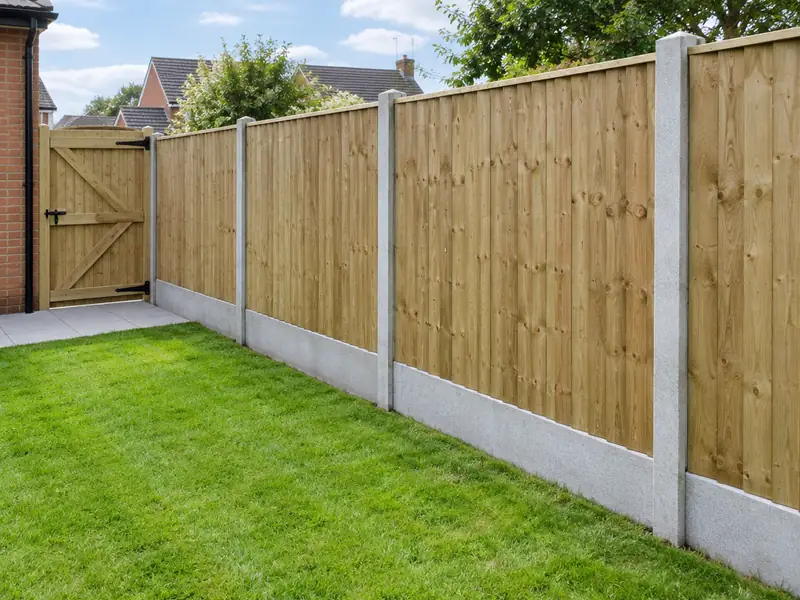
Fencing installation is setting fence posts into the ground, usually in concrete, and fixing panels or boards between them to mark a boundary, add privacy or keep children and pets in, with gates fitted where access is needed.
Thinking about new fencing and gates in Winchester? We take charge of the whole project, co-ordinating every trade involved, and one person keeps you updated. Guide prices for the South East sit at £1,350–£3,400 including VAT, and a typical job takes 1–3 days for a typical garden. Your own figure depends on what the survey finds and the specification you settle on.
- Guide price
- £1,350–£3,400 inc VAT
- Time on site
- 1–3 days for a typical garden
- Postcodes
- SO21, SO22 and SO23
- Planning rules
- England
- Local area
- Hampshire
- Survey
- Free, with a written quote
What should you budget for new fencing and gates in Winchester?
Every figure below is a guide for new fencing and gates in Winchester, inclusive of VAT. Regional pricing for the South East works out about 12% above the national guide, and the overall span is £1,350–£3,400. The survey costs you nothing, and after it we commit to a firm price for your specification in writing.
| Type of job | What it usually involves | Guide in Winchester |
|---|---|---|
| Repairs or a short run | Replacing a few panels and posts, or a short run of up to about 6m. | £350–£1,000 |
| Typical garden boundary | About 20m of panel or closeboard fencing with concrete posts and gravel boards. | £1,350–£3,400 |
| Composite or long runs with gates | Composite or premium fencing, longer runs, or a driveway gate. | £3,400–£7,800 |
The main things that change the figure:
- Total length and height of fencing
- Fence style and material: panels, closeboard or composite
- Ground conditions, slopes and removal of the old fence
- Number, size and type of gates
What’s included?
- Removal and disposal of the old fence and posts
- Concrete or timber posts set in concrete
- Concrete or timber gravel boards to keep panels off the soil
- Post caps and capping rails where specified
- Gates hung with hinges, latches and locks
- Site cleared and waste removed
Local housing and new fencing and gates
Southampton and Portsmouth have dense Victorian terraces, with plenty of post-war rebuilding after wartime bombing. Winchester keeps Georgian and medieval streets, Basingstoke expanded rapidly with 1960s and 1970s estates, and New Forest villages feature cob, thatch and brick. Brick and flint is common on the chalk downs, and new estates ring most towns.
Terraces suit loft rooms and side-return extensions; post-war and expanded-town homes often need window, roofline and cladding renewal. Cottages in the Forest may call for lime repairs and planning-sensitive windows.
So when we survey a Winchester property for new fencing and gates, the first step is working out how it was built and what has been changed since.
Permissions for new fencing and gates in Winchester
Because Winchester falls under England's rules, the guidance below is the version relevant to you. Before sending a price, we check your property's position with the council.
In England, fences, walls and gates up to 2 m high are usually permitted development, or up to 1 m where they are next to a road used by vehicles or its footpath. Listed buildings, conservation areas and estates with planning conditions can be stricter.
Building Regulations do not apply to ordinary garden fences, but boundary lines should be agreed with your neighbour first.
Rules change and every property is different, so we check the planning history and constraints for your address before we quote.
From survey to handover
A visit to your home
It starts with a survey at the property, free of charge. We check condition, access and services, ask how you want the finished result to look, and answer any questions you have about new fencing and gates.
Your fixed price
We put everything into a written, fixed-price quote: the specification, what's excluded, staged payments and the expected time on site. Take whatever time you need to decide; there's no pressure to commit.
Getting ready
Once you accept, we agree start dates, order materials and deal with any planning, building control or neighbour notices the job needs. You'll know who is coming and when before work begins.
On site to finish
The work is carried out to the agreed specification, with floors and furniture protected and the site kept tidy. At the end we clean up, walk through the finished job with you and hand over any certificates.
Working with SK Home Improvements
Common questions
Can I stay at home during the work?
In most cases, yes. Most people can live at home throughout, and we plan the work to keep disruption down by protecting floors, agreeing working hours and keeping access routes clear. Bigger jobs affecting kitchens, bathrooms or heating may mean a short spell with reduced facilities, and we talk this through with you at the survey.
How long does it take to replace a fence?
Replacing a typical 20m garden fence usually takes one to two days, including taking down the old fence, setting posts in concrete and fitting panels or boards. Longer runs, slopes, hard ground and gates take longer. Post concrete needs time to set before panels are fully loaded. We give you an expected timeline with your quote.
Are concrete posts better than timber?
Concrete posts do not rot and are the most durable choice for panel fences, especially on exposed sites. They are heavier and more utilitarian in appearance. Timber posts look more natural and suit closeboard and featheredge fences, but they eventually rot at ground level, even when treated. Aluminium posts suit composite systems. We recommend posts based on your fence style and exposure.
Who do I deal with during the job?
One point of contact manages your project from survey to handover. They schedule the trades working under our contract, keep you updated on progress, and are the person to call with any question. You don't need to coordinate builders, electricians or decorators separately, because that is part of what we do.
How high can my fence be?
Fence height limits depend on planning rules, your home's location, whether it is listed or in a conservation area, and which UK nation you live in. In England, fences up to 2m high are usually permitted development, reduced to 1m next to a road used by vehicles. Higher fences need planning permission. We check the rules for your boundary before quoting.
Nearby towns
We cover every part of Winchester, including SO21, SO22 and SO23, and nearby Eastleigh, Southampton and Totton. Wherever you are within that patch, the survey is free and the quote comes to you in writing.