
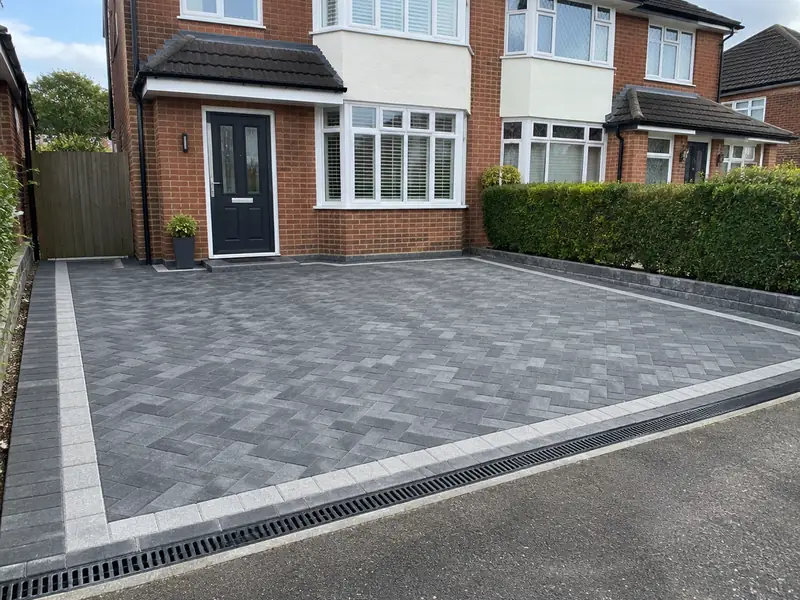
A new driveway is a hard-wearing surface for parking, such as block paving, resin bound gravel, tarmac or gravel, laid on an excavated and compacted sub-base with edging and drainage designed to carry vehicle loads and handle rainwater.
Whether you live in one of the larger towns, such as Southampton, Portsmouth, Basingstoke and Gosport, or somewhere quieter in Hampshire, the way we handle a new driveway is identical. We survey, agree the specification with you, and confirm a fixed price on paper. Everything is planned under the regulations in force in England, and guide costs in the South East sit at £4,500–£10,000 with VAT.
- Guide price
- £4,500–£10,000 inc VAT
- Time on site
- 3–7 days on site
- Planning rules
- England
- Price level
- About 12% above the national guide
- Towns listed
- 20
- Survey
- Free, with a written quote
Driveways prices in Hampshire
Budgeting for a new driveway in Hampshire? The numbers below include VAT and are adjusted for the South East, where costs are about 12% above the national guide. The headline range is £4,500–£10,000. Nothing is final until we have measured up at a free survey and agreed the specification with you.
| Type of job | What it usually involves | Guide in Hampshire |
|---|---|---|
| Gravel or tarmac | A typical 40–50m² drive in gravel on a grid, or tarmac with block edging. | £2,200–£5,600 |
| Block paving or resin bound | A typical 40–50m² drive with sub-base, edging and drainage. | £4,500–£10,000 |
| Large or premium driveway | Larger drives, natural stone, walls, steps or a new dropped kerb. | £9,000–£18,000 |
Your price depends mostly on:
- Driveway area and the depth of excavation needed
- Surface: gravel, tarmac, block paving, resin or stone
- Drainage, soakaways and changes in level
- Access for machinery and removal of spoil
What do you get?
- Survey of levels, drainage, manholes and access
- Excavation and removal of the old surface and soil
- Edging kerbs or restraints to hold the surface in place
- Drainage channels or soakaway where needed
- Manhole covers raised or replaced to new levels
- Site cleared and waste removed
Housing across Hampshire
Southampton and Portsmouth have dense Victorian terraces, with plenty of post-war rebuilding after wartime bombing. Winchester keeps Georgian and medieval streets, Basingstoke expanded rapidly with 1960s and 1970s estates, and New Forest villages feature cob, thatch and brick. Brick and flint is common on the chalk downs, and new estates ring most towns.
Terraces suit loft rooms and side-return extensions; post-war and expanded-town homes often need window, roofline and cladding renewal. Cottages in the Forest may call for lime repairs and planning-sensitive windows.
Coastal areas along the Solent face salt and wind, while chalk downland is better drained but exposed; inland clay can move in dry summers.
Planning and building rules in Hampshire
Planning law differs across the UK. For a home in Hampshire, it is the England rules below that count, and we check them with the council ahead of any quote.
In England, a new or replacement front-garden surface over 5 m² needs planning permission unless it is permeable or drains to a lawn or border within your property. A new dropped kerb needs consent from the council’s highways team, and access onto a classified road may need planning permission.
Building Regulations do not usually apply to driveways, but drainage must not discharge onto the road or a neighbour’s land.
Rules change and every property is different, so we check the planning history and constraints for your address before we quote.
How does the job run?
Free site survey
We begin by looking at the job in person. During the free survey we discuss options, materials and budget for a new driveway, and photograph or measure anything the quote needs to reflect.
Price and scope agreed
Next you receive a written quote with a fixed price for the agreed specification. It lists what is included, what is not, and how payments are staged, so you can compare it properly.
Booking the work
We handle the paperwork side: checking whether planning permission or building control approval is needed, submitting applications where they are, and scheduling the trades and materials around your dates.
Finish and handover
During the work we protect the areas around it and tidy up at the end of each day. Once complete, we check the finish, remove our materials and hand over paperwork such as building control sign-off where it applies.
What you can expect from us
Questions about a new driveway in Hampshire
How do you stop a driveway flooding?
A driveway stays dry when rainwater can drain away rather than pooling or running towards the house. Permeable surfaces such as resin bound gravel or permeable block paving let water soak through to the ground. Non-permeable surfaces need falls directing water to a channel drain, soakaway or garden border. We check levels and drainage during the survey and design the falls accordingly.
Which driveway surface is easiest to maintain?
Resin bound gravel is one of the easiest surfaces to maintain, because it is smooth, porous and resists weeds, needing only an occasional sweep and wash. Block paving needs re-sanding joints and occasional weed control. Tarmac needs little upkeep but can soften in heat. Gravel needs raking and topping up. We explain the upkeep of each surface before you choose.
Do you cover Southampton, Portsmouth and Basingstoke?
Yes. As well as Hampshire, we cover Southampton, Portsmouth and Basingstoke and the rest of Hampshire. Our coverage is UK-wide, so the process is the same wherever you are: a free site survey, a quote in writing that fixes the price for the agreed scope, and one point of contact while the work is planned and carried out.
How much does a new driveway cost?
A typical 40–50m² block paved or resin bound driveway costs £4,500–£10,000, including excavation, sub-base, edging and drainage. As a guide, allow roughly £70–£150 per square metre plus fixed costs for machinery and waste. Gravel and tarmac cost less, while natural stone, steps and walls cost more. A new dropped kerb is a separate cost. We confirm a fixed price after measuring.
How long will a new driveway take?
On a typical home, allow 3–7 days on site. Larger projects, older buildings and extra work found once things are opened up can extend that, while simpler jobs may be shorter. Your quote includes an estimate of time on site, and your point of contact keeps you updated on the programme as the work progresses.
Towns in Hampshire
Homes in all of the following Hampshire towns can get a written quote for a new driveway. Open a town page to see prices and the postcodes we cover.