
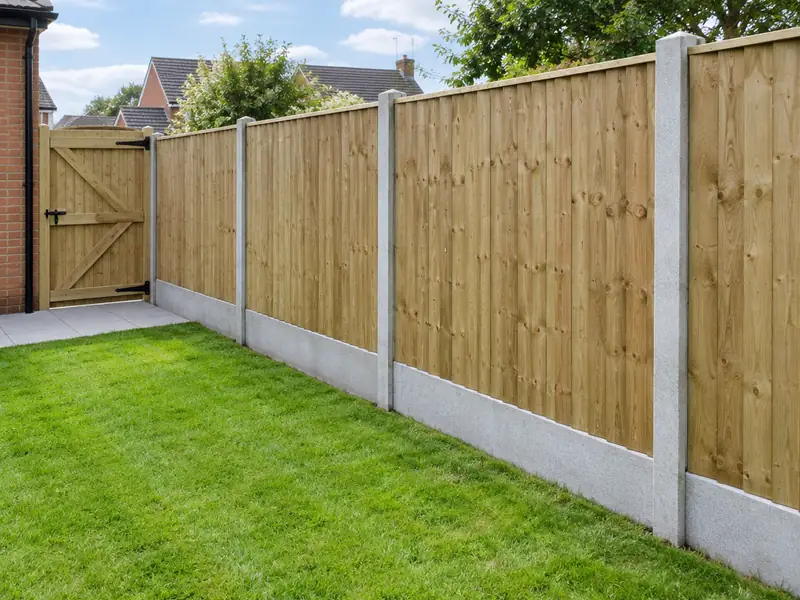
Fencing installation is setting fence posts into the ground, usually in concrete, and fixing panels or boards between them to mark a boundary, add privacy or keep children and pets in, with gates fitted where access is needed.
If you are planning new fencing and gates anywhere in Fife, including Dunfermline, Kirkcaldy, Glenrothes and St Andrews, we can visit, measure up and talk through the options. The planning and building regulations we work to are those for Scotland, and we check them for your address before quoting. Prices remain guide figures for Scotland, at £1,150–£2,900 including VAT, until the survey is done.
- Guide price
- £1,150–£2,900 inc VAT
- Time on site
- 1–3 days for a typical garden
- Planning rules
- Scotland
- Price level
- About 4% below the national guide
- Towns listed
- 4
- Survey
- Free, with a written quote
How much do new fencing and gates cost in Fife?
To help you plan, we show what new fencing and gates typically costs in Fife instead of holding figures back for a sales call. The range is £1,150–£2,900 with VAT, using rates in Scotland that are about 4% below the national guide. A free survey then fixes your actual price.
| Type of job | What it usually involves | Guide in Fife |
|---|---|---|
| Repairs or a short run | Replacing a few panels and posts, or a short run of up to about 6m. | £300–£850 |
| Typical garden boundary | About 20m of panel or closeboard fencing with concrete posts and gravel boards. | £1,150–£2,900 |
| Composite or long runs with gates | Composite or premium fencing, longer runs, or a driveway gate. | £2,900–£6,700 |
What moves the price up or down:
- Total length and height of fencing
- Fence style and material: panels, closeboard or composite
- Ground conditions, slopes and removal of the old fence
- Number, size and type of gates
Scope of the work
- Measured survey of each fence run, levels and slopes
- Concrete or timber posts set in concrete
- Concrete or timber gravel boards to keep panels off the soil
- Panels or boards fixed level or stepped to follow the ground
- Post caps and capping rails where specified
- Site cleared and waste removed
Homes in Fife
Fife's East Neuk fishing villages are known for pantiled roofs and crow-stepped gables, and St Andrews has historic stone streets. Kirkcaldy and Dunfermline have Victorian sandstone housing and interwar estates, Glenrothes was built as a post-war new town, and former mining towns in central Fife have rows of cottages and post-war council housing.
Pantiled and stone homes need careful roof repairs and lime work. Post-war and new-town houses commonly take re-rendering, window replacement and extensions, while bungalows suit loft conversions.
The coast faces cold easterly winds and salt from the North Sea, and frost is common inland through the winter.
Planning and building rules in Fife
Homes in Fife come under the regulations for Scotland, summarised below. We don't rely on general rules alone: we confirm the position for your address with the council before a quote goes out.
In Scotland, gates, fences and walls up to 2 m high are usually permitted development, with a 1 m limit in front of the house or next to a road.
A building warrant is not needed for ordinary garden fences.
Rules change and every property is different, so we check the planning history and constraints for your address before we quote.
From survey to handover
Survey and measure
We arrange a free site survey on a date convenient to you. We measure up, look at the existing structure and access, and discuss your plans for new fencing and gates so the price reflects your home.
Price and scope agreed
We turn the survey notes into a written quote. The price is fixed for the specification we agree, and the document sets out materials, scope and payment stages in plain language.
Booking the work
Preparation matters as much as the build. We agree access, parking and working hours with you, order materials in good time, and confirm any permissions so the job isn't held up once it starts.
Build and hand over
Our trades complete new fencing and gates while your point of contact keeps you updated. When everything is finished, we clear the site, take away waste and go through the result with you before handover.
How we work
Frequently asked questions
Can you combine new fencing and gates with other work?
Yes. Because we manage several trades under one contract, we can plan new fencing and gates alongside other work on your Fife home, such as new windows with rendering, or a kitchen refit with an extension. Combining jobs can reduce repeat set-up such as scaffolding, skips and access, and every element is listed and priced in the same written quote.
Are concrete posts better than timber?
Concrete posts do not rot and are the most durable choice for panel fences, especially on exposed sites. They are heavier and more utilitarian in appearance. Timber posts look more natural and suit closeboard and featheredge fences, but they eventually rot at ground level, even when treated. Aluminium posts suit composite systems. We recommend posts based on your fence style and exposure.
How do I make my fence last longer?
A fence lasts longer when timber is kept off the soil and protected from moisture. Gravel boards beneath the panels, concrete posts and keeping plants and soil away from the fence all help. Treat timber with a preservative or stain every few years, and replace damaged boards promptly. Composite fencing needs only occasional washing.
Who owns the fence between me and my neighbour?
Fence ownership is usually shown on the title plan or deeds, sometimes with a T mark on the side of the owner. If it is unclear, it may be shared. Even on your own boundary, it is sensible to talk to neighbours before replacing a fence, agree access and confirm the line. We fit the fence on the line you confirm and can face the good side outwards if you wish.
Can I stay at home during the work?
In most cases, yes. Most people can live at home throughout, and we plan the work to keep disruption down by protecting floors, agreeing working hours and keeping access routes clear. Bigger jobs affecting kitchens, bathrooms or heating may mean a short spell with reduced facilities, and we talk this through with you at the survey.
Towns in Fife
These are the towns in Fife where you can book a free survey for new fencing and gates. Each has its own page with guide prices and coverage details.