
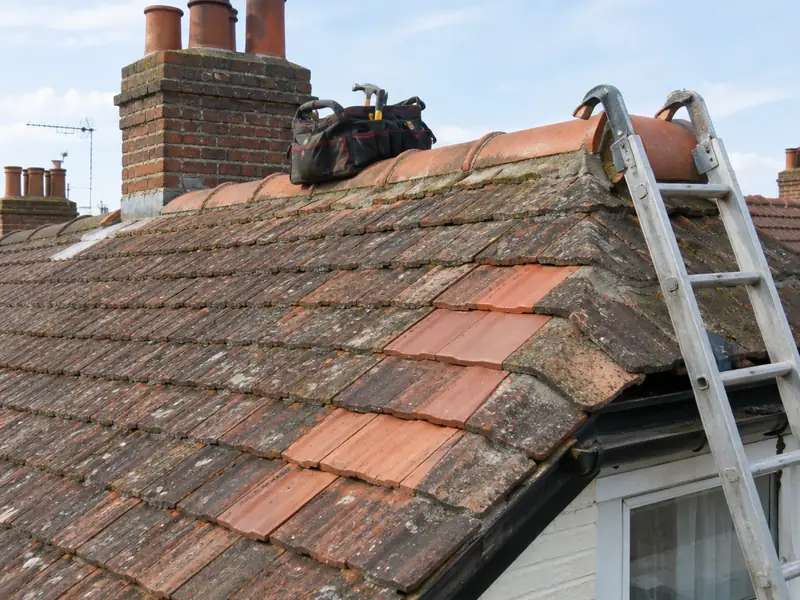
Roof repairs fix specific faults in a pitched or flat roof, such as slipped or cracked tiles, loose ridges, failed flashing, leaking valleys or chimney defects, to stop water getting in without replacing the whole roof.
We offer roof repairs throughout Fife, from Dunfermline, Kirkcaldy, Glenrothes and St Andrews to the smaller places in between. Each project starts with a free survey at your home and ends with a written figure, fixed for the work you choose. Because Fife is in Scotland, we work to the planning system and building standards used there, and guide prices for Scotland run at £300–£1,450 including VAT.
- Guide price
- £300–£1,450 inc VAT
- Time on site
- Half a day to 3 days for most repairs
- Planning rules
- Scotland
- Price level
- About 4% below the national guide
- Towns listed
- 4
- Survey
- Free, with a written quote
How much do roof repairs cost in Fife?
The costs listed here are typical for roof repairs around Fife and include VAT. They reflect labour and material costs in Scotland, about 4% below the national guide, giving a range of £300–£1,450. Exact pricing depends on your home, so we only fix it once a free site survey is done.
| Type of job | What it usually involves | Guide in Fife |
|---|---|---|
| Minor repair | Replacing a handful of slipped or broken tiles from ladders or a roof ladder. | £200–£500 |
| Ridge, flashing or valley repair | Rebedding a ridge run, renewing flashing or relining a short valley. | £400–£1,150 |
| Larger repair with scaffolding | Several faults, chimney work or repairs on high roofs needing scaffolding. | £950–£2,900 |
What moves the price up or down:
- Number and type of faults to repair
- Access: ladders, roof ladders, towers or full scaffolding
- Matching tiles, slates or lead to the existing roof
- Hidden damage to battens, felt or timbers found during repair
Scope of the work
- Photos of the problem areas and a clear written explanation
- Replacement of slipped, cracked or missing tiles and slates
- Ridge, hip and verge rebedding or dry-fix conversion
- Lead flashing, valley and chimney junction repairs
- Temporary weatherproofing where a full repair must wait
- Clearing debris from gutters and the work area
Housing across Fife
Fife's East Neuk fishing villages are known for pantiled roofs and crow-stepped gables, and St Andrews has historic stone streets. Kirkcaldy and Dunfermline have Victorian sandstone housing and interwar estates, Glenrothes was built as a post-war new town, and former mining towns in central Fife have rows of cottages and post-war council housing.
Pantiled and stone homes need careful roof repairs and lime work. Post-war and new-town houses commonly take re-rendering, window replacement and extensions, while bungalows suit loft conversions.
The coast faces cold easterly winds and salt from the North Sea, and frost is common inland through the winter.
Do you need permission in Fife?
Because Fife falls under Scotland's rules, the guidance below is the version relevant to you. Before sending a price, we check your property's position with the council.
In Scotland, like-for-like re-roofing does not usually need planning permission, except on listed buildings or in conservation areas.
Like-for-like re-covering does not usually need a building warrant, but structural changes or new roof windows can. Bats are protected across the UK; if they roost under roof tiles, soffits or fascias, work stops and a licensed ecologist advises before it restarts.
Rules change and every property is different, so we check the planning history and constraints for your address before we quote.
The four stages
Survey and measure
We begin by looking at the job in person. During the free survey we discuss options, materials and budget for roof repairs, and photograph or measure anything the quote needs to reflect.
Quote in writing
We turn the survey notes into a written quote. The price is fixed for the specification we agree, and the document sets out materials, scope and payment stages in plain language.
Booking the work
Next comes planning the work itself. We set a start date that suits you, line up the right trades, and make sure any approvals for roof repairs are in place before the first day on site.
The work itself
On site, the agreed plan is followed and any change is put in writing first. At completion we do a final clean, go through the snagging list with you and leave you with the relevant documents.
What you can expect from us
Frequently asked questions
How much does a roof repair cost?
A typical roof repair, such as replacing slipped tiles, rebedding a ridge or renewing flashing, costs £300–£1,450. Small repairs reachable by ladder sit at the lower end, while jobs needing scaffolding or several repairs cost more. Matching old tiles or slates and hidden damage to battens can also affect the price. We explain what we find and confirm a fixed price before starting.
How can I spot roof problems early?
Spotting roof problems early saves money. Look from the ground after storms for slipped or missing tiles, cracked ridge mortar or debris in gutters. In the loft, check for daylight, damp patches, stained timbers or wet insulation. Inside, watch for ceiling stains and peeling paint near outside walls. Clearing gutters each autumn prevents overflow damage.
How long will roof repairs take?
On a typical home, allow Half a day to 3 days for most repairs. Larger projects, older buildings and extra work found once things are opened up can extend that, while simpler jobs may be shorter. Your quote includes an estimate of time on site, and your point of contact keeps you updated on the programme as the work progresses.
Do you cover Dunfermline, Kirkcaldy and Glenrothes?
Yes. As well as Fife, we cover Dunfermline, Kirkcaldy and Glenrothes and the rest of Fife. Our coverage is UK-wide, so the process is the same wherever you are: a free site survey, a quote in writing that fixes the price for the agreed scope, and one point of contact while the work is planned and carried out.
Why is my roof leaking?
Roof leaks usually come from slipped or cracked tiles, failed flashing around chimneys and walls, leaking valleys, blocked gutters overflowing, or perished felt beneath the tiles. Water can travel along timbers before it drips, so the stain on your ceiling may not be directly under the fault. Condensation in the loft can also look like a leak. We trace the source before recommending a repair.
Towns in Fife
Choose your town from the list to see how we price and plan roof repairs in your part of Fife, including typical time on site.