
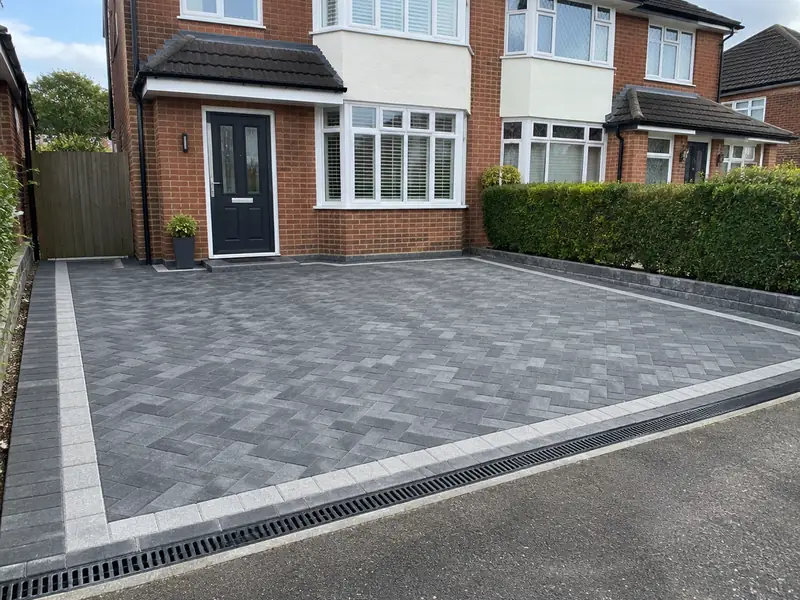
A new driveway is a hard-wearing surface for parking, such as block paving, resin bound gravel, tarmac or gravel, laid on an excavated and compacted sub-base with edging and drainage designed to carry vehicle loads and handle rainwater.
Homes across Fife vary a great deal, so we price a new driveway only after seeing the property. Our coverage takes in Dunfermline, Kirkcaldy, Glenrothes and St Andrews and the surrounding districts. As a guide, expect £3,800–£8,600 including VAT in Scotland; the final figure depends on size, materials and access. Any permissions are checked against the rules for Scotland before we quote.
- Guide price
- £3,800–£8,600 inc VAT
- Time on site
- 3–7 days on site
- Planning rules
- Scotland
- Price level
- About 4% below the national guide
- Towns listed
- 4
- Survey
- Free, with a written quote
How much does a new driveway cost in Fife?
In Fife, guide figures for a new driveway sit at £3,800–£8,600, VAT included. We set them using rates for Scotland, currently about 4% below the national guide. The table shows what pushes a project towards either end of the range; your own price is set after a free survey.
| Type of job | What it usually involves | Guide in Fife |
|---|---|---|
| Gravel or tarmac | A typical 40–50m² drive in gravel on a grid, or tarmac with block edging. | £1,900–£4,800 |
| Block paving or resin bound | A typical 40–50m² drive with sub-base, edging and drainage. | £3,800–£8,600 |
| Large or premium driveway | Larger drives, natural stone, walls, steps or a new dropped kerb. | £7,700–£15,500 |
Your price depends mostly on:
- Driveway area and the depth of excavation needed
- Surface: gravel, tarmac, block paving, resin or stone
- Drainage, soakaways and changes in level
- Access for machinery and removal of spoil
Scope of the work
- Survey of levels, drainage, manholes and access
- Excavation and removal of the old surface and soil
- Drainage channels or soakaway where needed
- Manhole covers raised or replaced to new levels
- New surface laid, compacted and finished
- Site cleared and waste removed
Housing across Fife
Fife's East Neuk fishing villages are known for pantiled roofs and crow-stepped gables, and St Andrews has historic stone streets. Kirkcaldy and Dunfermline have Victorian sandstone housing and interwar estates, Glenrothes was built as a post-war new town, and former mining towns in central Fife have rows of cottages and post-war council housing.
Pantiled and stone homes need careful roof repairs and lime work. Post-war and new-town houses commonly take re-rendering, window replacement and extensions, while bungalows suit loft conversions.
The coast faces cold easterly winds and salt from the North Sea, and frost is common inland through the winter.
Planning and building rules in Fife
Each UK nation sets its own consent rules, and Fife is in Scotland. What follows is a plain summary; we check the specifics for your property with the council before pricing anything.
In Scotland, a hard surface in front of a house is usually permitted development if it is permeable or drains within the property. A dropped kerb or road opening needs consent from the council as roads authority.
A building warrant is not normally needed for a driveway.
Rules change and every property is different, so we check the planning history and constraints for your address before we quote.
The four stages
A visit to your home
We arrange a free site survey on a date convenient to you. We measure up, look at the existing structure and access, and discuss your plans for a new driveway so the price reflects your home.
Your fixed price
The quote arrives in writing, not over the phone. It covers the full scope, the finishes you've chosen, any exclusions and the payment schedule, with a fixed price tied to that specification.
Dates and permissions
We handle the paperwork side: checking whether planning permission or building control approval is needed, submitting applications where they are, and scheduling the trades and materials around your dates.
On site to finish
Our trades complete a new driveway while your point of contact keeps you updated. When everything is finished, we clear the site, take away waste and go through the result with you before handover.
How we work
Frequently asked questions
Do I need permission for a dropped kerb?
A dropped kerb lets vehicles cross the pavement onto your drive, and creating or widening one needs consent from your local highways authority. They usually check visibility, the distance from junctions and trees, and whether there is enough space to park off the road. Many councils carry out the kerb work themselves or use approved contractors. We can help with the application.
How long will a new driveway take?
On a typical home, allow 3–7 days on site. Larger projects, older buildings and extra work found once things are opened up can extend that, while simpler jobs may be shorter. Your quote includes an estimate of time on site, and your point of contact keeps you updated on the programme as the work progresses.
How long does it take to lay a driveway?
Laying a typical driveway takes around three to seven days, depending on size, surface and ground conditions. Excavation and sub-base usually take the first few days, then edging, drainage and the surface. Resin needs dry weather and time to cure, and you will usually need to keep cars off for a short period afterwards. We confirm timings and access arrangements with your quote.
Who do I deal with during the job?
One point of contact manages your project from survey to handover. They schedule the trades working under our contract, keep you updated on progress, and are the person to call with any question. You don't need to coordinate builders, electricians or decorators separately, because that is part of what we do.
How do you stop a driveway flooding?
A driveway stays dry when rainwater can drain away rather than pooling or running towards the house. Permeable surfaces such as resin bound gravel or permeable block paving let water soak through to the ground. Non-permeable surfaces need falls directing water to a channel drain, soakaway or garden border. We check levels and drainage during the survey and design the falls accordingly.
Towns in Fife
Below is our list of Fife towns for a new driveway. If yours isn't shown, we may still cover it, so it is worth asking us directly.