
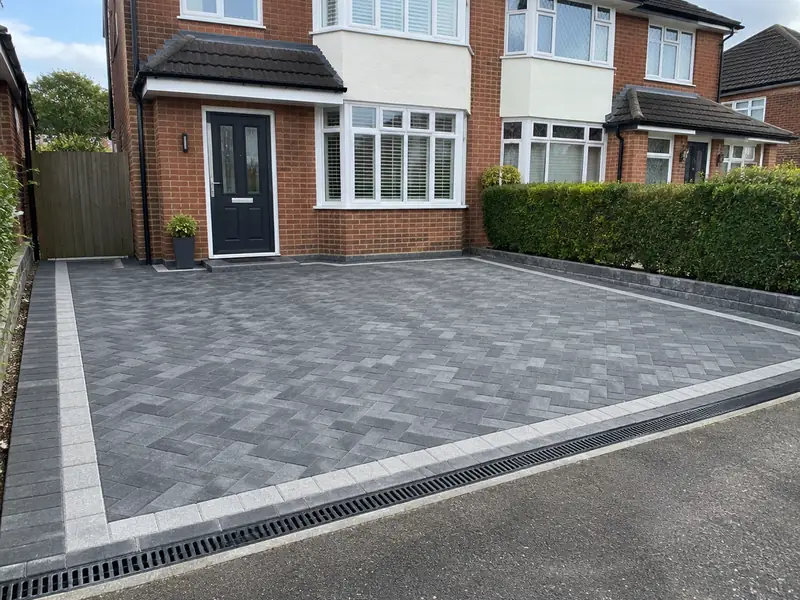
A new driveway is a hard-wearing surface for parking, such as block paving, resin bound gravel, tarmac or gravel, laid on an excavated and compacted sub-base with edging and drainage designed to carry vehicle loads and handle rainwater.
Kirkcaldy sits within our coverage for a new driveway, as do neighbouring Glenrothes, Edinburgh and Dunfermline. Before giving a price we want to see the property: the condition of what's there now, the access, and anything that might need extra work. The guide range for Scotland is £3,800–£8,600 including VAT, and your written quote will spell out exactly what that covers.
- Guide price
- £3,800–£8,600 inc VAT
- Time on site
- 3–7 days on site
- Postcodes
- KY1 and KY2
- Planning rules
- Scotland
- Local area
- Fife
- Survey
- Free, with a written quote
Driveways prices in Kirkcaldy
Every figure below is a guide for a new driveway in Kirkcaldy, inclusive of VAT. Regional pricing for Scotland works out about 4% below the national guide, and the overall span is £3,800–£8,600. The survey costs you nothing, and after it we commit to a firm price for your specification in writing.
| Type of job | What it usually involves | Guide in Kirkcaldy |
|---|---|---|
| Gravel or tarmac | A typical 40–50m² drive in gravel on a grid, or tarmac with block edging. | £1,900–£4,800 |
| Block paving or resin bound | A typical 40–50m² drive with sub-base, edging and drainage. | £3,800–£8,600 |
| Large or premium driveway | Larger drives, natural stone, walls, steps or a new dropped kerb. | £7,700–£15,500 |
What moves the price up or down:
- Driveway area and the depth of excavation needed
- Surface: gravel, tarmac, block paving, resin or stone
- Edging, steps, walls and manhole adjustments
- Access for machinery and removal of spoil
What’s included?
- Survey of levels, drainage, manholes and access
- Weed membrane and compacted MOT Type 1 sub-base
- Edging kerbs or restraints to hold the surface in place
- Drainage channels or soakaway where needed
- Manhole covers raised or replaced to new levels
- Site cleared and waste removed
Local housing and a new driveway
Fife's East Neuk fishing villages are known for pantiled roofs and crow-stepped gables, and St Andrews has historic stone streets. Kirkcaldy and Dunfermline have Victorian sandstone housing and interwar estates, Glenrothes was built as a post-war new town, and former mining towns in central Fife have rows of cottages and post-war council housing.
Pantiled and stone homes need careful roof repairs and lime work. Post-war and new-town houses commonly take re-rendering, window replacement and extensions, while bungalows suit loft conversions.
In Kirkcaldy, as elsewhere in Fife, we take the building's age and construction into account before recommending anything, because both can change what is involved in a new driveway.
Permissions for a new driveway in Kirkcaldy
Each UK nation sets its own consent rules, and Kirkcaldy is in Scotland. What follows is a plain summary; we check the specifics for your property with the council before pricing anything.
In Scotland, a hard surface in front of a house is usually permitted development if it is permeable or drains within the property. A dropped kerb or road opening needs consent from the council as roads authority.
A building warrant is not normally needed for a driveway.
Rules change and every property is different, so we check the planning history and constraints for your address before we quote.
The four stages
Survey and measure
Book a visit and we'll come to you. The survey covers measurements, the state of what's there now and any obvious constraints, so the price that follows is based on your actual home, not an average.
Your fixed price
You get the price in writing, itemised so you can see where the money goes. As long as the specification stays the same, that is the price you pay for a new driveway.
Dates and permissions
Preparation matters as much as the build. We agree access, parking and working hours with you, order materials in good time, and confirm any permissions so the job isn't held up once it starts.
The work itself
On site, the agreed plan is followed and any change is put in writing first. At completion we do a final clean, go through the snagging list with you and leave you with the relevant documents.
How we work
Frequently asked questions
Do I need planning permission for a driveway?
Whether a driveway needs planning permission depends on its size, surface and drainage, your home's location, whether it is listed or in a conservation area, and which UK nation you are in. In England, a new or replacement front driveway over 5m² needs permission unless it uses a permeable surface or drains to a lawn or border. We check the rules and design to suit.
Which driveway surface is easiest to maintain?
Resin bound gravel is one of the easiest surfaces to maintain, because it is smooth, porous and resists weeds, needing only an occasional sweep and wash. Block paving needs re-sanding joints and occasional weed control. Tarmac needs little upkeep but can soften in heat. Gravel needs raking and topping up. We explain the upkeep of each surface before you choose.
What is a sub-base and why does it matter?
The sub-base is the layer of crushed, compacted stone beneath the driveway surface that spreads the weight of vehicles into the ground. Most driveway failures, such as sinking, rutting and loose blocks, come from a sub-base that is too thin or poorly compacted. We excavate to the right depth for your soil and compact the sub-base in layers before laying the surface.
Who do I deal with during the job?
One point of contact manages your project from survey to handover. They schedule the trades working under our contract, keep you updated on progress, and are the person to call with any question. You don't need to coordinate builders, electricians or decorators separately, because that is part of what we do.
Do I need planning permission in Kirkcaldy?
It depends on the work, the size of the project, your property type and whether the building is listed or in a conservation area. Kirkcaldy is in Scotland, so Scotland's rules apply. Many smaller jobs need no planning application, but some still need building control approval. We check what applies to your address before quoting.
Nearby towns
Live in Kirkcaldy? Our coverage takes in the KY1 and KY2 postcode areas and reaches out to Glenrothes, Edinburgh and Dunfermline, so homes on the outskirts and in the next town along are included.