
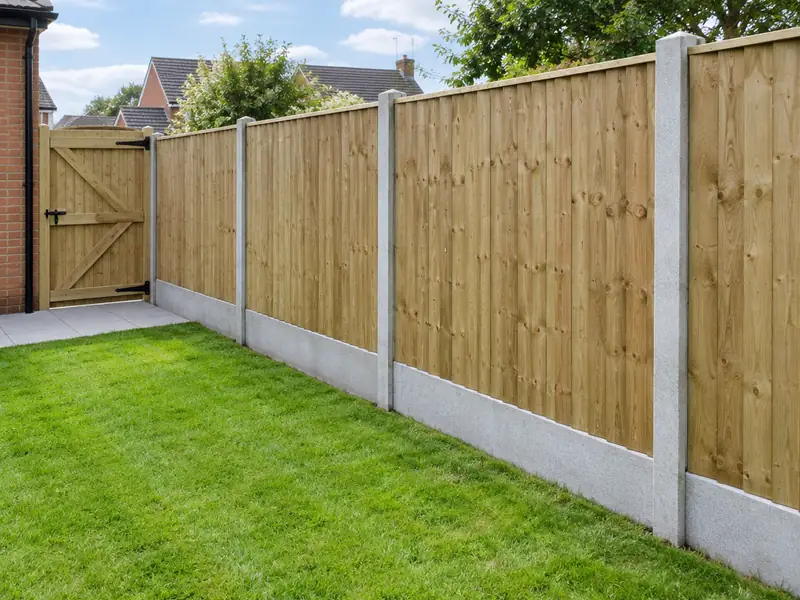
Fencing installation is setting fence posts into the ground, usually in concrete, and fixing panels or boards between them to mark a boundary, add privacy or keep children and pets in, with gates fitted where access is needed.
Homes across Northumberland vary a great deal, so we price new fencing and gates only after seeing the property. Our coverage takes in Blyth, Cramlington, Ashington and Bedlington and the surrounding districts. As a guide, expect £1,100–£2,700 including VAT in the North East; the final figure depends on size, materials and access. Any permissions are checked against the rules for England before we quote.
- Guide price
- £1,100–£2,700 inc VAT
- Time on site
- 1–3 days for a typical garden
- Planning rules
- England
- Price level
- About 10% below the national guide
- Towns listed
- 4
- Survey
- Free, with a written quote
How much do new fencing and gates cost in Northumberland?
No two jobs cost exactly the same, but the ranges below give a fair picture of new fencing and gates in Northumberland. Pricing for the North East runs about 10% below the national guide, and the overall guide is £1,100–£2,700 with VAT included. We'll confirm your figure after surveying the property for free.
| Type of job | What it usually involves | Guide in Northumberland |
|---|---|---|
| Repairs or a short run | Replacing a few panels and posts, or a short run of up to about 6m. | £250–£800 |
| Typical garden boundary | About 20m of panel or closeboard fencing with concrete posts and gravel boards. | £1,100–£2,700 |
| Composite or long runs with gates | Composite or premium fencing, longer runs, or a driveway gate. | £2,700–£6,300 |
What moves the price up or down:
- Total length and height of fencing
- Fence style and material: panels, closeboard or composite
- Ground conditions, slopes and removal of the old fence
- Number, size and type of gates
What do you get?
- Measured survey of each fence run, levels and slopes
- Removal and disposal of the old fence and posts
- Concrete or timber posts set in concrete
- Concrete or timber gravel boards to keep panels off the soil
- Post caps and capping rails where specified
- Gates hung with hinges, latches and locks
Housing across Northumberland
Stone dominates rural Northumberland, from sandstone farmhouses and villages to fortified bastle houses in the uplands. Alnwick, Hexham and Morpeth have historic stone centres, Berwick has Georgian streets, and south-east towns such as Ashington, Blyth and Bedlington have colliery terraces. Cramlington grew from the 1960s with planned estates.
Stone homes often need lime pointing, roof slating and breathable render. Colliery terraces suit loft conversions and rear extensions, and estate homes commonly take garage conversions and window upgrades.
The coast is exposed to cold North Sea winds, and the Cheviots and higher moorland see snow and hard frosts in winter.
Planning and building rules in Northumberland
Homes in Northumberland come under the regulations for England, summarised below. We don't rely on general rules alone: we confirm the position for your address with the council before a quote goes out.
In England, fences, walls and gates up to 2 m high are usually permitted development, or up to 1 m where they are next to a road used by vehicles or its footpath. Listed buildings, conservation areas and estates with planning conditions can be stricter.
Building Regulations do not apply to ordinary garden fences, but boundary lines should be agreed with your neighbour first.
Rules change and every property is different, so we check the planning history and constraints for your address before we quote.
How does the job run?
A visit to your home
Book a visit and we'll come to you. The survey covers measurements, the state of what's there now and any obvious constraints, so the price that follows is based on your actual home, not an average.
Quote in writing
We put everything into a written, fixed-price quote: the specification, what's excluded, staged payments and the expected time on site. Take whatever time you need to decide; there's no pressure to commit.
Plan and prepare
Next comes planning the work itself. We set a start date that suits you, line up the right trades, and make sure any approvals for new fencing and gates are in place before the first day on site.
The work itself
On site, the agreed plan is followed and any change is put in writing first. At completion we do a final clean, go through the snagging list with you and leave you with the relevant documents.
What you can expect from us
Questions about new fencing and gates in Northumberland
Are concrete posts better than timber?
Concrete posts do not rot and are the most durable choice for panel fences, especially on exposed sites. They are heavier and more utilitarian in appearance. Timber posts look more natural and suit closeboard and featheredge fences, but they eventually rot at ground level, even when treated. Aluminium posts suit composite systems. We recommend posts based on your fence style and exposure.
Can I stay at home during the work?
In most cases, yes. Most people can live at home throughout, and we plan the work to keep disruption down by protecting floors, agreeing working hours and keeping access routes clear. Bigger jobs affecting kitchens, bathrooms or heating may mean a short spell with reduced facilities, and we talk this through with you at the survey.
Do you cover Blyth, Cramlington and Ashington?
Yes. As well as Northumberland, we cover Blyth, Cramlington and Ashington and the rest of Northumberland. Our coverage is UK-wide, so the process is the same wherever you are: a free site survey, a quote in writing that fixes the price for the agreed scope, and one point of contact while the work is planned and carried out.
How do you fence a sloping garden?
On a sloping garden, fence panels are usually stepped, so each panel is level and set slightly higher or lower than the one before, with the gap below filled by a gravel board. Closeboard fences can instead follow the slope, giving a smooth top line. The choice depends on how steep the slope is and the look you want. We discuss both at the survey.
How high can my fence be?
Fence height limits depend on planning rules, your home's location, whether it is listed or in a conservation area, and which UK nation you live in. In England, fences up to 2m high are usually permitted development, reduced to 1m next to a road used by vehicles. Higher fences need planning permission. We check the rules for your boundary before quoting.
Towns in Northumberland
Find your town below. Every place listed in Northumberland is covered for new fencing and gates, with the same survey, written quote and fixed-price process.