
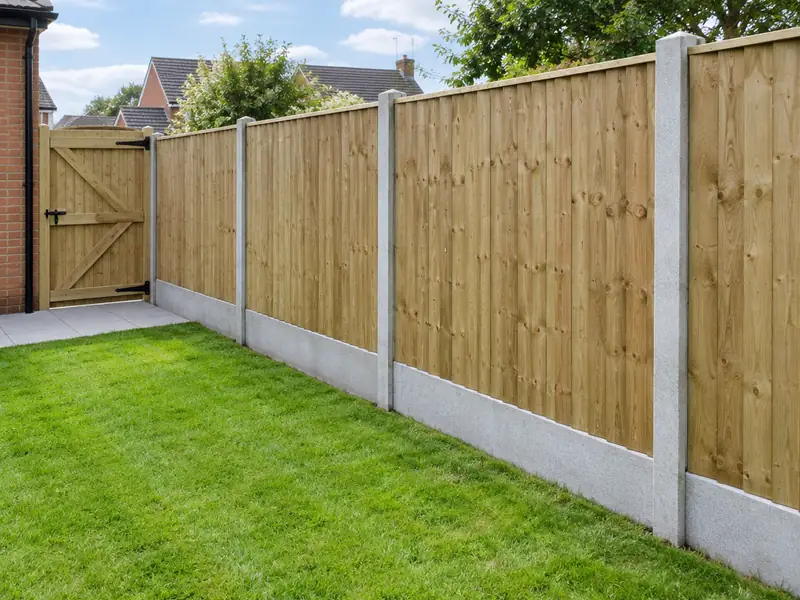
Fencing installation is setting fence posts into the ground, usually in concrete, and fixing panels or boards between them to mark a boundary, add privacy or keep children and pets in, with gates fitted where access is needed.
We arrange new fencing and gates for homeowners in Cramlington and the wider Northumberland. The job is planned, priced and managed by us and carried out by tradespeople engaged under our contract, so there is one agreement and one contact. On a typical home the work takes 1–3 days for a typical garden, and guide pricing in the North East is £1,100–£2,700, VAT included.
- Guide price
- £1,100–£2,700 inc VAT
- Time on site
- 1–3 days for a typical garden
- Postcodes
- NE23
- Planning rules
- England
- Local area
- Northumberland
- Survey
- Free, with a written quote
Fencing and gates prices in Cramlington
Use the table to gauge the cost of new fencing and gates in Cramlington before we visit. Figures include VAT and are scaled for the North East, coming out about 10% below the national guide, which gives £1,100–£2,700 overall. After a free survey, you receive a fixed written price.
| Type of job | What it usually involves | Guide in Cramlington |
|---|---|---|
| Repairs or a short run | Replacing a few panels and posts, or a short run of up to about 6m. | £250–£800 |
| Typical garden boundary | About 20m of panel or closeboard fencing with concrete posts and gravel boards. | £1,100–£2,700 |
| Composite or long runs with gates | Composite or premium fencing, longer runs, or a driveway gate. | £2,700–£6,300 |
Expect these to shape the final quote:
- Fence style and material: panels, closeboard or composite
- Post type: concrete, timber or aluminium
- Ground conditions, slopes and removal of the old fence
- Number, size and type of gates
Scope of the work
- Measured survey of each fence run, levels and slopes
- Removal and disposal of the old fence and posts
- Concrete or timber posts set in concrete
- Concrete or timber gravel boards to keep panels off the soil
- Post caps and capping rails where specified
- Site cleared and waste removed
Homes in Northumberland
Stone dominates rural Northumberland, from sandstone farmhouses and villages to fortified bastle houses in the uplands. Alnwick, Hexham and Morpeth have historic stone centres, Berwick has Georgian streets, and south-east towns such as Ashington, Blyth and Bedlington have colliery terraces. Cramlington grew from the 1960s with planned estates.
Stone homes often need lime pointing, roof slating and breathable render. Colliery terraces suit loft conversions and rear extensions, and estate homes commonly take garage conversions and window upgrades.
These patterns matter for new fencing and gates: older walls, roofs and floors in Cramlington can need different materials or extra preparation compared with newer homes.
Permissions for new fencing and gates in Cramlington
Cramlington is in England, so the planning and building rules set out below are the ones that apply. We confirm the details with the council before we quote.
In England, fences, walls and gates up to 2 m high are usually permitted development, or up to 1 m where they are next to a road used by vehicles or its footpath. Listed buildings, conservation areas and estates with planning conditions can be stricter.
Building Regulations do not apply to ordinary garden fences, but boundary lines should be agreed with your neighbour first.
Rules change and every property is different, so we check the planning history and constraints for your address before we quote.
The four stages
We look at the job
It starts with a survey at the property, free of charge. We check condition, access and services, ask how you want the finished result to look, and answer any questions you have about new fencing and gates.
Price and scope agreed
You get the price in writing, itemised so you can see where the money goes. As long as the specification stays the same, that is the price you pay for new fencing and gates.
Getting ready
Before anyone starts, we confirm the programme in writing, check whether consents are required and arrange deliveries. If a skip or scaffolding on the road needs a permit, we apply for it.
On site to finish
During the work we protect the areas around it and tidy up at the end of each day. Once complete, we check the finish, remove our materials and hand over paperwork such as building control sign-off where it applies.
How we work
Common questions
How do I make my fence last longer?
A fence lasts longer when timber is kept off the soil and protected from moisture. Gravel boards beneath the panels, concrete posts and keeping plants and soil away from the fence all help. Treat timber with a preservative or stain every few years, and replace damaged boards promptly. Composite fencing needs only occasional washing.
What happens at the survey?
We visit your home at a time that suits you, look at the area involved, take measurements and check access, condition and any services that might be affected. We talk through what you want from new fencing and gates, explain the options and answer questions. There is no charge and no obligation; afterwards we send a written quote.
How long will new fencing and gates take?
On a typical home, allow 1–3 days for a typical garden. Larger projects, older buildings and extra work found once things are opened up can extend that, while simpler jobs may be shorter. Your quote includes an estimate of time on site, and your point of contact keeps you updated on the programme as the work progresses.
What kind of gate do I need?
The right gate depends on its job. A side gate for access to the back garden is usually timber or metal, around 0.9m to 1m wide, with a secure lock. Driveway gates are wider, often in pairs, and need strong posts. Composite and metal gates resist warping. We measure the opening, check posts and suggest hinges, latches and locks for security.
Who owns the fence between me and my neighbour?
Fence ownership is usually shown on the title plan or deeds, sometimes with a T mark on the side of the owner. If it is unclear, it may be shared. Even on your own boundary, it is sensible to talk to neighbours before replacing a fence, agree access and confirm the line. We fit the fence on the line you confirm and can face the good side outwards if you wish.
Nearby towns
We welcome enquiries from all NE23 postcodes in Cramlington, plus Bedlington, Blyth and Gosforth. Each one gets the same survey at no charge and a written price fixed for the work described.