
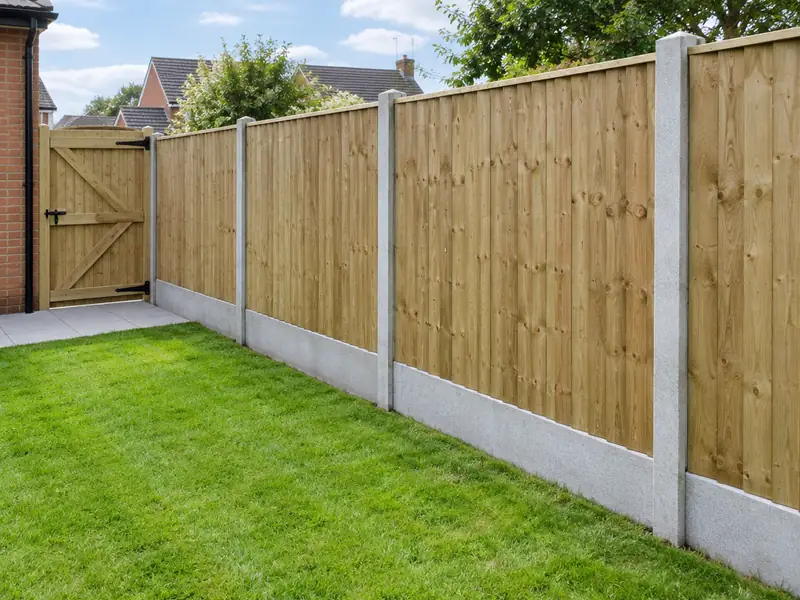
Fencing installation is setting fence posts into the ground, usually in concrete, and fixing panels or boards between them to mark a boundary, add privacy or keep children and pets in, with gates fitted where access is needed.
Across Cumbria, people look into new fencing and gates to replace something worn out, to make the house work better for them, or to get it ready for a sale. We cover Carlisle, Barrow-in-Furness, Kendal and Whitehaven and the smaller towns around them, working to the rules that apply in England. Expect a guide of £1,150–£2,800, VAT included, in the North West, and every quote follows a free visit.
- Guide price
- £1,150–£2,800 inc VAT
- Time on site
- 1–3 days for a typical garden
- Planning rules
- England
- Price level
- About 5% below the national guide
- Towns listed
- 5
- Survey
- Free, with a written quote
How much do new fencing and gates cost in Cumbria?
Prices for new fencing and gates vary from house to house, but in Cumbria most projects fall within £1,150–£2,800 including VAT. That reflects costs in the North West, about 5% below the national guide. Treat the table as a budgeting aid; the written figure follows a survey we carry out for free.
| Type of job | What it usually involves | Guide in Cumbria |
|---|---|---|
| Repairs or a short run | Replacing a few panels and posts, or a short run of up to about 6m. | £300–£850 |
| Typical garden boundary | About 20m of panel or closeboard fencing with concrete posts and gravel boards. | £1,150–£2,800 |
| Composite or long runs with gates | Composite or premium fencing, longer runs, or a driveway gate. | £2,800–£6,600 |
The main things that change the figure:
- Total length and height of fencing
- Fence style and material: panels, closeboard or composite
- Post type: concrete, timber or aluminium
- Ground conditions, slopes and removal of the old fence
Scope of the work
- Removal and disposal of the old fence and posts
- Concrete or timber gravel boards to keep panels off the soil
- Panels or boards fixed level or stepped to follow the ground
- Post caps and capping rails where specified
- Gates hung with hinges, latches and locks
- Site cleared and waste removed
Homes in Cumbria
Lake District villages are built largely of slate and rubble stone, often finished in roughcast or limewash, under slate roofs. Kendal is known for grey limestone and Penrith for red sandstone, Carlisle has sandstone and brick terraces, and west coast towns such as Barrow, Workington and Whitehaven have Victorian industrial terraces and post-war estates.
Stone cottages often need lime pointing, roof slating and breathable render. Industrial terraces can gain space through attic conversions and rear extensions, while rural homes commonly add porches, driveways and window upgrades.
Cumbria is among the wettest parts of England, and high ground and west-facing coasts see severe wind-driven rain, so exposure ratings matter for render and pointing.
Do you need permission in Cumbria?
Which rules apply depends on where you live. For Cumbria, the answer is England, and the points below reflect that; we verify them with the council before quoting.
In England, fences, walls and gates up to 2 m high are usually permitted development, or up to 1 m where they are next to a road used by vehicles or its footpath. Listed buildings, conservation areas and estates with planning conditions can be stricter.
Building Regulations do not apply to ordinary garden fences, but boundary lines should be agreed with your neighbour first.
Rules change and every property is different, so we check the planning history and constraints for your address before we quote.
How does the job run?
Free site survey
We begin by looking at the job in person. During the free survey we discuss options, materials and budget for new fencing and gates, and photograph or measure anything the quote needs to reflect.
Price and scope agreed
You get the price in writing, itemised so you can see where the money goes. As long as the specification stays the same, that is the price you pay for new fencing and gates.
Booking the work
We handle the paperwork side: checking whether planning permission or building control approval is needed, submitting applications where they are, and scheduling the trades and materials around your dates.
Build and hand over
On site, the agreed plan is followed and any change is put in writing first. At completion we do a final clean, go through the snagging list with you and leave you with the relevant documents.
What you can expect from us
Questions about new fencing and gates in Cumbria
Which postcodes in Cumbria do you cover?
We cover CA1, LA13, LA8 and CA28, along with the rest of Cumbria. If your postcode is not listed, get in touch anyway: our coverage is UK-wide, and we can usually arrange a survey wherever you live. Enter your postcode in the guide-price tool or contact form and we will confirm.
Who do I deal with during the job?
One point of contact manages your project from survey to handover. They schedule the trades working under our contract, keep you updated on progress, and are the person to call with any question. You don't need to coordinate builders, electricians or decorators separately, because that is part of what we do.
What kind of gate do I need?
The right gate depends on its job. A side gate for access to the back garden is usually timber or metal, around 0.9m to 1m wide, with a secure lock. Driveway gates are wider, often in pairs, and need strong posts. Composite and metal gates resist warping. We measure the opening, check posts and suggest hinges, latches and locks for security.
How do you fence a sloping garden?
On a sloping garden, fence panels are usually stepped, so each panel is level and set slightly higher or lower than the one before, with the gap below filled by a gravel board. Closeboard fences can instead follow the slope, giving a smooth top line. The choice depends on how steep the slope is and the look you want. We discuss both at the survey.
How high can my fence be?
Fence height limits depend on planning rules, your home's location, whether it is listed or in a conservation area, and which UK nation you live in. In England, fences up to 2m high are usually permitted development, reduced to 1m next to a road used by vehicles. Higher fences need planning permission. We check the rules for your boundary before quoting.
Towns in Cumbria
Looking for new fencing and gates somewhere in Cumbria? Start with the towns below; each links to a page with pricing for your region and coverage details.