
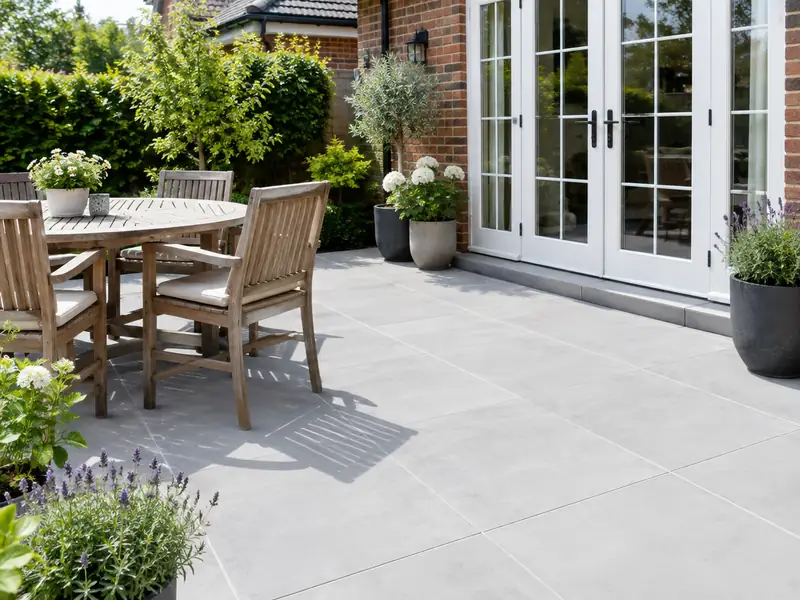
A patio is a paved outdoor area next to the house or in the garden, laid in porcelain, natural stone or concrete slabs on a compacted sub-base and mortar bed, with falls that direct rainwater away from the house.
Across County Antrim, people look into a new patio to replace something worn out, to make the house work better for them, or to get it ready for a sale. We cover Belfast, Lisburn, Newtownabbey and Carrickfergus and the smaller towns around them, working to the rules that apply in Northern Ireland. Expect a guide of £2,200–£4,700, VAT included, in Northern Ireland, and every quote follows a free visit.
- Guide price
- £2,200–£4,700 inc VAT
- Time on site
- 3–7 days on site
- Planning rules
- Northern Ireland
- Price level
- About 14% below the national guide
- Towns listed
- 7
- Survey
- Free, with a written quote
How much does a new patio cost in County Antrim?
The table below shows guide prices for a new patio in County Antrim. They are based on rates in Northern Ireland, which run about 14% below the national guide, giving an overall range of £2,200–£4,700. All figures include VAT and are firmed up after a free site survey.
| Type of job | What it usually involves | Guide in County Antrim |
|---|---|---|
| Small patio or path | Around 10m² of concrete slabs or a garden path. | £850–£2,200 |
| Typical 20m² patio | Sandstone or porcelain on a full sub-base with jointing and edging. | £2,200–£4,700 |
| Large or multi-level patio | Bigger areas, steps, retaining walls or premium stone. | £4,700–£10,500 |
The main things that change the figure:
- Patio area and the amount of excavation
- Slab material, size and laying pattern
- Drainage needed to keep water away from the house
- Access for materials and removing spoil
What do you get?
- Survey of levels, damp-proof course, drainage and access
- Compacted MOT Type 1 sub-base
- Primer on porcelain slabs for a strong bond
- Jointing with mortar or a brush-in compound
- Edging and neat cuts around drains and walls
- Site cleared, waste removed and paving cleaned
Homes in County Antrim
Belfast has long rows of red-brick Victorian terraces, Edwardian villas in the north and south of the city and large post-war estates, while towns such as Ballymena, Antrim, Larne and Carrickfergus mix terraces, semis and newer developments. Dark basalt appears in older rural buildings, and pebbledash or roughcast is a very common finish.
Terraces suit loft conversions and rear extensions, and many need window and roof renewal. Pebbledashed homes commonly need re-rendering, and detached rural houses often take extensions, porches and driveways.
The north coast and glens are exposed to strong winds, salt and frequent rain, which affects render, roofline and outdoor work.
Planning and building rules in County Antrim
Because County Antrim falls under Northern Ireland's rules, the guidance below is the version relevant to you. Before sending a price, we check your property's position with the council.
A ground-level patio does not usually need planning permission in Northern Ireland; raised platforms are more restricted.
Building control approval is not normally needed for a patio.
Rules change and every property is different, so we check the planning history and constraints for your address before we quote.
How does the job run?
Free site survey
We arrange a free site survey on a date convenient to you. We measure up, look at the existing structure and access, and discuss your plans for a new patio so the price reflects your home.
Quote in writing
We turn the survey notes into a written quote. The price is fixed for the specification we agree, and the document sets out materials, scope and payment stages in plain language.
Getting ready
We handle the paperwork side: checking whether planning permission or building control approval is needed, submitting applications where they are, and scheduling the trades and materials around your dates.
Finish and handover
Work goes ahead as scheduled and you deal with one contact throughout. When the last trade leaves, we clear and clean the site, talk you through what has been done and pass on any certificates and care instructions.
How we work
Frequently asked questions
What happens if my garden slopes?
A sloping garden can still have a level patio by cutting into the slope, building up with retaining walls, or creating terraces with steps between them. Retaining walls must be built to hold back the soil and allow drainage behind them. This adds cost but creates usable, level space. We look at the slope during the survey and suggest the most practical design.
Is porcelain or sandstone better for a patio?
Porcelain is dense, stain-resistant and stays looking clean with little care, making it a good choice if you want a modern, low-maintenance patio. Indian sandstone has natural colour variation and a softer, traditional look, and costs a little less, but it can stain and weather over time and benefits from sealing. Both make durable patios when properly laid. We bring samples to the survey.
Which postcodes in County Antrim do you cover?
We cover BT1, BT17, BT36 and BT38, along with the rest of County Antrim. If your postcode is not listed, get in touch anyway: our coverage is UK-wide, and we can usually arrange a survey wherever you live. Enter your postcode in the guide-price tool or contact form and we will confirm.
How much does a new patio cost?
A typical 20m² patio in sandstone or porcelain costs £2,200–£4,700, including excavation, sub-base, laying and jointing. As a guide, allow roughly £100–£220 per square metre plus fixed costs for set-up and waste. Concrete slabs cost less, while slate, granite and large-format porcelain cost more. Steps, walls and drainage add to the total. We confirm a fixed price after the survey.
How long will a new patio take?
On a typical home, allow 3–7 days on site. Larger projects, older buildings and extra work found once things are opened up can extend that, while simpler jobs may be shorter. Your quote includes an estimate of time on site, and your point of contact keeps you updated on the programme as the work progresses.
Towns in County Antrim
Find your town below. Every place listed in County Antrim is covered for a new patio, with the same survey, written quote and fixed-price process.