
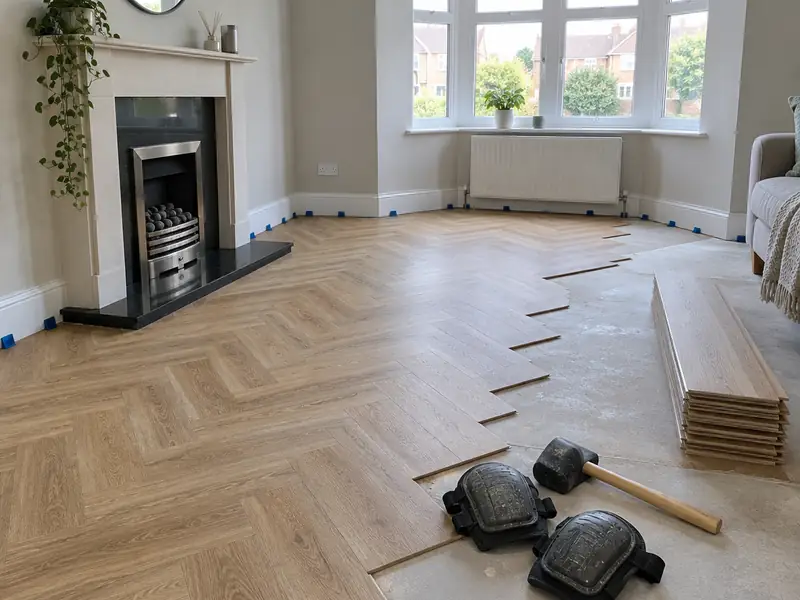
Flooring installation is the supply and fitting of a new floor finish, such as laminate, luxury vinyl tile, engineered wood or solid wood, over a properly levelled and prepared subfloor, with underlay, trims and thresholds finished neatly.
Across County Antrim, people look into new flooring to replace something worn out, to make the house work better for them, or to get it ready for a sale. We cover Belfast, Lisburn, Newtownabbey and Carrickfergus and the smaller towns around them, working to the rules that apply in Northern Ireland. Expect a guide of £1,050–£3,400, VAT included, in Northern Ireland, and every quote follows a free visit.
- Guide price
- £1,050–£3,400 inc VAT
- Time on site
- 1–2 days per room, longer if levelling is needed
- Planning rules
- Northern Ireland
- Price level
- About 14% below the national guide
- Towns listed
- 7
- Survey
- Free, with a written quote
How much does new flooring cost in County Antrim?
Here is how the guide price for new flooring breaks down in County Antrim. We start from national figures and adjust for Northern Ireland, which comes out about 14% below the national guide. The resulting range, VAT included, is £1,050–£3,400, and a survey, at no cost to you, firms it up.
| Type of job | What it usually involves | Guide in County Antrim |
|---|---|---|
| Laminate in one room | Around 15–20m² of laminate with underlay, trims and door trimming. | £500–£1,550 |
| LVT or engineered wood | Around 20–25m² of LVT or engineered wood, with levelling and moisture protection. | £1,050–£3,000 |
| Whole floor or solid wood | An open-plan ground floor, solid wood or herringbone, with extensive preparation. | £3,000–£7,700 |
What moves the price up or down:
- Flooring type, plank size and laying pattern
- Condition of the subfloor and any levelling needed
- Lifting and disposing of existing floor coverings
- Underfloor heating, moisture barriers and acoustic underlay
What do you get?
- Measured survey of each room and checks on the subfloor
- Lifting and disposal of old carpet, laminate or vinyl
- Subfloor repairs, levelling compound or plywood overlay where needed
- Damp-proof membrane and suitable underlay for your floor type
- Door trimming so doors clear the new floor
- Threshold strips, scotia or skirting finished neatly
Housing across County Antrim
Belfast has long rows of red-brick Victorian terraces, Edwardian villas in the north and south of the city and large post-war estates, while towns such as Ballymena, Antrim, Larne and Carrickfergus mix terraces, semis and newer developments. Dark basalt appears in older rural buildings, and pebbledash or roughcast is a very common finish.
Terraces suit loft conversions and rear extensions, and many need window and roof renewal. Pebbledashed homes commonly need re-rendering, and detached rural houses often take extensions, porches and driveways.
The north coast and glens are exposed to strong winds, salt and frequent rain, which affects render, roofline and outdoor work.
Planning and building rules in County Antrim
The notes below cover Northern Ireland, which is where County Antrim sits. Rules change and every property is different, so we speak to the council before pricing your job.
Internal improvements do not need planning permission in Northern Ireland unless the building is listed.
The Building Regulations (Northern Ireland) apply to structural work, drainage and ventilation; electrical work should be tested and certified.
Rules change and every property is different, so we check the planning history and constraints for your address before we quote.
How does the job run?
A visit to your home
We begin by looking at the job in person. During the free survey we discuss options, materials and budget for new flooring, and photograph or measure anything the quote needs to reflect.
Your fixed price
After the survey we send a quote for new flooring that fixes the price for the scope we've agreed. If you want to change materials or scope, we revise it in writing before anything is booked.
Getting ready
We handle the paperwork side: checking whether planning permission or building control approval is needed, submitting applications where they are, and scheduling the trades and materials around your dates.
Finish and handover
The work is carried out to the agreed specification, with floors and furniture protected and the site kept tidy. At the end we clean up, walk through the finished job with you and hand over any certificates.
How we work
Frequently asked questions
How much will new flooring cost in County Antrim?
As a guide, expect to pay £1,050–£3,400 including VAT for new flooring in County Antrim. That range is adjusted for Northern Ireland, which runs about 14% below the national guide. Where your project lands depends on size, materials, access and the condition of what is already there. We confirm a fixed price in writing after a free survey of your home.
How much does new flooring cost?
New flooring for a typical 20–25m² room costs £1,050–£3,400 supplied and fitted, depending on the material and the state of the subfloor. As a guide, allow roughly £45–£140 per square metre including underlay and fitting, with laminate at the lower end and engineered or solid wood at the top. Herringbone patterns, levelling and stairs add cost. We confirm a fixed price after measuring each room.
Do you cover Belfast, Lisburn and Newtownabbey?
Yes. As well as County Antrim, we cover Belfast, Lisburn and Newtownabbey and the rest of County Antrim. Our coverage is UK-wide, so the process is the same wherever you are: a free site survey, a quote in writing that fixes the price for the agreed scope, and one point of contact while the work is planned and carried out.
How do I look after a new floor?
Looking after a new floor is mostly about keeping grit off it, because grit acts like sandpaper. Use doormats, sweep or vacuum regularly and clean with a damp, not wet, mop using a cleaner made for that floor type. Put felt pads under furniture legs. Oiled wood floors need occasional re-oiling, while lacquered wood, laminate and LVT just need regular cleaning.
What preparation does the subfloor need?
A good floor starts with a flat, dry, sound subfloor. Concrete floors may need a damp-proof membrane and levelling compound, while timber floors may need loose boards fixing and a plywood overlay. Old adhesive, tiles or vinyl may have to be removed. Skipping preparation causes creaking, gaps and uneven wear. We check the subfloor at the survey and include preparation in the price.
Towns in County Antrim
We offer new flooring in each of the towns below, all within County Antrim. Select yours for guide prices, postcodes covered and nearby places.