
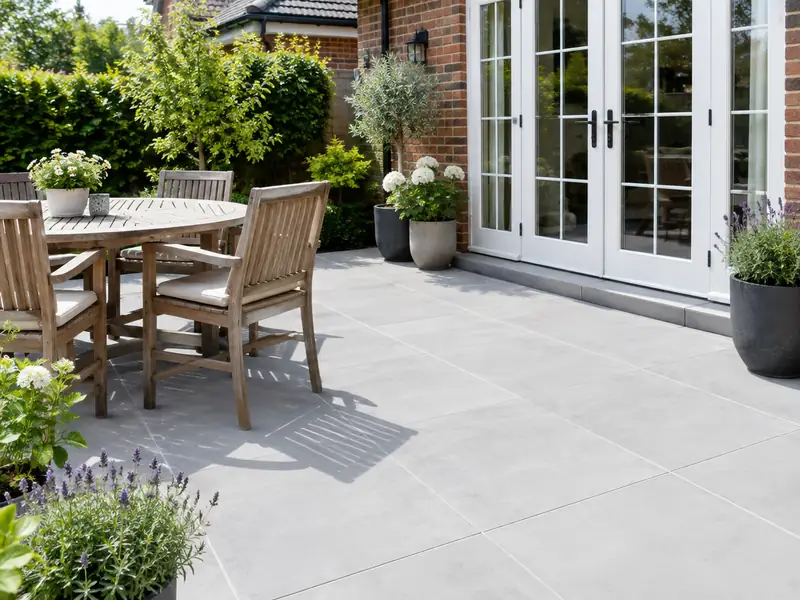
A patio is a paved outdoor area next to the house or in the garden, laid in porcelain, natural stone or concrete slabs on a compacted sub-base and mortar bed, with falls that direct rainwater away from the house.
Our guide for a new patio in the East of England comes to £2,600–£5,800 with VAT added, and that range applies across Suffolk, including Ipswich, Lowestoft, Bury St Edmunds and Haverhill. Your own price depends on the size of the job, the specification and how easy it is to work on the site. We survey for free, check any consents needed under the rules in England, and then put the price in writing.
- Guide price
- £2,600–£5,800 inc VAT
- Time on site
- 3–7 days on site
- Planning rules
- England
- Price level
- About 5% above the national guide
- Towns listed
- 7
- Survey
- Free, with a written quote
Patios and paving prices in Suffolk
Use the table to gauge the cost of a new patio in Suffolk before we visit. Figures include VAT and are scaled for the East of England, coming out about 5% above the national guide, which gives £2,600–£5,800 overall. After a free survey, you receive a fixed written price.
| Type of job | What it usually involves | Guide in Suffolk |
|---|---|---|
| Small patio or path | Around 10m² of concrete slabs or a garden path. | £1,050–£2,600 |
| Typical 20m² patio | Sandstone or porcelain on a full sub-base with jointing and edging. | £2,600–£5,800 |
| Large or multi-level patio | Bigger areas, steps, retaining walls or premium stone. | £5,800–£12,500 |
What moves the price up or down:
- Patio area and the amount of excavation
- Ground levels, slopes, steps and retaining walls
- Drainage needed to keep water away from the house
- Access for materials and removing spoil
What do you get?
- Survey of levels, damp-proof course, drainage and access
- Compacted MOT Type 1 sub-base
- Slabs laid on a full mortar bed with falls away from the house
- Primer on porcelain slabs for a strong bond
- Jointing with mortar or a brush-in compound
- Site cleared, waste removed and paving cleaned
Housing across Suffolk
Suffolk villages are full of timber-framed cottages, many limewashed in traditional colours such as Suffolk pink, with pargeting and thatch in places. Flint and pale gault brick are common too. Ipswich has Victorian terraces and interwar estates, Bury St Edmunds has Georgian streets, and Lowestoft and Felixstowe mix Victorian seaside housing with newer estates.
Timber-framed buildings need breathable lime plaster and render, and roof repairs that suit the original materials. Terraces suit loft conversions and rear extensions, while newer homes commonly take garage conversions and porches.
One of the driest counties, but the coast is eroding in places, and clay soils inland can shrink and crack in dry summers.
Do you need permission in Suffolk?
Because Suffolk falls under England's rules, the guidance below is the version relevant to you. Before sending a price, we check your property's position with the council.
A ground-level patio in a back garden does not usually need planning permission in England. Raised decks or platforms more than 30 cm high do.
Building Regulations do not normally apply to patios, but levels must stay below the damp-proof course and drain away from the house.
Rules change and every property is different, so we check the planning history and constraints for your address before we quote.
How does the job run?
We look at the job
We arrange a free site survey on a date convenient to you. We measure up, look at the existing structure and access, and discuss your plans for a new patio so the price reflects your home.
Price and scope agreed
We turn the survey notes into a written quote. The price is fixed for the specification we agree, and the document sets out materials, scope and payment stages in plain language.
Booking the work
Before anyone starts, we confirm the programme in writing, check whether consents are required and arrange deliveries. If a skip or scaffolding on the road needs a permit, we apply for it.
Finish and handover
The work is carried out to the agreed specification, with floors and furniture protected and the site kept tidy. At the end we clean up, walk through the finished job with you and hand over any certificates.
How we work
Questions about a new patio in Suffolk
How do you make sure water drains away from the house?
A patio needs a gentle fall, usually a little over 1 in 80, so rainwater runs away from the house towards the garden, a drain or a soakaway. The surface should also sit well below the damp-proof course. If the patio meets a door threshold, a channel drain may be needed. We set levels with string lines and check falls as we lay each section.
What should I do before the work starts?
Before work starts, clear garden furniture, pots and ornaments from the area and agree where materials will be delivered and stored. We need a route for wheelbarrows and, on larger jobs, a small digger, so let us know about side gates, narrow passages or access through the house. Tell us about any known drains, cables or pipes in the area.
What happens at the survey?
We visit your home at a time that suits you, look at the area involved, take measurements and check access, condition and any services that might be affected. We talk through what you want from a new patio, explain the options and answer questions. There is no charge and no obligation; afterwards we send a written quote.
Is porcelain or sandstone better for a patio?
Porcelain is dense, stain-resistant and stays looking clean with little care, making it a good choice if you want a modern, low-maintenance patio. Indian sandstone has natural colour variation and a softer, traditional look, and costs a little less, but it can stain and weather over time and benefits from sealing. Both make durable patios when properly laid. We bring samples to the survey.
Do you cover Ipswich, Lowestoft and Bury St Edmunds?
Yes. As well as Suffolk, we cover Ipswich, Lowestoft and Bury St Edmunds and the rest of Suffolk. Our coverage is UK-wide, so the process is the same wherever you are: a free site survey, a quote in writing that fixes the price for the agreed scope, and one point of contact while the work is planned and carried out.
Towns in Suffolk
Choose your town from the list to see how we price and plan a new patio in your part of Suffolk, including typical time on site.