
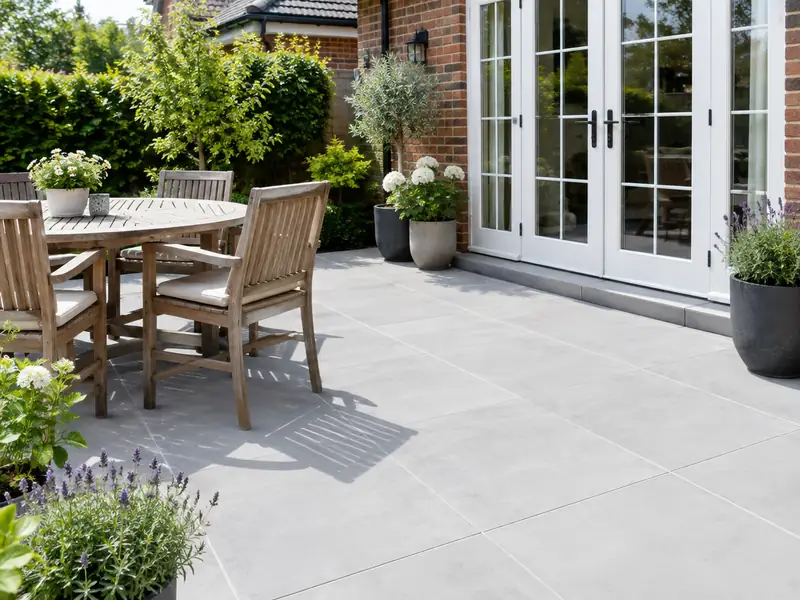
A patio is a paved outdoor area next to the house or in the garden, laid in porcelain, natural stone or concrete slabs on a compacted sub-base and mortar bed, with falls that direct rainwater away from the house.
For a homeowner in Bury St Edmunds, planning a new patio tends to begin with two questions: what will it cost, and how disruptive will it be? Our guide range is £2,600–£5,800 including VAT, and a typical job runs to 3–7 days on site. Both numbers firm up once we have seen the property, measured up and agreed exactly what is included.
- Guide price
- £2,600–£5,800 inc VAT
- Time on site
- 3–7 days on site
- Postcodes
- IP32 and IP33
- Planning rules
- England
- Local area
- Suffolk
- Survey
- Free, with a written quote
Patios and paving prices in Bury St Edmunds
No two jobs cost exactly the same, but the ranges below give a fair picture of a new patio in Bury St Edmunds. Pricing for the East of England runs about 5% above the national guide, and the overall guide is £2,600–£5,800 with VAT included. We'll confirm your figure after surveying the property for free.
| Type of job | What it usually involves | Guide in Bury St Edmunds |
|---|---|---|
| Small patio or path | Around 10m² of concrete slabs or a garden path. | £1,050–£2,600 |
| Typical 20m² patio | Sandstone or porcelain on a full sub-base with jointing and edging. | £2,600–£5,800 |
| Large or multi-level patio | Bigger areas, steps, retaining walls or premium stone. | £5,800–£12,500 |
The main things that change the figure:
- Patio area and the amount of excavation
- Ground levels, slopes, steps and retaining walls
- Drainage needed to keep water away from the house
- Access for materials and removing spoil
What do you get?
- Survey of levels, damp-proof course, drainage and access
- Excavation and removal of turf, soil or old paving
- Compacted MOT Type 1 sub-base
- Slabs laid on a full mortar bed with falls away from the house
- Jointing with mortar or a brush-in compound
- Edging and neat cuts around drains and walls
Homes in Suffolk
Suffolk villages are full of timber-framed cottages, many limewashed in traditional colours such as Suffolk pink, with pargeting and thatch in places. Flint and pale gault brick are common too. Ipswich has Victorian terraces and interwar estates, Bury St Edmunds has Georgian streets, and Lowestoft and Felixstowe mix Victorian seaside housing with newer estates.
Timber-framed buildings need breathable lime plaster and render, and roof repairs that suit the original materials. Terraces suit loft conversions and rear extensions, while newer homes commonly take garage conversions and porches.
That variety is why a guide price for a new patio in Bury St Edmunds is only a starting point; the survey shows what your particular property needs.
Do you need permission in Bury St Edmunds?
England, Wales, Scotland and Northern Ireland each handle planning a little differently. Bury St Edmunds comes under England, covered below, and we raise any questions with the council before your quote is finalised.
A ground-level patio in a back garden does not usually need planning permission in England. Raised decks or platforms more than 30 cm high do.
Building Regulations do not normally apply to patios, but levels must stay below the damp-proof course and drain away from the house.
Rules change and every property is different, so we check the planning history and constraints for your address before we quote.
How does the job run?
We look at the job
It starts with a survey at the property, free of charge. We check condition, access and services, ask how you want the finished result to look, and answer any questions you have about a new patio.
Written quote
We put everything into a written, fixed-price quote: the specification, what's excluded, staged payments and the expected time on site. Take whatever time you need to decide; there's no pressure to commit.
Plan and prepare
Before anyone starts, we confirm the programme in writing, check whether consents are required and arrange deliveries. If a skip or scaffolding on the road needs a permit, we apply for it.
On site to finish
Work goes ahead as scheduled and you deal with one contact throughout. When the last trade leaves, we clear and clean the site, talk you through what has been done and pass on any certificates and care instructions.
Why homeowners choose us
Frequently asked questions
How do I clean and look after my patio?
Most patios just need regular sweeping and an occasional wash with water and a mild patio cleaner. Porcelain is the easiest to keep clean. Natural stone benefits from a sealant to reduce staining and from prompt cleaning of spills like oil or wine. Re-point any joints that crack or wash out. Avoid high-pressure jet washing close to joints, which can damage them.
Does a patio need planning permission?
Most patios do not need planning permission, but it depends on the size, height and location, your home's position, whether it is listed or in a conservation area, and which UK nation you are in. Raised patios or decking more than a small height above the ground may need permission because of overlooking. We check the position for your garden before quoting.
Who do I deal with during the job?
One point of contact manages your project from survey to handover. They schedule the trades working under our contract, keep you updated on progress, and are the person to call with any question. You don't need to coordinate builders, electricians or decorators separately, because that is part of what we do.
Do you cover Thetford, Stowmarket and Newmarket?
Yes. As well as Bury St Edmunds, we cover Thetford, Stowmarket and Newmarket and the rest of Suffolk. Our coverage is UK-wide, so the process is the same wherever you are: a free site survey, a quote in writing that fixes the price for the agreed scope, and one point of contact while the work is planned and carried out.
Is porcelain or sandstone better for a patio?
Porcelain is dense, stain-resistant and stays looking clean with little care, making it a good choice if you want a modern, low-maintenance patio. Indian sandstone has natural colour variation and a softer, traditional look, and costs a little less, but it can stain and weather over time and benefits from sealing. Both make durable patios when properly laid. We bring samples to the survey.
Also covering areas around Bury St Edmunds
Coverage for Bury St Edmunds spans IP32 and IP33. Close by, Thetford, Stowmarket and Newmarket are covered too, and the rest of our UK-wide area follows the same survey-then-quote process from start to finish.