
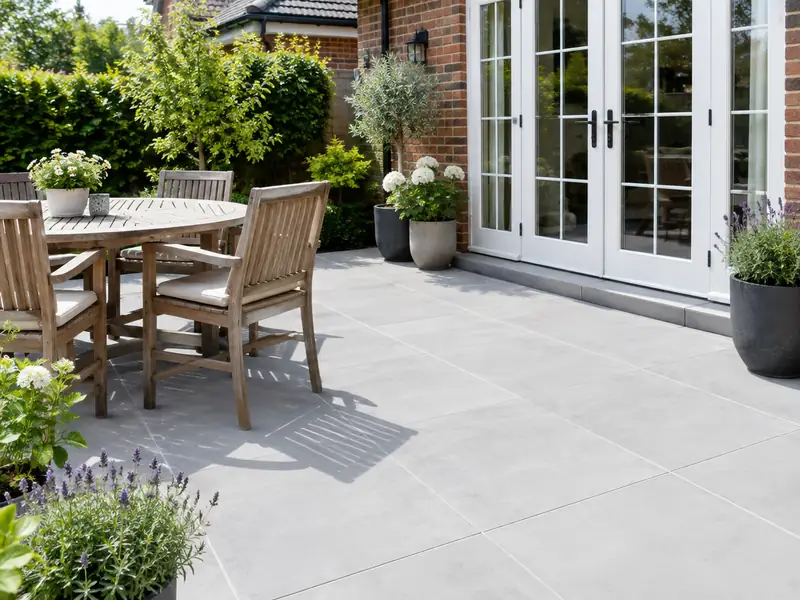
A patio is a paved outdoor area next to the house or in the garden, laid in porcelain, natural stone or concrete slabs on a compacted sub-base and mortar bed, with falls that direct rainwater away from the house.
Across Glasgow, people look into a new patio to replace something worn out, to make the house work better for them, or to get it ready for a sale. We cover Glasgow and the smaller towns around them, working to the rules that apply in Scotland. Expect a guide of £2,400–£5,300, VAT included, in Scotland, and every quote follows a free visit.
- Guide price
- £2,400–£5,300 inc VAT
- Time on site
- 3–7 days on site
- Planning rules
- Scotland
- Price level
- About 4% below the national guide
- Towns listed
- Whole area
- Survey
- Free, with a written quote
How much does a new patio cost in Glasgow?
The table below shows guide prices for a new patio in Glasgow. They are based on rates in Scotland, which run about 4% below the national guide, giving an overall range of £2,400–£5,300. All figures include VAT and are firmed up after a free site survey.
| Type of job | What it usually involves | Guide in Glasgow |
|---|---|---|
| Small patio or path | Around 10m² of concrete slabs or a garden path. | £950–£2,400 |
| Typical 20m² patio | Sandstone or porcelain on a full sub-base with jointing and edging. | £2,400–£5,300 |
| Large or multi-level patio | Bigger areas, steps, retaining walls or premium stone. | £5,300–£11,500 |
What moves the price up or down:
- Patio area and the amount of excavation
- Ground levels, slopes, steps and retaining walls
- Drainage needed to keep water away from the house
- Access for materials and removing spoil
What do you get?
- Survey of levels, damp-proof course, drainage and access
- Excavation and removal of turf, soil or old paving
- Compacted MOT Type 1 sub-base
- Slabs laid on a full mortar bed with falls away from the house
- Primer on porcelain slabs for a strong bond
- Site cleared, waste removed and paving cleaned
Housing across Glasgow
Glasgow is known for its blond and red sandstone tenements, built in large numbers in the late Victorian and Edwardian periods, alongside terraced and villa housing in the West End and Southside. Interwar cottage flats, large post-war housing schemes, high-rise blocks and newer developments make up much of the rest of the city.
Tenement flats commonly need window replacement and internal renovation, often with neighbours' agreement for shared parts. Villas and cottage flats suit kitchen and bathroom refits, loft conversions and extensions.
High rainfall and frequent wind-driven rain mean sandstone, pointing and roofs need regular care, especially on exposed elevations.
Planning and building rules in Glasgow
Because Glasgow falls under Scotland's rules, the guidance below is the version relevant to you. Before sending a price, we check your property's position with the council.
A ground-level patio does not usually need planning permission in Scotland; raised decking is limited in height under permitted development.
A building warrant is not normally needed for a patio.
Rules change and every property is different, so we check the planning history and constraints for your address before we quote.
The four stages
A visit to your home
It starts with a survey at the property, free of charge. We check condition, access and services, ask how you want the finished result to look, and answer any questions you have about a new patio.
Your fixed price
You get the price in writing, itemised so you can see where the money goes. As long as the specification stays the same, that is the price you pay for a new patio.
Dates and permissions
Next comes planning the work itself. We set a start date that suits you, line up the right trades, and make sure any approvals for a new patio are in place before the first day on site.
Finish and handover
On site, the agreed plan is followed and any change is put in writing first. At completion we do a final clean, go through the snagging list with you and leave you with the relevant documents.
How we work
Frequently asked questions
How long will a new patio take?
On a typical home, allow 3–7 days on site. Larger projects, older buildings and extra work found once things are opened up can extend that, while simpler jobs may be shorter. Your quote includes an estimate of time on site, and your point of contact keeps you updated on the programme as the work progresses.
Which postcodes in Glasgow do you cover?
We cover Glasgow, along with the rest of Glasgow. If your postcode is not listed, get in touch anyway: our coverage is UK-wide, and we can usually arrange a survey wherever you live. Enter your postcode in the guide-price tool or contact form and we will confirm.
Is porcelain or sandstone better for a patio?
Porcelain is dense, stain-resistant and stays looking clean with little care, making it a good choice if you want a modern, low-maintenance patio. Indian sandstone has natural colour variation and a softer, traditional look, and costs a little less, but it can stain and weather over time and benefits from sealing. Both make durable patios when properly laid. We bring samples to the survey.
How do you make sure water drains away from the house?
A patio needs a gentle fall, usually a little over 1 in 80, so rainwater runs away from the house towards the garden, a drain or a soakaway. The surface should also sit well below the damp-proof course. If the patio meets a door threshold, a channel drain may be needed. We set levels with string lines and check falls as we lay each section.
What happens if my garden slopes?
A sloping garden can still have a level patio by cutting into the slope, building up with retaining walls, or creating terraces with steps between them. Retaining walls must be built to hold back the soil and allow drainage behind them. This adds cost but creates usable, level space. We look at the slope during the survey and suggest the most practical design.