
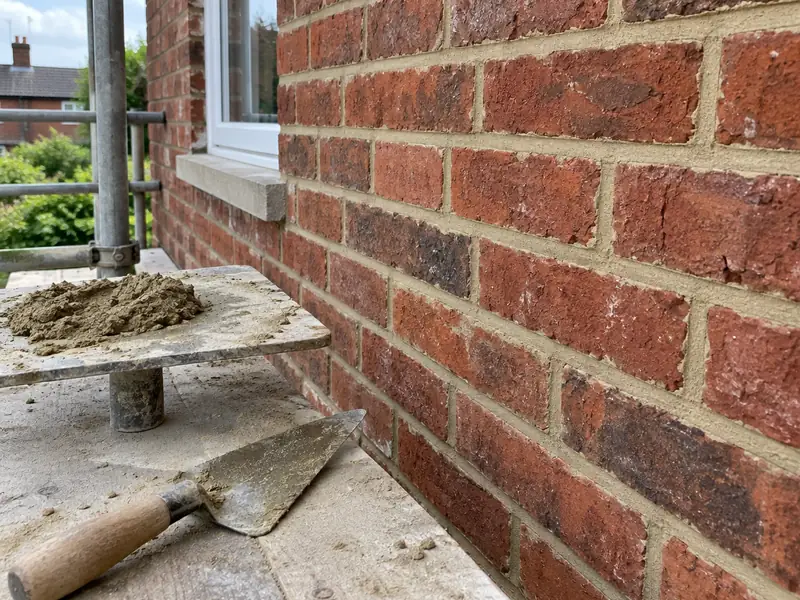
Repointing is raking out old, crumbling mortar from between bricks and replacing it with fresh mortar, sealing the joints against rain and protecting the wall; brickwork repairs replace spalled or cracked bricks and rebuild damaged sections.
Homeowners in Great Sankey usually consider brickwork and repointing for one of a few reasons: something has worn out, the house no longer suits the way they live, or they are getting it ready to sell. We visit, agree a specification and put a fixed price in writing. Most jobs like this take 3–10 days for a typical house, and we work across Cheshire, including Warrington, Newton-le-Willows and Widnes.
- Guide price
- £2,400–£5,700 inc VAT
- Time on site
- 3–10 days for a typical house
- Postcodes
- WA5
- Planning rules
- England
- Local area
- Warrington
- Survey
- Free, with a written quote
What should you budget for brickwork and repointing in Great Sankey?
The table below shows guide prices for brickwork and repointing in Great Sankey. They are based on rates in the North West, which run about 5% below the national guide, giving an overall range of £2,400–£5,700. All figures include VAT and are firmed up after a free site survey.
| Type of job | What it usually involves | Guide in Great Sankey |
|---|---|---|
| Chimney or small area | Repointing a chimney stack, gable or single wall, including access. | £550–£1,700 |
| Typical semi-detached | Repointing the main elevations of a 3-bed semi, including scaffolding. | £2,400–£5,700 |
| Detached or lime work | Larger houses, or period homes repointed in lime with brick repairs. | £4,800–£9,500 |
Expect these to shape the final quote:
- Wall area to repoint and the height of the house
- Mortar type: cement or lime, and joint style
- Number of bricks to replace and how well they match
- Scaffolding and access, including chimneys
What does the job include in Great Sankey?
- Scaffolding or access towers where needed
- Raking out old mortar to the correct depth
- Mortar mixed to suit the wall, in lime or cement
- Colour and joint style matched as closely as possible
- Replacement of spalled or cracked bricks
- Clean-down of brick faces after pointing
Building in Great Sankey
Chester mixes Georgian and Victorian terraces with black-and-white revival frontages, and red sandstone shows up across the west of the county. Crewe has railway-era brick terraces, Macclesfield has mill workers' cottages, and Wilmslow, Knutsford and Alderley Edge are known for large detached homes. Interwar semis and newer estates surround Warrington and Northwich.
Terraced and mill-era cottages often need repointing, roof work and loft space. Larger detached homes commonly take on kitchen extensions, bifold doors and garden landscaping, while interwar semis suit side extensions and replacement windows.
Building traditions across Cheshire also raise conservation and planning questions, so we check those for brickwork and repointing in Great Sankey at the survey stage.
Do you need permission in Great Sankey?
As Great Sankey is in England, read the following with that system of planning and building control in mind. We check what applies to your house with the council before you receive a quote.
Repointing and repairing brickwork with matching materials is maintenance, so it does not need planning permission in England. On a listed building, work that affects its character, including a change of mortar or brick, may need listed building consent.
Building Regulations do not normally apply to repointing or brick repairs, but rebuilding a wall, chimney or structural section can need building control involvement.
Rules change and every property is different, so we check the planning history and constraints for your address before we quote.
How does the job run?
Survey and measure
We begin by looking at the job in person. During the free survey we discuss options, materials and budget for brickwork and repointing, and photograph or measure anything the quote needs to reflect.
Quote in writing
We put everything into a written, fixed-price quote: the specification, what's excluded, staged payments and the expected time on site. Take whatever time you need to decide; there's no pressure to commit.
Booking the work
Once you accept, we agree start dates, order materials and deal with any planning, building control or neighbour notices the job needs. You'll know who is coming and when before work begins.
Build and hand over
The job proceeds in the order set out in the programme, with dust and debris kept under control. Finally we tidy away, inspect the work together and pass the finished project over to you with its paperwork.
What you can expect from us
Common questions
Should my house be repointed with lime or cement?
Houses built before about the 1920s were usually built with soft bricks and lime mortar, and should normally be repointed in lime. Hard cement mortar in these walls traps moisture and can cause the brick faces to crumble. Newer homes built with cement mortar are usually repointed in a similar mix. We check your wall construction before recommending a mortar.
Who do I deal with during the job?
One point of contact manages your project from survey to handover. They schedule the trades working under our contract, keep you updated on progress, and are the person to call with any question. You don't need to coordinate builders, electricians or decorators separately, because that is part of what we do.
Can I stay at home during the work?
In most cases, yes. Most people can live at home throughout, and we plan the work to keep disruption down by protecting floors, agreeing working hours and keeping access routes clear. Bigger jobs affecting kitchens, bathrooms or heating may mean a short spell with reduced facilities, and we talk this through with you at the survey.
Is repointing messy or noisy?
Raking out old mortar is noisy and dusty, especially when power tools are used on hard mortar. We sheet scaffolding to contain dust, keep windows closed nearby and clear up at the end of each day. The noisy phase moves around the house elevation by elevation. Inside, you may notice some dust on windowsills, so it helps to keep windows shut.
How do I know if my house needs repointing?
A house needs repointing when the mortar between bricks is crumbling, recessed well behind the brick face, cracked or missing. You may be able to scrape it out with a key. Damp patches inside, especially on exposed walls, and plants growing in joints are other signs. Patches of failed mortar can be repointed on their own, but widespread decay usually means a full elevation.
Nearby towns
Whether you're in the centre of Great Sankey or on its outskirts, WA5 addresses are covered. We extend the same service, and the same fixed-price approach, to Warrington, Newton-le-Willows and Widnes.