
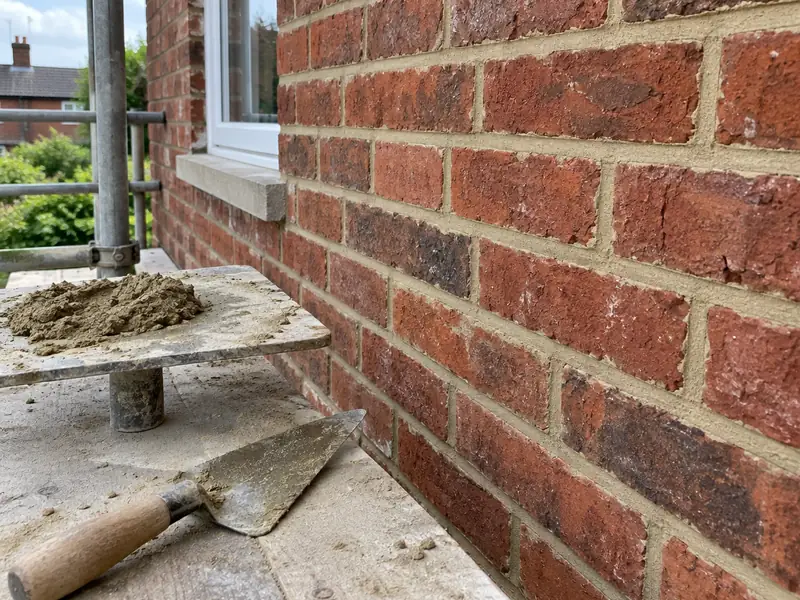
Repointing is raking out old, crumbling mortar from between bricks and replacing it with fresh mortar, sealing the joints against rain and protecting the wall; brickwork repairs replace spalled or cracked bricks and rebuild damaged sections.
Getting brickwork and repointing right in Consett starts with understanding the house you already have: its age, how it was built and what has been altered over the years. We survey first, then commit on paper to a price that holds as long as the scope stays the same. Across the North East, guide prices run at £2,200–£5,400 including VAT, and homes in Stanley, Newburn and Chester-le-Street are covered too.
- Guide price
- £2,200–£5,400 inc VAT
- Time on site
- 3–10 days for a typical house
- Postcodes
- DH8
- Planning rules
- England
- Local area
- County Durham
- Survey
- Free, with a written quote
How much does brickwork and repointing cost in Consett?
What will brickwork and repointing cost in Consett? Our guide range is £2,200–£5,400 including VAT. That figure is adjusted for the North East, about 10% below the national guide, and is intended for planning a budget. A firm written price for your chosen specification follows a free survey at your home.
| Type of job | What it usually involves | Guide in Consett |
|---|---|---|
| Chimney or small area | Repointing a chimney stack, gable or single wall, including access. | £550–£1,600 |
| Typical semi-detached | Repointing the main elevations of a 3-bed semi, including scaffolding. | £2,200–£5,400 |
| Detached or lime work | Larger houses, or period homes repointed in lime with brick repairs. | £4,500–£9,000 |
What moves the price up or down:
- Wall area to repoint and the height of the house
- Mortar type: cement or lime, and joint style
- Number of bricks to replace and how well they match
- Condition of the existing mortar and how hard it is to remove
What does the job include in Consett?
- Survey of mortar, bricks, cracks and the cause of any damp
- Scaffolding or access towers where needed
- Mortar mixed to suit the wall, in lime or cement
- Colour and joint style matched as closely as possible
- Replacement of spalled or cracked bricks
- Waste removal and a tidy site
Building in Consett
Colliery villages across County Durham are lined with brick and stone terraces, many built for mining families. Durham City has Georgian and Victorian streets, Darlington has Victorian terraces and villas, and Peterlee and Newton Aycliffe were planned as post-war new towns. Dales farmhouses in Weardale and Teesdale are stone, often under stone or slate roofs.
Colliery terraces commonly suit loft rooms, rear extensions and window replacement, and many need repointing. New-town homes often benefit from rendering or cladding upgrades and roofline renewal, while stone farmhouses may need lime work.
That mix of housing shapes how we approach brickwork and repointing in Consett: the age and construction of your home affect the materials, the method and, in the end, the price.
Do you need permission in Consett?
Which rules apply depends on where you live. For Consett, the answer is England, and the points below reflect that; we verify them with the council before quoting.
Repointing and repairing brickwork with matching materials is maintenance, so it does not need planning permission in England. On a listed building, work that affects its character, including a change of mortar or brick, may need listed building consent.
Building Regulations do not normally apply to repointing or brick repairs, but rebuilding a wall, chimney or structural section can need building control involvement.
Rules change and every property is different, so we check the planning history and constraints for your address before we quote.
From survey to handover
Survey and measure
We begin by looking at the job in person. During the free survey we discuss options, materials and budget for brickwork and repointing, and photograph or measure anything the quote needs to reflect.
Price and scope agreed
Next you receive a written quote with a fixed price for the agreed specification. It lists what is included, what is not, and how payments are staged, so you can compare it properly.
Getting ready
Before anyone starts, we confirm the programme in writing, check whether consents are required and arrange deliveries. If a skip or scaffolding on the road needs a permit, we apply for it.
On site to finish
The work is carried out to the agreed specification, with floors and furniture protected and the site kept tidy. At the end we clean up, walk through the finished job with you and hand over any certificates.
What you can expect from us
Questions about brickwork and repointing in Consett
Will repointing cure damp?
Repointing can stop damp caused by rain getting through failed mortar joints, which is common on exposed walls. It will not fix damp from leaking gutters, a bridged damp-proof course, condensation or high ground levels against the wall. We look for the cause during the survey and recommend fixing that, so repointing is not done for the wrong reason.
Is repointing messy or noisy?
Raking out old mortar is noisy and dusty, especially when power tools are used on hard mortar. We sheet scaffolding to contain dust, keep windows closed nearby and clear up at the end of each day. The noisy phase moves around the house elevation by elevation. Inside, you may notice some dust on windowsills, so it helps to keep windows shut.
Is the price fixed?
Yes, for the specification we agree. Your written quote sets out exactly what is included at a fixed price. It only changes if you ask for something different, or if a problem the survey could not reasonably reveal later needs extra work. In either case we explain the change and confirm it in writing before going ahead.
Can I stay at home during the work?
In most cases, yes. Most people can live at home throughout, and we plan the work to keep disruption down by protecting floors, agreeing working hours and keeping access routes clear. Bigger jobs affecting kitchens, bathrooms or heating may mean a short spell with reduced facilities, and we talk this through with you at the survey.
Should my house be repointed with lime or cement?
Houses built before about the 1920s were usually built with soft bricks and lime mortar, and should normally be repointed in lime. Hard cement mortar in these walls traps moisture and can cause the brick faces to crumble. Newer homes built with cement mortar are usually repointed in a similar mix. We check your wall construction before recommending a mortar.
Near Consett
Our coverage in Consett includes DH8. We also travel to Stanley, Newburn and Chester-le-Street, so neighbouring addresses are looked after on exactly the same terms as those in town.