
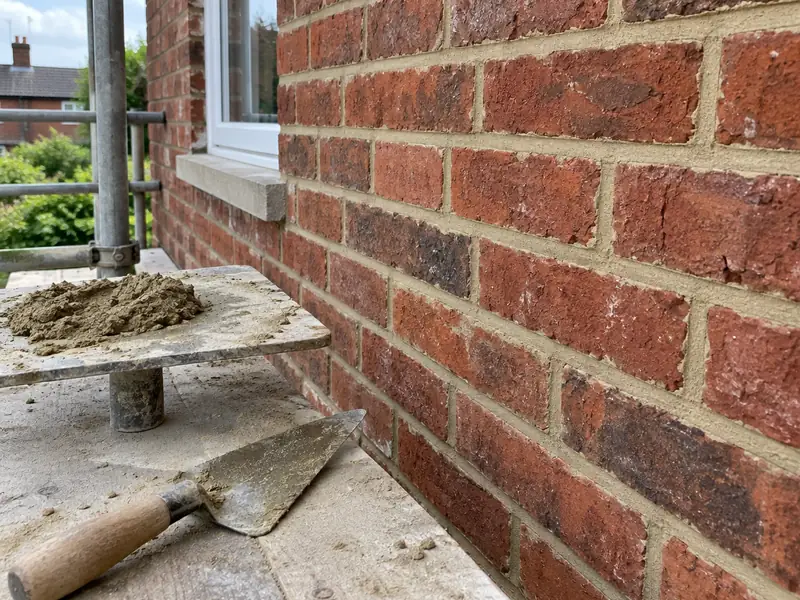
Repointing is raking out old, crumbling mortar from between bricks and replacing it with fresh mortar, sealing the joints against rain and protecting the wall; brickwork repairs replace spalled or cracked bricks and rebuild damaged sections.
Paignton sits within our coverage for brickwork and repointing, as do neighbouring Torquay, Newton Abbot and Exmouth. Before giving a price we want to see the property: the condition of what's there now, the access, and anything that might need extra work. The guide range for the South West is £2,600–£6,100 including VAT, and your written quote will spell out exactly what that covers.
- Guide price
- £2,600–£6,100 inc VAT
- Time on site
- 3–10 days for a typical house
- Postcodes
- TQ3 and TQ4
- Planning rules
- England
- Local area
- Torbay
- Survey
- Free, with a written quote
What should you budget for brickwork and repointing in Paignton?
The costs listed here are typical for brickwork and repointing around Paignton and include VAT. They reflect labour and material costs in the South West, about 2% above the national guide, giving a range of £2,600–£6,100. Exact pricing depends on your home, so we only fix it once a free site survey is done.
| Type of job | What it usually involves | Guide in Paignton |
|---|---|---|
| Chimney or small area | Repointing a chimney stack, gable or single wall, including access. | £600–£1,850 |
| Typical semi-detached | Repointing the main elevations of a 3-bed semi, including scaffolding. | £2,600–£6,100 |
| Detached or lime work | Larger houses, or period homes repointed in lime with brick repairs. | £5,100–£10,000 |
What moves the price up or down:
- Mortar type: cement or lime, and joint style
- Number of bricks to replace and how well they match
- Scaffolding and access, including chimneys
- Condition of the existing mortar and how hard it is to remove
What does the job include in Paignton?
- Survey of mortar, bricks, cracks and the cause of any damp
- Scaffolding or access towers where needed
- Colour and joint style matched as closely as possible
- Replacement of spalled or cracked bricks
- Clean-down of brick faces after pointing
- Waste removal and a tidy site
What are homes like around Paignton?
Devon is known for cob and thatch cottages, especially in mid and east Devon, alongside granite on Dartmoor and red sandstone around Exeter. Exeter and Plymouth have Georgian and Victorian terraces, Plymouth's centre was largely rebuilt after the war, and seaside towns such as Torquay and Exmouth have rendered villas and newer estates.
Mild but wet, with strong coastal winds; exposed elevations need render and pointing specified for driving rain, and cob walls must be kept dry at the base.
Knowing the typical building types in Devon helps, but a survey of your own home in Paignton is what decides the right approach to brickwork and repointing.
Planning and building rules in Paignton
Paignton is in England, so the planning and building rules set out below are the ones that apply. We confirm the details with the council before we quote.
Repointing and repairing brickwork with matching materials is maintenance, so it does not need planning permission in England. On a listed building, work that affects its character, including a change of mortar or brick, may need listed building consent.
Building Regulations do not normally apply to repointing or brick repairs, but rebuilding a wall, chimney or structural section can need building control involvement.
Rules change and every property is different, so we check the planning history and constraints for your address before we quote.
From survey to handover
A visit to your home
It starts with a survey at the property, free of charge. We check condition, access and services, ask how you want the finished result to look, and answer any questions you have about brickwork and repointing.
Your fixed price
After the survey we send a quote for brickwork and repointing that fixes the price for the scope we've agreed. If you want to change materials or scope, we revise it in writing before anything is booked.
Dates and permissions
Next comes planning the work itself. We set a start date that suits you, line up the right trades, and make sure any approvals for brickwork and repointing are in place before the first day on site.
On site to finish
During the work we protect the areas around it and tidy up at the end of each day. Once complete, we check the finish, remove our materials and hand over paperwork such as building control sign-off where it applies.
How we work
Common questions
How do I know if my house needs repointing?
A house needs repointing when the mortar between bricks is crumbling, recessed well behind the brick face, cracked or missing. You may be able to scrape it out with a key. Damp patches inside, especially on exposed walls, and plants growing in joints are other signs. Patches of failed mortar can be repointed on their own, but widespread decay usually means a full elevation.
Is repointing messy or noisy?
Raking out old mortar is noisy and dusty, especially when power tools are used on hard mortar. We sheet scaffolding to contain dust, keep windows closed nearby and clear up at the end of each day. The noisy phase moves around the house elevation by elevation. Inside, you may notice some dust on windowsills, so it helps to keep windows shut.
What happens at the survey?
We visit your home at a time that suits you, look at the area involved, take measurements and check access, condition and any services that might be affected. We talk through what you want from brickwork and repointing, explain the options and answer questions. There is no charge and no obligation; afterwards we send a written quote.
Can you combine brickwork and repointing with other work?
Yes. Because we manage several trades under one contract, we can plan brickwork and repointing alongside other work on your Paignton home, such as new windows with rendering, or a kitchen refit with an extension. Combining jobs can reduce repeat set-up such as scaffolding, skips and access, and every element is listed and priced in the same written quote.
Can you match the colour of my existing mortar?
Matching mortar colour is done by choosing the right sand and, where needed, adding pigment or using a coloured lime. We make test panels and let them dry, because mortar looks darker when wet. The joint style, such as flush, bucket handle or weatherstruck, also affects the look. An exact match is not always possible on old walls, but a careful match blends in well.
Nearby towns
If your address falls within TQ3 and TQ4, we cover it. The same goes for neighbouring Torquay, Newton Abbot and Exmouth, which we include alongside Paignton when arranging surveys and quotes.