
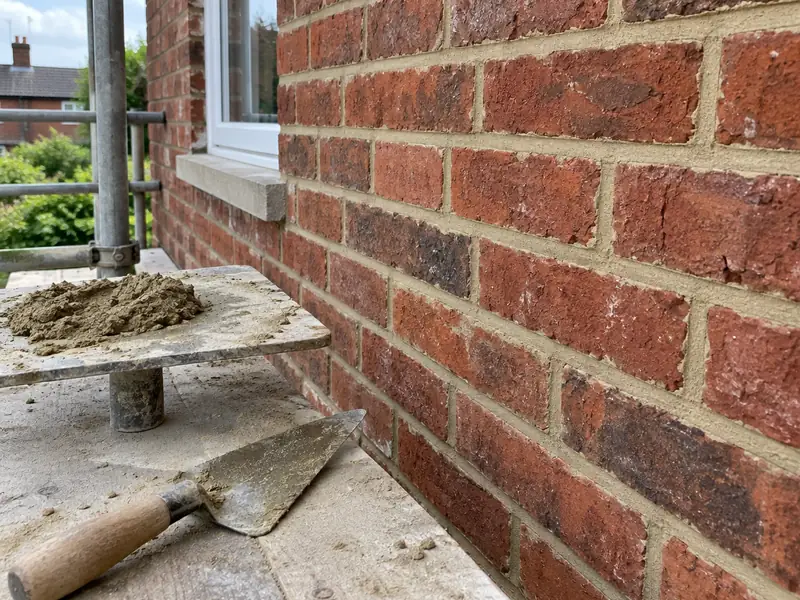
Repointing is raking out old, crumbling mortar from between bricks and replacing it with fresh mortar, sealing the joints against rain and protecting the wall; brickwork repairs replace spalled or cracked bricks and rebuild damaged sections.
Addresses across KT1, KT2, KT3 and KT5 fall within our coverage for brickwork and repointing, so if your home is in Surbiton we can arrange a survey on a day that works for you. We inspect the existing building, discuss materials and layout, and then price the agreed specification in writing. Expect a guide range of £3,200–£7,800 including VAT before that visit.
- Guide price
- £3,200–£7,800 inc VAT
- Time on site
- 3–10 days for a typical house
- Postcodes
- KT1, KT2, KT3, KT5 and KT6
- Planning rules
- England
- Local area
- Greater London
- Survey
- Free, with a written quote
How much does brickwork and repointing cost in Surbiton?
The table below shows guide prices for brickwork and repointing in Surbiton. They are based on rates in London, which run about 30% above the national guide, giving an overall range of £3,200–£7,800. All figures include VAT and are firmed up after a free site survey.
| Type of job | What it usually involves | Guide in Surbiton |
|---|---|---|
| Chimney or small area | Repointing a chimney stack, gable or single wall, including access. | £800–£2,300 |
| Typical semi-detached | Repointing the main elevations of a 3-bed semi, including scaffolding. | £3,200–£7,800 |
| Detached or lime work | Larger houses, or period homes repointed in lime with brick repairs. | £6,500–£13,000 |
What moves the price up or down:
- Wall area to repoint and the height of the house
- Number of bricks to replace and how well they match
- Scaffolding and access, including chimneys
- Condition of the existing mortar and how hard it is to remove
What does the job include in Surbiton?
- Scaffolding or access towers where needed
- Raking out old mortar to the correct depth
- Colour and joint style matched as closely as possible
- Replacement of spalled or cracked bricks
- Clean-down of brick faces after pointing
- Waste removal and a tidy site
Homes in London
London's housing is dominated by Victorian and Edwardian terraces, often in yellow London stock brick, with Georgian terraces in central districts and mansion blocks across many inner areas. Outer boroughs have large belts of interwar semis, and there are extensive post-war council estates. Many houses have been split into flats, and conservation areas are widespread.
Terraces suit side-return extensions and rear dormer loft conversions; interwar semis commonly take hip-to-gable lofts. Shared party walls, restricted parking and conservation rules often shape the plans and the programme.
So when we survey a Surbiton property for brickwork and repointing, the first step is working out how it was built and what has been changed since.
Permissions for brickwork and repointing in Surbiton
Each UK nation sets its own consent rules, and Surbiton is in England. What follows is a plain summary; we check the specifics for your property with the council before pricing anything.
Repointing and repairing brickwork with matching materials is maintenance, so it does not need planning permission in England. On a listed building, work that affects its character, including a change of mortar or brick, may need listed building consent.
Building Regulations do not normally apply to repointing or brick repairs, but rebuilding a wall, chimney or structural section can need building control involvement.
Rules change and every property is different, so we check the planning history and constraints for your address before we quote.
The four stages
A visit to your home
Book a visit and we'll come to you. The survey covers measurements, the state of what's there now and any obvious constraints, so the price that follows is based on your actual home, not an average.
Written quote
You get the price in writing, itemised so you can see where the money goes. As long as the specification stays the same, that is the price you pay for brickwork and repointing.
Plan and prepare
We handle the paperwork side: checking whether planning permission or building control approval is needed, submitting applications where they are, and scheduling the trades and materials around your dates.
Finish and handover
On site, the agreed plan is followed and any change is put in writing first. At completion we do a final clean, go through the snagging list with you and leave you with the relevant documents.
Why homeowners choose us
Frequently asked questions
Can you combine brickwork and repointing with other work?
Yes. Because we manage several trades under one contract, we can plan brickwork and repointing alongside other work on your Surbiton home, such as new windows with rendering, or a kitchen refit with an extension. Combining jobs can reduce repeat set-up such as scaffolding, skips and access, and every element is listed and priced in the same written quote.
Who do I deal with during the job?
One point of contact manages your project from survey to handover. They schedule the trades working under our contract, keep you updated on progress, and are the person to call with any question. You don't need to coordinate builders, electricians or decorators separately, because that is part of what we do.
What causes bricks to crumble?
Bricks usually crumble, or spall, when water gets into them and turns to ice, pushing the face off. This is often caused by hard cement mortar or impermeable paint trapping moisture in soft bricks, or by leaking gutters soaking the wall. Damaged bricks can be cut out and replaced with matching ones, or turned round if the back face is sound. We fix the cause at the same time.
Should my house be repointed with lime or cement?
Houses built before about the 1920s were usually built with soft bricks and lime mortar, and should normally be repointed in lime. Hard cement mortar in these walls traps moisture and can cause the brick faces to crumble. Newer homes built with cement mortar are usually repointed in a similar mix. We check your wall construction before recommending a mortar.
How do I know if my house needs repointing?
A house needs repointing when the mortar between bricks is crumbling, recessed well behind the brick face, cracked or missing. You may be able to scrape it out with a key. Damp patches inside, especially on exposed walls, and plants growing in joints are other signs. Patches of failed mortar can be repointed on their own, but widespread decay usually means a full elevation.
Near Surbiton
If your address falls within KT1, KT2, KT3 and KT5, we cover it. The same goes for neighbouring Hook, New Malden and Chessington, which we include alongside Surbiton when arranging surveys and quotes.