
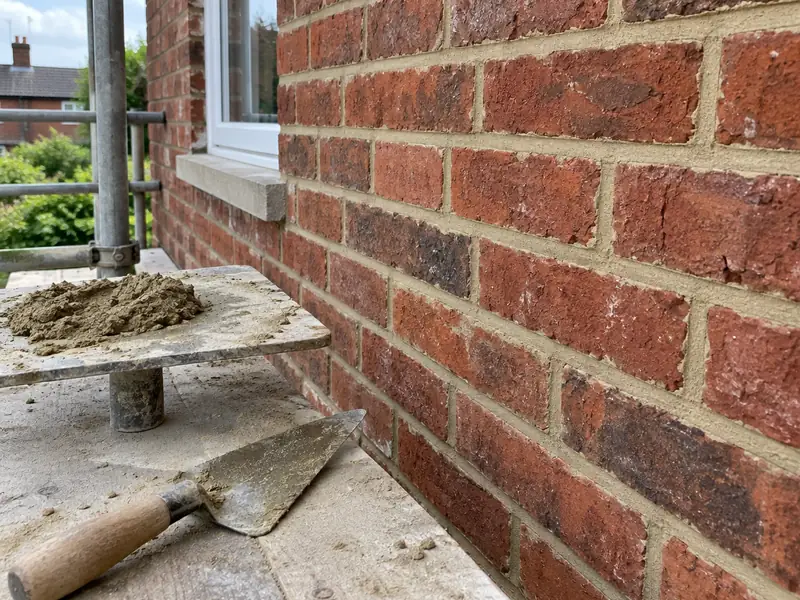
Repointing is raking out old, crumbling mortar from between bricks and replacing it with fresh mortar, sealing the joints against rain and protecting the wall; brickwork repairs replace spalled or cracked bricks and rebuild damaged sections.
Every house in Rhondda is a little different, so we never price brickwork and repointing from a brochure. We look at the structure, access and existing finishes first, then put in writing a fixed figure for the scope we settle on. As a rough steer, homeowners in Wales should budget £2,300–£5,500 including VAT, with work typically taking 3–10 days for a typical house.
- Guide price
- £2,300–£5,500 inc VAT
- Time on site
- 3–10 days for a typical house
- Postcodes
- CF41 and CF43
- Planning rules
- Wales
- Local area
- Rhondda Cynon Taff
- Survey
- Free, with a written quote
Brickwork and repointing prices in Rhondda
The table below shows guide prices for brickwork and repointing in Rhondda. They are based on rates in Wales, which run about 8% below the national guide, giving an overall range of £2,300–£5,500. All figures include VAT and are firmed up after a free site survey.
| Type of job | What it usually involves | Guide in Rhondda |
|---|---|---|
| Chimney or small area | Repointing a chimney stack, gable or single wall, including access. | £550–£1,650 |
| Typical semi-detached | Repointing the main elevations of a 3-bed semi, including scaffolding. | £2,300–£5,500 |
| Detached or lime work | Larger houses, or period homes repointed in lime with brick repairs. | £4,600–£9,200 |
Expect these to shape the final quote:
- Wall area to repoint and the height of the house
- Number of bricks to replace and how well they match
- Scaffolding and access, including chimneys
- Condition of the existing mortar and how hard it is to remove
Scope of the work
- Survey of mortar, bricks, cracks and the cause of any damp
- Raking out old mortar to the correct depth
- Colour and joint style matched as closely as possible
- Replacement of spalled or cracked bricks
- Clean-down of brick faces after pointing
- Waste removal and a tidy site
Homes in Mid Glamorgan
The Rhondda, Cynon and Merthyr valleys are lined with stone terraces built for mining families, stepped along steep hillsides. Pontypridd, Caerphilly and Merthyr Tydfil have Victorian centres, and Bridgend has grown with large modern estates alongside interwar and post-war housing.
Valley terraces commonly need repointing, roof repairs, rendering and window replacement, and loft conversions can add useful space. Newer estate homes often take garage conversions, porches and landscaping.
So when we survey a Rhondda property for brickwork and repointing, the first step is working out how it was built and what has been changed since.
Permissions for brickwork and repointing in Rhondda
For anyone in Rhondda, the relevant framework is Wales's. The summary below is general, so we always contact the council about your address before putting a price in writing.
In Wales, repointing and like-for-like brick repairs are maintenance and do not need planning permission; listed buildings may need consent for changes in materials.
Building Regulations do not normally apply to repointing, though structural rebuilding can.
Rules change and every property is different, so we check the planning history and constraints for your address before we quote.
What happens after you get in touch?
Survey and measure
We arrange a free site survey on a date convenient to you. We measure up, look at the existing structure and access, and discuss your plans for brickwork and repointing so the price reflects your home.
Written quote
We turn the survey notes into a written quote. The price is fixed for the specification we agree, and the document sets out materials, scope and payment stages in plain language.
Getting ready
Preparation matters as much as the build. We agree access, parking and working hours with you, order materials in good time, and confirm any permissions so the job isn't held up once it starts.
Finish and handover
Our trades complete brickwork and repointing while your point of contact keeps you updated. When everything is finished, we clear the site, take away waste and go through the result with you before handover.
Working with SK Home Improvements
Brickwork and repointing in Rhondda: questions
What causes bricks to crumble?
Bricks usually crumble, or spall, when water gets into them and turns to ice, pushing the face off. This is often caused by hard cement mortar or impermeable paint trapping moisture in soft bricks, or by leaking gutters soaking the wall. Damaged bricks can be cut out and replaced with matching ones, or turned round if the back face is sound. We fix the cause at the same time.
Can you match the colour of my existing mortar?
Matching mortar colour is done by choosing the right sand and, where needed, adding pigment or using a coloured lime. We make test panels and let them dry, because mortar looks darker when wet. The joint style, such as flush, bucket handle or weatherstruck, also affects the look. An exact match is not always possible on old walls, but a careful match blends in well.
Is the price fixed?
Yes, for the specification we agree. Your written quote sets out exactly what is included at a fixed price. It only changes if you ask for something different, or if a problem the survey could not reasonably reveal later needs extra work. In either case we explain the change and confirm it in writing before going ahead.
Who do I deal with during the job?
One point of contact manages your project from survey to handover. They schedule the trades working under our contract, keep you updated on progress, and are the person to call with any question. You don't need to coordinate builders, electricians or decorators separately, because that is part of what we do.
Should my house be repointed with lime or cement?
Houses built before about the 1920s were usually built with soft bricks and lime mortar, and should normally be repointed in lime. Hard cement mortar in these walls traps moisture and can cause the brick faces to crumble. Newer homes built with cement mortar are usually repointed in a similar mix. We check your wall construction before recommending a mortar.
Also covering areas around Rhondda
We cover every part of Rhondda, including CF41 and CF43, and nearby Tonypandy, Aberdare and Pontypridd. Wherever you are within that patch, the survey is free and the quote comes to you in writing.