
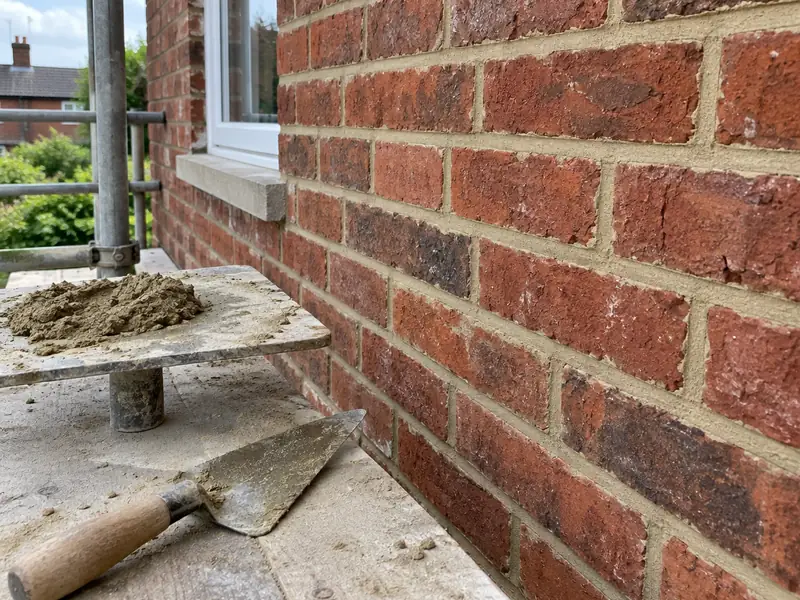
Repointing is raking out old, crumbling mortar from between bricks and replacing it with fresh mortar, sealing the joints against rain and protecting the wall; brickwork repairs replace spalled or cracked bricks and rebuild damaged sections.
We arrange brickwork and repointing for homeowners in Wellington and the wider Shropshire. The job is planned, priced and managed by us and carried out by tradespeople engaged under our contract, so there is one agreement and one contact. On a typical home the work takes 3–10 days for a typical house, and guide pricing in the West Midlands is £2,400–£5,900, VAT included.
- Guide price
- £2,400–£5,900 inc VAT
- Time on site
- 3–10 days for a typical house
- Postcodes
- TF1 and TF5
- Planning rules
- England
- Local area
- Telford and Wrekin
- Survey
- Free, with a written quote
How much does brickwork and repointing cost in Wellington?
Below is a breakdown of typical costs for brickwork and repointing in Wellington. Because rates in the West Midlands are about 2% below the national guide, the overall guide comes to £2,400–£5,900, including VAT. Size, materials and access move the figure, and a free-of-charge survey settles it.
| Type of job | What it usually involves | Guide in Wellington |
|---|---|---|
| Chimney or small area | Repointing a chimney stack, gable or single wall, including access. | £600–£1,750 |
| Typical semi-detached | Repointing the main elevations of a 3-bed semi, including scaffolding. | £2,400–£5,900 |
| Detached or lime work | Larger houses, or period homes repointed in lime with brick repairs. | £4,900–£9,800 |
Your price depends mostly on:
- Wall area to repoint and the height of the house
- Number of bricks to replace and how well they match
- Scaffolding and access, including chimneys
- Condition of the existing mortar and how hard it is to remove
What does the job include in Wellington?
- Survey of mortar, bricks, cracks and the cause of any damp
- Scaffolding or access towers where needed
- Raking out old mortar to the correct depth
- Mortar mixed to suit the wall, in lime or cement
- Clean-down of brick faces after pointing
- Waste removal and a tidy site
Homes in Shropshire
Shrewsbury and Ludlow are known for black-and-white timber-framed buildings alongside Georgian brick, and red sandstone is common in the north of the county. Telford was built as a new town from the late 1960s with large planned estates, and market towns such as Oswestry, Bridgnorth and Whitchurch mix historic centres with interwar and newer housing.
Timber-framed and stone buildings often need lime plaster, breathable finishes and roof repairs. Telford homes commonly suit extensions, window replacement and roofline or cladding renewal.
With that background in mind, here is how we typically handle brickwork and repointing for homes in Wellington, from the first visit to the finished result.
Planning and building rules in Wellington
Which rules apply depends on where you live. For Wellington, the answer is England, and the points below reflect that; we verify them with the council before quoting.
Repointing and repairing brickwork with matching materials is maintenance, so it does not need planning permission in England. On a listed building, work that affects its character, including a change of mortar or brick, may need listed building consent.
Building Regulations do not normally apply to repointing or brick repairs, but rebuilding a wall, chimney or structural section can need building control involvement.
Rules change and every property is different, so we check the planning history and constraints for your address before we quote.
The four stages
We look at the job
We begin by looking at the job in person. During the free survey we discuss options, materials and budget for brickwork and repointing, and photograph or measure anything the quote needs to reflect.
Quote in writing
After the survey we send a quote for brickwork and repointing that fixes the price for the scope we've agreed. If you want to change materials or scope, we revise it in writing before anything is booked.
Dates and permissions
With the quote agreed, we book the work in and handle preparation: permissions where needed, building control notifications, material orders and access arrangements for your Wellington property.
Build and hand over
The job proceeds in the order set out in the programme, with dust and debris kept under control. Finally we tidy away, inspect the work together and pass the finished project over to you with its paperwork.
Working with SK Home Improvements
Common questions
Is the price fixed?
Yes, for the specification we agree. Your written quote sets out exactly what is included at a fixed price. It only changes if you ask for something different, or if a problem the survey could not reasonably reveal later needs extra work. In either case we explain the change and confirm it in writing before going ahead.
Should my house be repointed with lime or cement?
Houses built before about the 1920s were usually built with soft bricks and lime mortar, and should normally be repointed in lime. Hard cement mortar in these walls traps moisture and can cause the brick faces to crumble. Newer homes built with cement mortar are usually repointed in a similar mix. We check your wall construction before recommending a mortar.
Will repointing cure damp?
Repointing can stop damp caused by rain getting through failed mortar joints, which is common on exposed walls. It will not fix damp from leaking gutters, a bridged damp-proof course, condensation or high ground levels against the wall. We look for the cause during the survey and recommend fixing that, so repointing is not done for the wrong reason.
What happens at the survey?
We visit your home at a time that suits you, look at the area involved, take measurements and check access, condition and any services that might be affected. We talk through what you want from brickwork and repointing, explain the options and answer questions. There is no charge and no obligation; afterwards we send a written quote.
Is repointing messy or noisy?
Raking out old mortar is noisy and dusty, especially when power tools are used on hard mortar. We sheet scaffolding to contain dust, keep windows closed nearby and clear up at the end of each day. The noisy phase moves around the house elevation by elevation. Inside, you may notice some dust on windowsills, so it helps to keep windows shut.
Also covering areas around Wellington
Live in Wellington? Our coverage takes in the TF1 and TF5 postcode areas and reaches out to Telford, Shrewsbury and Stafford, so homes on the outskirts and in the next town along are included.