
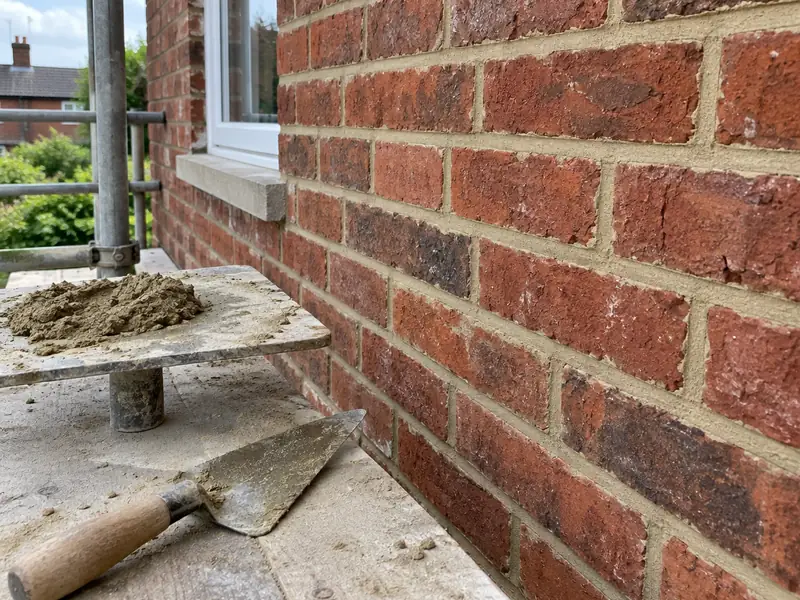
Repointing is raking out old, crumbling mortar from between bricks and replacing it with fresh mortar, sealing the joints against rain and protecting the wall; brickwork repairs replace spalled or cracked bricks and rebuild damaged sections.
Planning brickwork and repointing for a home in Banstead means making a handful of decisions about materials, layout, finish and timing. We help you work through them at a free survey, then confirm in writing what it will cost for the options you pick. Most projects of this type need 3–10 days for a typical house, and we cover every KT17, KT18, SM2 and SM7 address as well as the rest of Surrey.
- Guide price
- £2,800–£6,700 inc VAT
- Time on site
- 3–10 days for a typical house
- Postcodes
- KT17, KT18, SM2 and SM7
- Planning rules
- England
- Local area
- Surrey
- Survey
- Free, with a written quote
What should you budget for brickwork and repointing in Banstead?
Prices for brickwork and repointing vary from house to house, but in Banstead most projects fall within £2,800–£6,700 including VAT. That reflects costs in the South East, about 12% above the national guide. Treat the table as a budgeting aid; the written figure follows a survey we carry out for free.
| Type of job | What it usually involves | Guide in Banstead |
|---|---|---|
| Chimney or small area | Repointing a chimney stack, gable or single wall, including access. | £650–£2,000 |
| Typical semi-detached | Repointing the main elevations of a 3-bed semi, including scaffolding. | £2,800–£6,700 |
| Detached or lime work | Larger houses, or period homes repointed in lime with brick repairs. | £5,600–£11,000 |
The main things that change the figure:
- Wall area to repoint and the height of the house
- Mortar type: cement or lime, and joint style
- Scaffolding and access, including chimneys
- Condition of the existing mortar and how hard it is to remove
Scope of the work
- Survey of mortar, bricks, cracks and the cause of any damp
- Raking out old mortar to the correct depth
- Mortar mixed to suit the wall, in lime or cement
- Colour and joint style matched as closely as possible
- Clean-down of brick faces after pointing
- Waste removal and a tidy site
Homes in Surrey
Surrey has many Victorian and Edwardian villas, interwar semis in the commuter towns near London, and Arts and Crafts houses with tile-hanging and tall chimneys. Bargate stone appears around Godalming, and large detached homes are common in Guildford, Woking, Weybridge and the Surrey Hills villages.
Mild and relatively dry, with clay soils in the north and Weald that can move in summer; mature trees near houses affect foundations.
Building traditions across Surrey also raise conservation and planning questions, so we check those for brickwork and repointing in Banstead at the survey stage.
Planning and building rules in Banstead
The notes below cover England, which is where Banstead sits. Rules change and every property is different, so we speak to the council before pricing your job.
Repointing and repairing brickwork with matching materials is maintenance, so it does not need planning permission in England. On a listed building, work that affects its character, including a change of mortar or brick, may need listed building consent.
Building Regulations do not normally apply to repointing or brick repairs, but rebuilding a wall, chimney or structural section can need building control involvement.
Rules change and every property is different, so we check the planning history and constraints for your address before we quote.
From survey to handover
Free site survey
It starts with a survey at the property, free of charge. We check condition, access and services, ask how you want the finished result to look, and answer any questions you have about brickwork and repointing.
Quote in writing
We put everything into a written, fixed-price quote: the specification, what's excluded, staged payments and the expected time on site. Take whatever time you need to decide; there's no pressure to commit.
Booking the work
Before anyone starts, we confirm the programme in writing, check whether consents are required and arrange deliveries. If a skip or scaffolding on the road needs a permit, we apply for it.
Build and hand over
During the work we protect the areas around it and tidy up at the end of each day. Once complete, we check the finish, remove our materials and hand over paperwork such as building control sign-off where it applies.
Working with SK Home Improvements
Frequently asked questions
Can you combine brickwork and repointing with other work?
Yes. Because we manage several trades under one contract, we can plan brickwork and repointing alongside other work on your Banstead home, such as new windows with rendering, or a kitchen refit with an extension. Combining jobs can reduce repeat set-up such as scaffolding, skips and access, and every element is listed and priced in the same written quote.
How long will brickwork and repointing take?
On a typical home, allow 3–10 days for a typical house. Larger projects, older buildings and extra work found once things are opened up can extend that, while simpler jobs may be shorter. Your quote includes an estimate of time on site, and your point of contact keeps you updated on the programme as the work progresses.
Will repointing cure damp?
Repointing can stop damp caused by rain getting through failed mortar joints, which is common on exposed walls. It will not fix damp from leaking gutters, a bridged damp-proof course, condensation or high ground levels against the wall. We look for the cause during the survey and recommend fixing that, so repointing is not done for the wrong reason.
How do I know if my house needs repointing?
A house needs repointing when the mortar between bricks is crumbling, recessed well behind the brick face, cracked or missing. You may be able to scrape it out with a key. Damp patches inside, especially on exposed walls, and plants growing in joints are other signs. Patches of failed mortar can be repointed on their own, but widespread decay usually means a full elevation.
Should my house be repointed with lime or cement?
Houses built before about the 1920s were usually built with soft bricks and lime mortar, and should normally be repointed in lime. Hard cement mortar in these walls traps moisture and can cause the brick faces to crumble. Newer homes built with cement mortar are usually repointed in a similar mix. We check your wall construction before recommending a mortar.
Nearby towns
Homes across KT17, KT18, SM2 and SM7 in Banstead are within our coverage, as are those in Sutton, Ewell and Epsom. If you are just outside these areas, ask anyway, because we work right across the UK.