
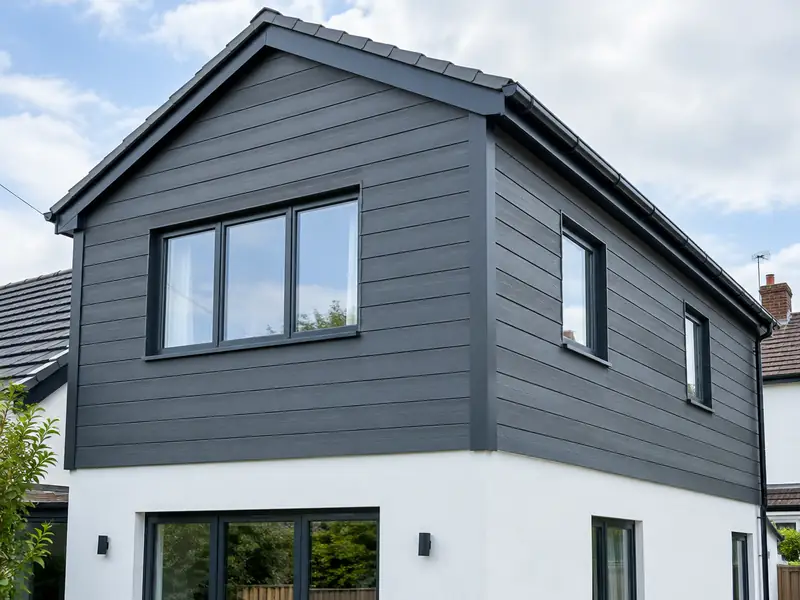
Cladding is a protective outer layer of boards or panels, such as timber, composite, fibre cement or uPVC, fixed to battens on the outside of a wall to change its appearance, shed rain and, where insulation is added, reduce heat loss.
We take on cladding throughout Inverurie and the surrounding AB51 postcodes, as well as in Aberdeen, Nigg and Peterhead. The guide range for this work in Scotland is £4,800–£11,500 including VAT; where your project falls depends on its size, the materials you pick and how easy the site is to reach. A free survey turns that range into a fixed figure.
- Guide price
- £4,800–£11,500 inc VAT
- Time on site
- 3 days to 3 weeks depending on area
- Postcodes
- AB51
- Planning rules
- Scotland
- Local area
- Aberdeenshire
- Survey
- Free, with a written quote
How much does cladding cost in Inverurie?
Every figure below is a guide for cladding in Inverurie, inclusive of VAT. Regional pricing for Scotland works out about 4% below the national guide, and the overall span is £4,800–£11,500. The survey costs you nothing, and after it we commit to a firm price for your specification in writing.
| Type of job | What it usually involves | Guide in Inverurie |
|---|---|---|
| Feature area or dormer | A gable, dormer, bay or small feature wall in uPVC, timber or composite. | £1,450–£4,800 |
| Extension or upper storey | About 40–60m² of timber, composite or fibre cement with membrane and battens. | £4,800–£11,500 |
| Whole house | Cladding most elevations of a house, often with added insulation. | £11,500–£29,000 |
What moves the price up or down:
- Wall area to be clad and the height of the building
- Cladding material and board profile
- Insulation behind the cladding
- Window reveals, corners and roof junctions to detail
What does the job include in Inverurie?
- Scaffolding or access towers as needed
- Breather membrane and treated battens fixed to the wall
- Insulation behind the cladding where agreed
- Cavity barriers and fire-stopping where regulations require
- Corner trims, window reveals and ventilated top and bottom edges
- Waste removal and a clean site on completion
Local housing and cladding
Aberdeen is built largely of grey granite, from tenements and terraces to granite villas in the West End, with post-war council housing and newer estates on the outskirts. Across Aberdeenshire, harled stone cottages, fishing-town terraces in Peterhead and Fraserburgh, and modern developments in commuter towns such as Westhill and Ellon are common.
Granite walls need repointing with a mortar matched to the stone, and slate roofs often want attention after hard winters. Harled cottages need breathable finishes, while newer estates commonly add extensions, garage conversions and driveways.
If your house in Inverurie fits one of these patterns, it helps us anticipate what cladding will involve, though we always confirm the details on site.
Planning and building rules in Inverurie
Which rules apply depends on where you live. For Inverurie, the answer is Scotland, and the points below reflect that; we verify them with the council before quoting.
In Scotland, changing the external finish of a house in a conservation area or on a listed building needs consent; elsewhere, like-for-like re-rendering is usually treated as repair.
Large-scale re-cladding or external insulation can need a building warrant; like-for-like render repairs normally do not.
Rules change and every property is different, so we check the planning history and constraints for your address before we quote.
From survey to handover
Free site survey
First, someone visits your home in Inverurie to see the space, take measurements and note anything that could affect the work, such as access or the condition of what is there. There is no charge for this visit.
Written quote
After the survey we send a quote for cladding that fixes the price for the scope we've agreed. If you want to change materials or scope, we revise it in writing before anything is booked.
Booking the work
Before anyone starts, we confirm the programme in writing, check whether consents are required and arrange deliveries. If a skip or scaffolding on the road needs a permit, we apply for it.
Finish and handover
Our trades complete cladding while your point of contact keeps you updated. When everything is finished, we clear the site, take away waste and go through the result with you before handover.
How we work
Frequently asked questions
Can cladding improve insulation?
Cladding can improve insulation if insulation boards are fixed to the wall behind the battens, which reduces heat loss and can help with cold or damp internal walls. This adds thickness, so window reveals, sills and roof edges need careful detailing. Cladding alone, without insulation, adds very little warmth. We can price both options so you can compare.
Do I need planning permission to clad my house?
Whether cladding needs planning permission depends on the material and how it changes the look of the house, your home's location, whether it is listed or in a conservation area, and which UK nation you live in. In England, cladding is generally permitted development only if the materials look similar to the existing house, and it is not permitted development in conservation areas. We check before quoting.
Do I need planning permission in Inverurie?
It depends on the work, the size of the project, your property type and whether the building is listed or in a conservation area. Inverurie is in Scotland, so Scotland's rules apply. Many smaller jobs need no planning application, but some still need building control approval. We check what applies to your address before quoting.
What happens at the survey?
We visit your home at a time that suits you, look at the area involved, take measurements and check access, condition and any services that might be affected. We talk through what you want from cladding, explain the options and answer questions. There is no charge and no obligation; afterwards we send a written quote.
Which cladding material needs the least maintenance?
Fibre cement, composite and uPVC cladding need the least upkeep, usually just an occasional wash. Thermally modified and hardwood timber can be left to weather naturally to a silver-grey, which needs no treatment, but keeping the original colour means re-staining every few years. Painted timber needs repainting regularly. We explain the long-term care of each option.
Near Inverurie
Coverage for Inverurie spans AB51. Close by, Aberdeen, Nigg and Peterhead are covered too, and the rest of our UK-wide area follows the same survey-then-quote process from start to finish.