
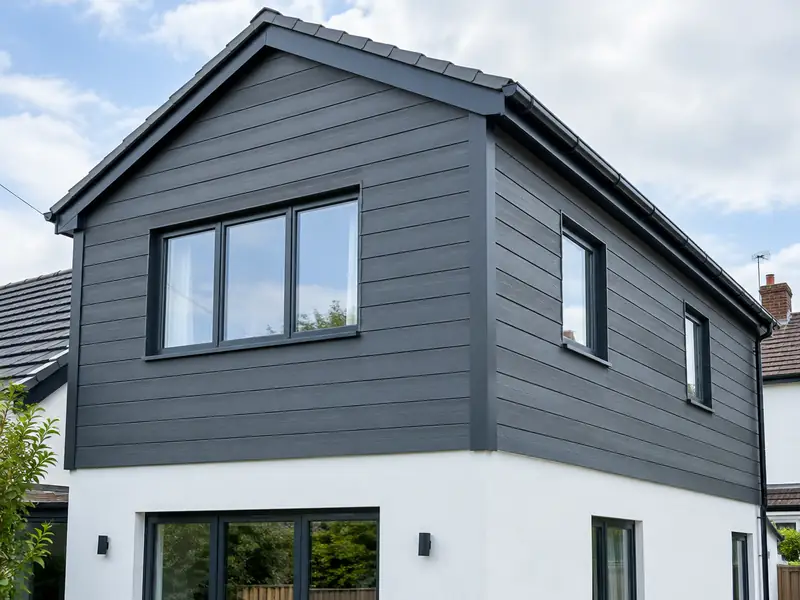
Cladding is a protective outer layer of boards or panels, such as timber, composite, fibre cement or uPVC, fixed to battens on the outside of a wall to change its appearance, shed rain and, where insulation is added, reduce heat loss.
For a homeowner in Newbury, planning cladding tends to begin with two questions: what will it cost, and how disruptive will it be? Our guide range is £5,600–£13,500 including VAT, and a typical job runs to 3 days to 3 weeks depending on area. Both numbers firm up once we have seen the property, measured up and agreed exactly what is included.
- Guide price
- £5,600–£13,500 inc VAT
- Time on site
- 3 days to 3 weeks depending on area
- Postcodes
- RG14 and RG20
- Planning rules
- England
- Local area
- West Berkshire
- Survey
- Free, with a written quote
What should you budget for cladding in Newbury?
Use the table to gauge the cost of cladding in Newbury before we visit. Figures include VAT and are scaled for the South East, coming out about 12% above the national guide, which gives £5,600–£13,500 overall. After a free survey, you receive a fixed written price.
| Type of job | What it usually involves | Guide in Newbury |
|---|---|---|
| Feature area or dormer | A gable, dormer, bay or small feature wall in uPVC, timber or composite. | £1,700–£5,600 |
| Extension or upper storey | About 40–60m² of timber, composite or fibre cement with membrane and battens. | £5,600–£13,500 |
| Whole house | Cladding most elevations of a house, often with added insulation. | £13,500–£33,500 |
Expect these to shape the final quote:
- Wall area to be clad and the height of the building
- Cladding material and board profile
- Insulation behind the cladding
- Window reveals, corners and roof junctions to detail
What does the job include in Newbury?
- Survey of the wall, boundaries, damp and window details
- Breather membrane and treated battens fixed to the wall
- Insulation behind the cladding where agreed
- Cladding boards fixed with suitable stainless or coated fixings
- Corner trims, window reveals and ventilated top and bottom edges
- Waste removal and a clean site on completion
Local housing and cladding
Reading's Victorian terraces often show the town's patterned red and silver-grey brickwork, while Windsor, Maidenhead and Newbury mix Georgian, Victorian and Edwardian houses. Bracknell grew as a post-war new town with planned estates, Slough has a great deal of interwar and post-war housing, and newer developments sit on the edge of most towns.
Period terraces lend themselves to side-return extensions and dormer lofts; post-war and new-town homes often need replacement windows, roofline renewal and extra space. Larger detached houses commonly take on kitchen extensions, bifold doors and landscaping.
Building traditions across Berkshire also raise conservation and planning questions, so we check those for cladding in Newbury at the survey stage.
Do you need permission in Newbury?
Each UK nation sets its own consent rules, and Newbury is in England. What follows is a plain summary; we check the specifics for your property with the council before pricing anything.
In England, re-rendering or cladding a house is often allowed without planning permission, but stone, render, timber, plastic or tile cladding is not permitted development in conservation areas, and listed buildings need consent.
If you render or re-clad more than 25% of an external wall, Building Regulations usually require the wall’s insulation to be improved where that is practical, and building control should be notified.
Rules change and every property is different, so we check the planning history and constraints for your address before we quote.
How does the job run?
Survey and measure
First, someone visits your home in Newbury to see the space, take measurements and note anything that could affect the work, such as access or the condition of what is there. There is no charge for this visit.
Written quote
You get the price in writing, itemised so you can see where the money goes. As long as the specification stays the same, that is the price you pay for cladding.
Dates and permissions
With the quote agreed, we book the work in and handle preparation: permissions where needed, building control notifications, material orders and access arrangements for your Newbury property.
The work itself
Work goes ahead as scheduled and you deal with one contact throughout. When the last trade leaves, we clear and clean the site, talk you through what has been done and pass on any certificates and care instructions.
What you can expect from us
Cladding in Newbury: questions
How long does cladding take to install?
Cladding a small dormer or gable usually takes a few days, an extension or upper storey around one to two weeks, and a whole house two to three weeks or more. Scaffolding, insulation and detailing around many windows add time. Timber boards may need to acclimatise on site first. We give you a programme with the written quote.
Do I need planning permission to clad my house?
Whether cladding needs planning permission depends on the material and how it changes the look of the house, your home's location, whether it is listed or in a conservation area, and which UK nation you live in. In England, cladding is generally permitted development only if the materials look similar to the existing house, and it is not permitted development in conservation areas. We check before quoting.
Who do I deal with during the job?
One point of contact manages your project from survey to handover. They schedule the trades working under our contract, keep you updated on progress, and are the person to call with any question. You don't need to coordinate builders, electricians or decorators separately, because that is part of what we do.
Can cladding improve insulation?
Cladding can improve insulation if insulation boards are fixed to the wall behind the battens, which reduces heat loss and can help with cold or damp internal walls. This adds thickness, so window reveals, sills and roof edges need careful detailing. Cladding alone, without insulation, adds very little warmth. We can price both options so you can compare.
How long will cladding take?
On a typical home, allow 3 days to 3 weeks depending on area. Larger projects, older buildings and extra work found once things are opened up can extend that, while simpler jobs may be shorter. Your quote includes an estimate of time on site, and your point of contact keeps you updated on the programme as the work progresses.
Nearby towns
From RG14 and RG20 to the edges of Newbury and on into Thatcham, Basingstoke and Didcot, we can arrange a site visit and a written quote for your project, planned around dates that work for you.