
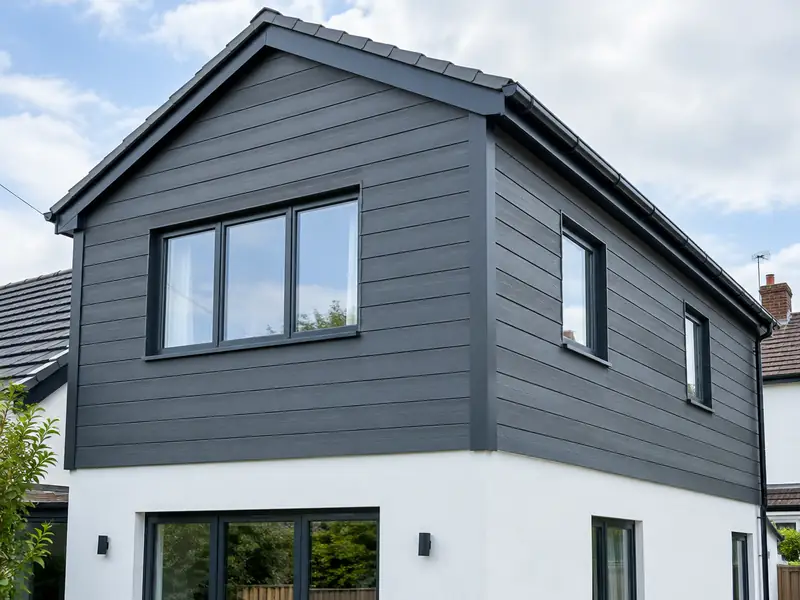
Cladding is a protective outer layer of boards or panels, such as timber, composite, fibre cement or uPVC, fixed to battens on the outside of a wall to change its appearance, shed rain and, where insulation is added, reduce heat loss.
We handle cladding as a managed project across County Londonderry: one contract, one contact, and trades working to an agreed specification. Coverage includes Derry/Londonderry, Coleraine, Limavady and Magherafelt and their surroundings. In Northern Ireland the consent rules have their own details, which we check for you. Typical prices in Northern Ireland fall within £4,300–£10,500, VAT included, and are fixed in writing after a survey.
- Guide price
- £4,300–£10,500 inc VAT
- Time on site
- 3 days to 3 weeks depending on area
- Planning rules
- Northern Ireland
- Price level
- About 14% below the national guide
- Towns listed
- 4
- Survey
- Free, with a written quote
How much does cladding cost in County Londonderry?
Below is a breakdown of typical costs for cladding in County Londonderry. Because rates in Northern Ireland are about 14% below the national guide, the overall guide comes to £4,300–£10,500, including VAT. Size, materials and access move the figure, and a free-of-charge survey settles it.
| Type of job | What it usually involves | Guide in County Londonderry |
|---|---|---|
| Feature area or dormer | A gable, dormer, bay or small feature wall in uPVC, timber or composite. | £1,300–£4,300 |
| Extension or upper storey | About 40–60m² of timber, composite or fibre cement with membrane and battens. | £4,300–£10,500 |
| Whole house | Cladding most elevations of a house, often with added insulation. | £10,500–£26,000 |
The main things that change the figure:
- Cladding material and board profile
- Insulation behind the cladding
- Window reveals, corners and roof junctions to detail
- Scaffolding, access and distance from boundaries
What’s included?
- Survey of the wall, boundaries, damp and window details
- Scaffolding or access towers as needed
- Breather membrane and treated battens fixed to the wall
- Cavity barriers and fire-stopping where regulations require
- Cladding boards fixed with suitable stainless or coated fixings
- Corner trims, window reveals and ventilated top and bottom edges
Homes in County Londonderry
Derry has Georgian and Victorian terraces around its walled city, alongside large post-war estates and newer developments. Coleraine, Limavady and Magherafelt mix older town centres with semis and estates, Portstewart has seaside villas, and rural areas have many detached homes and bungalows, often roughcast.
Terraces suit loft conversions and rear extensions, while rural bungalows commonly take extensions, loft rooms and driveways. Roughcast homes often need re-rendering, and coastal houses need roofline and window renewal.
The north coast faces Atlantic wind, rain and salt, and the Sperrins inland are colder and wetter.
Do you need permission in County Londonderry?
England, Wales, Scotland and Northern Ireland each handle planning a little differently. County Londonderry comes under Northern Ireland, covered below, and we raise any questions with the council before your quote is finalised.
In Northern Ireland, re-rendering is usually treated as repair, but conservation areas and listed buildings are controlled.
Significant re-cladding or external insulation should be checked with building control under the Building Regulations (Northern Ireland).
Rules change and every property is different, so we check the planning history and constraints for your address before we quote.
How does the job run?
Free site survey
A free survey comes first. It gives us what we need to price cladding properly, including dimensions, existing materials and access for deliveries, and gives you the chance to ask anything you like.
Written quote
You get the price in writing, itemised so you can see where the money goes. As long as the specification stays the same, that is the price you pay for cladding.
Plan and prepare
With the quote agreed, we book the work in and handle preparation: permissions where needed, building control notifications, material orders and access arrangements for your County Londonderry property.
The work itself
The job proceeds in the order set out in the programme, with dust and debris kept under control. Finally we tidy away, inspect the work together and pass the finished project over to you with its paperwork.
How we work
Questions about cladding in County Londonderry
Are there fire-safety rules for cladding?
Building regulations limit the fire-spread performance of cladding on walls close to a boundary and on taller buildings, which can rule out some timber or composite products in those positions. Cavity barriers behind the cladding also help stop fire spreading through the gap. Fibre cement is non-combustible. We check boundary distances and product data before recommending a material.
Do I need planning permission to clad my house?
Whether cladding needs planning permission depends on the material and how it changes the look of the house, your home's location, whether it is listed or in a conservation area, and which UK nation you live in. In England, cladding is generally permitted development only if the materials look similar to the existing house, and it is not permitted development in conservation areas. We check before quoting.
What happens at the survey?
We visit your home at a time that suits you, look at the area involved, take measurements and check access, condition and any services that might be affected. We talk through what you want from cladding, explain the options and answer questions. There is no charge and no obligation; afterwards we send a written quote.
Which postcodes in County Londonderry do you cover?
We cover BT48, BT52, BT49 and BT45, along with the rest of County Londonderry. If your postcode is not listed, get in touch anyway: our coverage is UK-wide, and we can usually arrange a survey wherever you live. Enter your postcode in the guide-price tool or contact form and we will confirm.
How long does cladding take to install?
Cladding a small dormer or gable usually takes a few days, an extension or upper storey around one to two weeks, and a whole house two to three weeks or more. Scaffolding, insulation and detailing around many windows add time. Timber boards may need to acclimatise on site first. We give you a programme with the written quote.
Towns in County Londonderry
Find your town below. Every place listed in County Londonderry is covered for cladding, with the same survey, written quote and fixed-price process.