
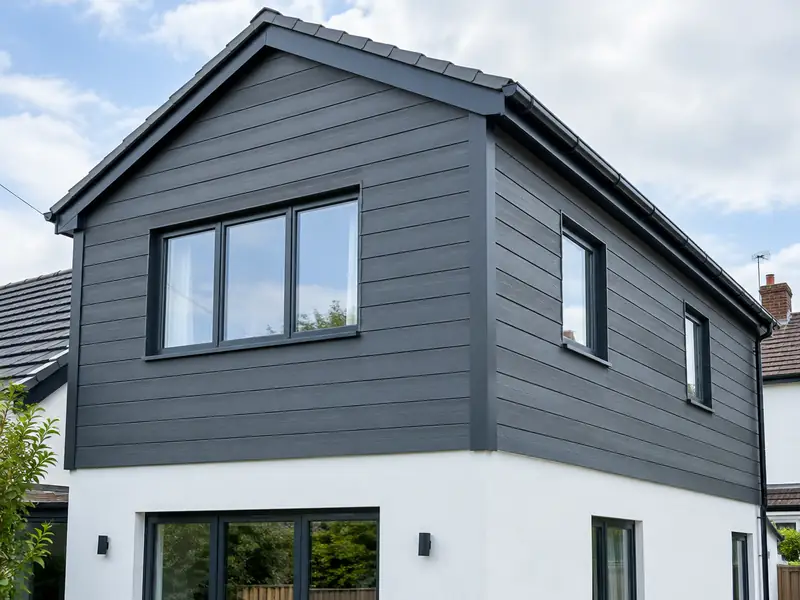
Cladding is a protective outer layer of boards or panels, such as timber, composite, fibre cement or uPVC, fixed to battens on the outside of a wall to change its appearance, shed rain and, where insulation is added, reduce heat loss.
We offer cladding across Devon, and Newton Abbot is one of the places we cover, along with nearby Torquay, Paignton and Exmouth. Before anything is agreed we visit, check the existing structure and talk through your options. You then receive a written quote setting out the full scope; for most homes in the South West it sits within £5,100–£12,000 including VAT.
- Guide price
- £5,100–£12,000 inc VAT
- Time on site
- 3 days to 3 weeks depending on area
- Postcodes
- TQ12
- Planning rules
- England
- Local area
- Devon
- Survey
- Free, with a written quote
Cladding prices in Newton Abbot
Below is a breakdown of typical costs for cladding in Newton Abbot. Because rates in the South West are about 2% above the national guide, the overall guide comes to £5,100–£12,000, including VAT. Size, materials and access move the figure, and a free-of-charge survey settles it.
| Type of job | What it usually involves | Guide in Newton Abbot |
|---|---|---|
| Feature area or dormer | A gable, dormer, bay or small feature wall in uPVC, timber or composite. | £1,550–£5,100 |
| Extension or upper storey | About 40–60m² of timber, composite or fibre cement with membrane and battens. | £5,100–£12,000 |
| Whole house | Cladding most elevations of a house, often with added insulation. | £12,000–£30,500 |
Expect these to shape the final quote:
- Wall area to be clad and the height of the building
- Cladding material and board profile
- Window reveals, corners and roof junctions to detail
- Scaffolding, access and distance from boundaries
Scope of the work
- Survey of the wall, boundaries, damp and window details
- Scaffolding or access towers as needed
- Breather membrane and treated battens fixed to the wall
- Insulation behind the cladding where agreed
- Cladding boards fixed with suitable stainless or coated fixings
- Waste removal and a clean site on completion
Local housing and cladding
Devon is known for cob and thatch cottages, especially in mid and east Devon, alongside granite on Dartmoor and red sandstone around Exeter. Exeter and Plymouth have Georgian and Victorian terraces, Plymouth's centre was largely rebuilt after the war, and seaside towns such as Torquay and Exmouth have rendered villas and newer estates.
Cob and stone homes need breathable lime plaster and render rather than cement. Victorian terraces suit loft rooms and window replacement, while post-war and newer homes often take extensions, rendering and roofline renewal.
If your house in Newton Abbot fits one of these patterns, it helps us anticipate what cladding will involve, though we always confirm the details on site.
Do you need permission in Newton Abbot?
As Newton Abbot is in England, read the following with that system of planning and building control in mind. We check what applies to your house with the council before you receive a quote.
In England, re-rendering or cladding a house is often allowed without planning permission, but stone, render, timber, plastic or tile cladding is not permitted development in conservation areas, and listed buildings need consent.
If you render or re-clad more than 25% of an external wall, Building Regulations usually require the wall’s insulation to be improved where that is practical, and building control should be notified.
Rules change and every property is different, so we check the planning history and constraints for your address before we quote.
The four stages
A visit to your home
It starts with a survey at the property, free of charge. We check condition, access and services, ask how you want the finished result to look, and answer any questions you have about cladding.
Your fixed price
After the survey we send a quote for cladding that fixes the price for the scope we've agreed. If you want to change materials or scope, we revise it in writing before anything is booked.
Plan and prepare
We handle the paperwork side: checking whether planning permission or building control approval is needed, submitting applications where they are, and scheduling the trades and materials around your dates.
Build and hand over
The work is carried out to the agreed specification, with floors and furniture protected and the site kept tidy. At the end we clean up, walk through the finished job with you and hand over any certificates.
How we work
Questions about cladding in Newton Abbot
How much does house cladding cost?
Cladding around 40–60m² of wall, such as an extension or upper storey, costs £5,100–£12,000, including membrane, battens and trims. As a guide, allow roughly £80–£180 per square metre plus fixed costs for scaffolding and set-up. uPVC and softwood sit at the lower end, while hardwood, composite and fibre cement cost more. Adding insulation increases the price. We confirm a fixed figure after the survey.
Are there fire-safety rules for cladding?
Building regulations limit the fire-spread performance of cladding on walls close to a boundary and on taller buildings, which can rule out some timber or composite products in those positions. Cavity barriers behind the cladding also help stop fire spreading through the gap. Fibre cement is non-combustible. We check boundary distances and product data before recommending a material.
Can you combine cladding with other work?
Yes. Because we manage several trades under one contract, we can plan cladding alongside other work on your Newton Abbot home, such as new windows with rendering, or a kitchen refit with an extension. Combining jobs can reduce repeat set-up such as scaffolding, skips and access, and every element is listed and priced in the same written quote.
Do I need planning permission in Newton Abbot?
It depends on the work, the size of the project, your property type and whether the building is listed or in a conservation area. Newton Abbot is in England, so England's rules apply. Many smaller jobs need no planning application, but some still need building control approval. We check what applies to your address before quoting.
Can you clad over existing render or brick?
Cladding is usually fixed over existing render or brick using battens, as long as the wall is sound and dry. Loose render may need removing first so the fixings hold. The battens create a ventilated gap so any moisture can drain and dry. We check the wall during the survey and explain any preparation needed before cladding.
Near Newton Abbot
If your address falls within TQ12, we cover it. The same goes for neighbouring Torquay, Paignton and Exmouth, which we include alongside Newton Abbot when arranging surveys and quotes.