
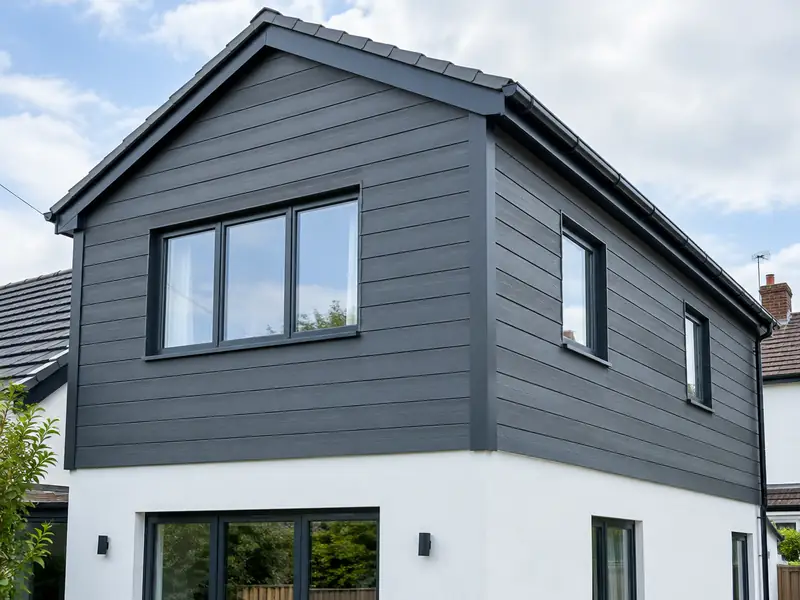
Cladding is a protective outer layer of boards or panels, such as timber, composite, fibre cement or uPVC, fixed to battens on the outside of a wall to change its appearance, shed rain and, where insulation is added, reduce heat loss.
If you have cladding on your list for a property in Poole, we can help from the first measurements to the final clean-up. For a typical home, plan for 3 days to 3 weeks depending on area, though larger or more complex jobs take longer. We cover postcodes BH14, BH15 and BH17 and nearby Bournemouth, Christchurch and New Milton, and every quote we send is fixed for the scope described in it.
- Guide price
- £5,100–£12,000 inc VAT
- Time on site
- 3 days to 3 weeks depending on area
- Postcodes
- BH14, BH15 and BH17
- Planning rules
- England
- Local area
- Dorset
- Survey
- Free, with a written quote
How much does cladding cost in Poole?
Below is a breakdown of typical costs for cladding in Poole. Because rates in the South West are about 2% above the national guide, the overall guide comes to £5,100–£12,000, including VAT. Size, materials and access move the figure, and a free-of-charge survey settles it.
| Type of job | What it usually involves | Guide in Poole |
|---|---|---|
| Feature area or dormer | A gable, dormer, bay or small feature wall in uPVC, timber or composite. | £1,550–£5,100 |
| Extension or upper storey | About 40–60m² of timber, composite or fibre cement with membrane and battens. | £5,100–£12,000 |
| Whole house | Cladding most elevations of a house, often with added insulation. | £12,000–£30,500 |
Your price depends mostly on:
- Wall area to be clad and the height of the building
- Cladding material and board profile
- Insulation behind the cladding
- Scaffolding, access and distance from boundaries
What does the job include in Poole?
- Scaffolding or access towers as needed
- Insulation behind the cladding where agreed
- Cavity barriers and fire-stopping where regulations require
- Cladding boards fixed with suitable stainless or coated fixings
- Corner trims, window reveals and ventilated top and bottom edges
- Waste removal and a clean site on completion
What are homes like around Poole?
Dorset's older villages use Purbeck and Portland stone, chalk and flint, and thatch on cob or brick cottages. Bournemouth and Poole have Victorian and Edwardian villas, large interwar suburbs and plenty of bungalows and flats, while Weymouth, Dorchester and Bridport mix Georgian and Victorian streets with newer estates.
Stone and thatched cottages may need lime repairs and conservation-area window choices. Bungalows around Bournemouth and Poole commonly suit loft conversions, and coastal homes often need roofline, rendering and window renewal.
For cladding in Poole, this means checking things like wall construction, roof structure and existing services before we put a figure on paper.
Permissions for cladding in Poole
As Poole is in England, read the following with that system of planning and building control in mind. We check what applies to your house with the council before you receive a quote.
In England, re-rendering or cladding a house is often allowed without planning permission, but stone, render, timber, plastic or tile cladding is not permitted development in conservation areas, and listed buildings need consent.
If you render or re-clad more than 25% of an external wall, Building Regulations usually require the wall’s insulation to be improved where that is practical, and building control should be notified.
Rules change and every property is different, so we check the planning history and constraints for your address before we quote.
From survey to handover
A visit to your home
First, someone visits your home in Poole to see the space, take measurements and note anything that could affect the work, such as access or the condition of what is there. There is no charge for this visit.
Written quote
The quote arrives in writing, not over the phone. It covers the full scope, the finishes you've chosen, any exclusions and the payment schedule, with a fixed price tied to that specification.
Plan and prepare
Before anyone starts, we confirm the programme in writing, check whether consents are required and arrange deliveries. If a skip or scaffolding on the road needs a permit, we apply for it.
Build and hand over
During the work we protect the areas around it and tidy up at the end of each day. Once complete, we check the finish, remove our materials and hand over paperwork such as building control sign-off where it applies.
Why homeowners choose us
Common questions
Can you clad over existing render or brick?
Cladding is usually fixed over existing render or brick using battens, as long as the wall is sound and dry. Loose render may need removing first so the fixings hold. The battens create a ventilated gap so any moisture can drain and dry. We check the wall during the survey and explain any preparation needed before cladding.
How long will cladding take?
On a typical home, allow 3 days to 3 weeks depending on area. Larger projects, older buildings and extra work found once things are opened up can extend that, while simpler jobs may be shorter. Your quote includes an estimate of time on site, and your point of contact keeps you updated on the programme as the work progresses.
Do I need planning permission to clad my house?
Whether cladding needs planning permission depends on the material and how it changes the look of the house, your home's location, whether it is listed or in a conservation area, and which UK nation you live in. In England, cladding is generally permitted development only if the materials look similar to the existing house, and it is not permitted development in conservation areas. We check before quoting.
How much does house cladding cost?
Cladding around 40–60m² of wall, such as an extension or upper storey, costs £5,100–£12,000, including membrane, battens and trims. As a guide, allow roughly £80–£180 per square metre plus fixed costs for scaffolding and set-up. uPVC and softwood sit at the lower end, while hardwood, composite and fibre cement cost more. Adding insulation increases the price. We confirm a fixed figure after the survey.
Can I stay at home during the work?
In most cases, yes. Most people can live at home throughout, and we plan the work to keep disruption down by protecting floors, agreeing working hours and keeping access routes clear. Bigger jobs affecting kitchens, bathrooms or heating may mean a short spell with reduced facilities, and we talk this through with you at the survey.
Nearby towns
Coverage for Poole spans BH14, BH15 and BH17. Close by, Bournemouth, Christchurch and New Milton are covered too, and the rest of our UK-wide area follows the same survey-then-quote process from start to finish.