
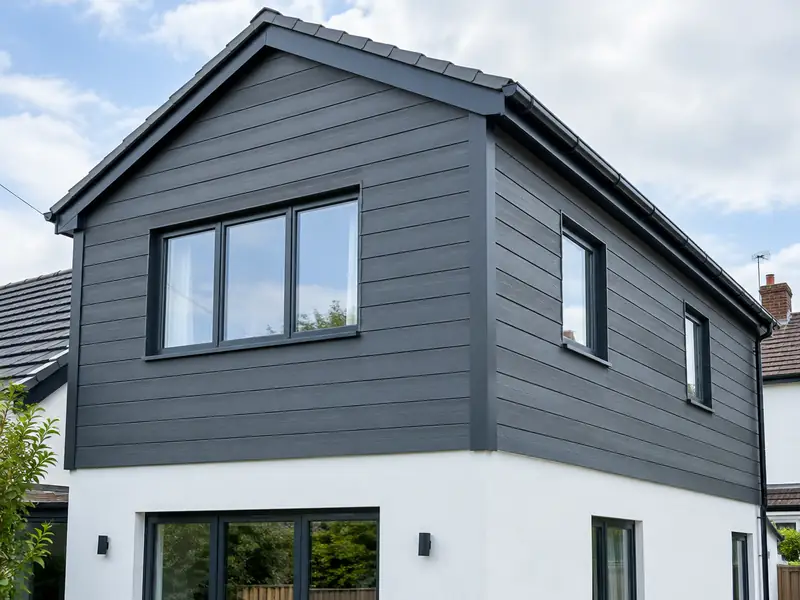
Cladding is a protective outer layer of boards or panels, such as timber, composite, fibre cement or uPVC, fixed to battens on the outside of a wall to change its appearance, shed rain and, where insulation is added, reduce heat loss.
Looking for cladding in Dumfries and Galloway? We organise the whole job, bringing in the trades it needs under one agreement, and you have a single contact. We cover Dumfries, Stranraer, Annan and Locharbriggs, along with villages and suburbs nearby. The rules in Scotland decide what consents are needed, and our guide range of £4,800–£11,500 including VAT gives you a realistic starting point for a budget.
- Guide price
- £4,800–£11,500 inc VAT
- Time on site
- 3 days to 3 weeks depending on area
- Planning rules
- Scotland
- Price level
- About 4% below the national guide
- Towns listed
- 4
- Survey
- Free, with a written quote
How much does cladding cost in Dumfries and Galloway?
These are guide costs, not quotes. For cladding in Dumfries and Galloway the range is £4,800–£11,500, VAT included, reflecting prices in Scotland that are about 4% below the national guide. Once we have visited for a free survey, you get a firm figure for the scope you approve.
| Type of job | What it usually involves | Guide in Dumfries and Galloway |
|---|---|---|
| Feature area or dormer | A gable, dormer, bay or small feature wall in uPVC, timber or composite. | £1,450–£4,800 |
| Extension or upper storey | About 40–60m² of timber, composite or fibre cement with membrane and battens. | £4,800–£11,500 |
| Whole house | Cladding most elevations of a house, often with added insulation. | £11,500–£29,000 |
The main things that change the figure:
- Cladding material and board profile
- Insulation behind the cladding
- Window reveals, corners and roof junctions to detail
- Scaffolding, access and distance from boundaries
Scope of the work
- Scaffolding or access towers as needed
- Breather membrane and treated battens fixed to the wall
- Insulation behind the cladding where agreed
- Cladding boards fixed with suitable stainless or coated fixings
- Corner trims, window reveals and ventilated top and bottom edges
- Waste removal and a clean site on completion
Housing across Dumfries and Galloway
Dumfries is known for red sandstone buildings, and older towns across the region, such as Kirkcudbright and Castle Douglas, have Georgian and Victorian streets. Rural homes are often harled whinstone or sandstone farmhouses and cottages under slate roofs, with post-war and modern housing on the edges of towns such as Stranraer and Annan.
Stone and harled homes commonly need lime-based repairs, re-harling and roof slating work. Town houses suit extensions and loft conversions, and rural properties often take porches, driveways and fencing.
Mild but wet, with exposed Solway and west coasts and remote rural sites that can need extra planning for access.
Planning and building rules in Dumfries and Galloway
Homes in Dumfries and Galloway come under the regulations for Scotland, summarised below. We don't rely on general rules alone: we confirm the position for your address with the council before a quote goes out.
In Scotland, changing the external finish of a house in a conservation area or on a listed building needs consent; elsewhere, like-for-like re-rendering is usually treated as repair.
Large-scale re-cladding or external insulation can need a building warrant; like-for-like render repairs normally do not.
Rules change and every property is different, so we check the planning history and constraints for your address before we quote.
From survey to handover
Free site survey
A free survey comes first. It gives us what we need to price cladding properly, including dimensions, existing materials and access for deliveries, and gives you the chance to ask anything you like.
Written quote
We turn the survey notes into a written quote. The price is fixed for the specification we agree, and the document sets out materials, scope and payment stages in plain language.
Booking the work
Preparation matters as much as the build. We agree access, parking and working hours with you, order materials in good time, and confirm any permissions so the job isn't held up once it starts.
On site to finish
Our trades complete cladding while your point of contact keeps you updated. When everything is finished, we clear the site, take away waste and go through the result with you before handover.
What you can expect from us
Questions about cladding in Dumfries and Galloway
Will timber cladding change colour?
Untreated timber cladding naturally weathers to a silver-grey over a year or two as sunlight breaks down the surface. The change can be uneven at first, especially under eaves where rain does not reach. If you want to keep the original colour, a UV-protective stain or oil is needed and must be renewed every few years. Pre-weathered and coated boards are also available.
Do I need planning permission to clad my house?
Whether cladding needs planning permission depends on the material and how it changes the look of the house, your home's location, whether it is listed or in a conservation area, and which UK nation you live in. In England, cladding is generally permitted development only if the materials look similar to the existing house, and it is not permitted development in conservation areas. We check before quoting.
How long will cladding take?
On a typical home, allow 3 days to 3 weeks depending on area. Larger projects, older buildings and extra work found once things are opened up can extend that, while simpler jobs may be shorter. Your quote includes an estimate of time on site, and your point of contact keeps you updated on the programme as the work progresses.
Can I stay at home during the work?
In most cases, yes. Most people can live at home throughout, and we plan the work to keep disruption down by protecting floors, agreeing working hours and keeping access routes clear. Bigger jobs affecting kitchens, bathrooms or heating may mean a short spell with reduced facilities, and we talk this through with you at the survey.
Can cladding improve insulation?
Cladding can improve insulation if insulation boards are fixed to the wall behind the battens, which reduces heat loss and can help with cold or damp internal walls. This adds thickness, so window reveals, sills and roof edges need careful detailing. Cladding alone, without insulation, adds very little warmth. We can price both options so you can compare.
Towns in Dumfries and Galloway
Homes in all of the following Dumfries and Galloway towns can get a written quote for cladding. Open a town page to see prices and the postcodes we cover.