
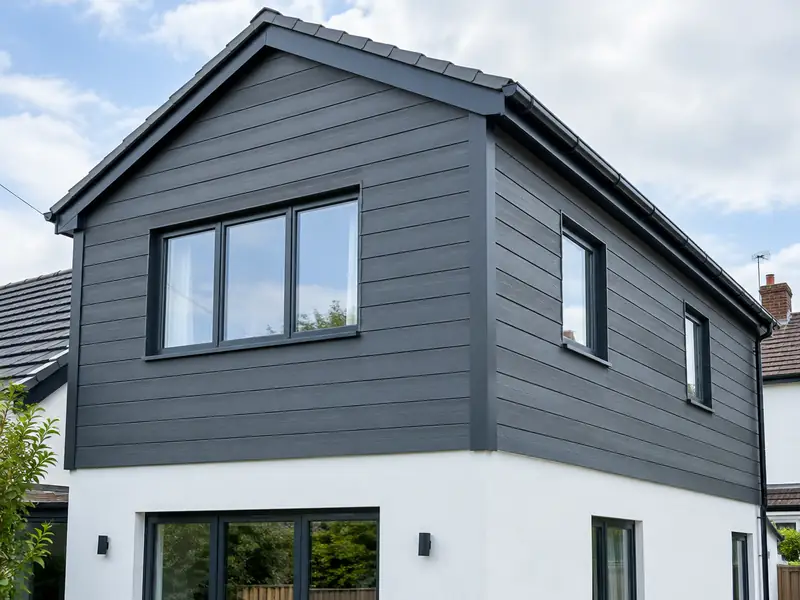
Cladding is a protective outer layer of boards or panels, such as timber, composite, fibre cement or uPVC, fixed to battens on the outside of a wall to change its appearance, shed rain and, where insulation is added, reduce heat loss.
From a first conversation about cladding to the day the site is cleared, homeowners in Bexhill-on-Sea deal with us directly. We come out to measure up at no cost, explain the choices in plain terms and send a written quote. For context, comparable work in the South East usually falls within £5,600–£13,500 including VAT, and it is available across TN39 and TN40.
- Guide price
- £5,600–£13,500 inc VAT
- Time on site
- 3 days to 3 weeks depending on area
- Postcodes
- TN39 and TN40
- Planning rules
- England
- Local area
- East Sussex
- Survey
- Free, with a written quote
How much does cladding cost in Bexhill-on-Sea?
The costs listed here are typical for cladding around Bexhill-on-Sea and include VAT. They reflect labour and material costs in the South East, about 12% above the national guide, giving a range of £5,600–£13,500. Exact pricing depends on your home, so we only fix it once a free site survey is done.
| Type of job | What it usually involves | Guide in Bexhill-on-Sea |
|---|---|---|
| Feature area or dormer | A gable, dormer, bay or small feature wall in uPVC, timber or composite. | £1,700–£5,600 |
| Extension or upper storey | About 40–60m² of timber, composite or fibre cement with membrane and battens. | £5,600–£13,500 |
| Whole house | Cladding most elevations of a house, often with added insulation. | £13,500–£33,500 |
What moves the price up or down:
- Wall area to be clad and the height of the building
- Cladding material and board profile
- Window reveals, corners and roof junctions to detail
- Scaffolding, access and distance from boundaries
What do you get?
- Survey of the wall, boundaries, damp and window details
- Scaffolding or access towers as needed
- Insulation behind the cladding where agreed
- Cladding boards fixed with suitable stainless or coated fixings
- Corner trims, window reveals and ventilated top and bottom edges
- Waste removal and a clean site on completion
Local housing and cladding
Brighton and Hove are known for Regency stucco terraces and bow-fronted houses, alongside Victorian terraces climbing the hills. Lewes and Brighton have mathematical tiles and flint walls, Eastbourne has large Victorian and Edwardian villas, and Wealden villages use tile-hanging, weatherboarding and timber frames. Interwar suburbs and newer estates fill out most towns.
Regency and Victorian houses often need sash-style windows, stucco or render repair and careful decorating. Hillside terraces suit loft conversions, and flint or brick walls commonly need repointing in lime mortar.
That variety is why a guide price for cladding in Bexhill-on-Sea is only a starting point; the survey shows what your particular property needs.
Permissions for cladding in Bexhill-on-Sea
The notes below cover England, which is where Bexhill-on-Sea sits. Rules change and every property is different, so we speak to the council before pricing your job.
In England, re-rendering or cladding a house is often allowed without planning permission, but stone, render, timber, plastic or tile cladding is not permitted development in conservation areas, and listed buildings need consent.
If you render or re-clad more than 25% of an external wall, Building Regulations usually require the wall’s insulation to be improved where that is practical, and building control should be notified.
Rules change and every property is different, so we check the planning history and constraints for your address before we quote.
How does the job run?
Survey and measure
We begin by looking at the job in person. During the free survey we discuss options, materials and budget for cladding, and photograph or measure anything the quote needs to reflect.
Quote in writing
After the survey we send a quote for cladding that fixes the price for the scope we've agreed. If you want to change materials or scope, we revise it in writing before anything is booked.
Plan and prepare
Preparation matters as much as the build. We agree access, parking and working hours with you, order materials in good time, and confirm any permissions so the job isn't held up once it starts.
Build and hand over
During the work we protect the areas around it and tidy up at the end of each day. Once complete, we check the finish, remove our materials and hand over paperwork such as building control sign-off where it applies.
Why homeowners choose us
Frequently asked questions
How long does cladding take to install?
Cladding a small dormer or gable usually takes a few days, an extension or upper storey around one to two weeks, and a whole house two to three weeks or more. Scaffolding, insulation and detailing around many windows add time. Timber boards may need to acclimatise on site first. We give you a programme with the written quote.
Do I need planning permission to clad my house?
Whether cladding needs planning permission depends on the material and how it changes the look of the house, your home's location, whether it is listed or in a conservation area, and which UK nation you live in. In England, cladding is generally permitted development only if the materials look similar to the existing house, and it is not permitted development in conservation areas. We check before quoting.
Which postcodes in Bexhill-on-Sea do you cover?
We cover TN39 and TN40, along with the rest of East Sussex. If your postcode is not listed, get in touch anyway: our coverage is UK-wide, and we can usually arrange a survey wherever you live. Enter your postcode in the guide-price tool or contact form and we will confirm.
Can you combine cladding with other work?
Yes. Because we manage several trades under one contract, we can plan cladding alongside other work on your Bexhill-on-Sea home, such as new windows with rendering, or a kitchen refit with an extension. Combining jobs can reduce repeat set-up such as scaffolding, skips and access, and every element is listed and priced in the same written quote.
Can you clad over existing render or brick?
Cladding is usually fixed over existing render or brick using battens, as long as the wall is sound and dry. Loose render may need removing first so the fixings hold. The battens create a ventilated gap so any moisture can drain and dry. We check the wall during the survey and explain any preparation needed before cladding.
Also covering areas around Bexhill-on-Sea
We survey and quote throughout Bexhill-on-Sea's TN39 and TN40 postcodes and in surrounding places such as Hastings, Hailsham and Eastbourne. The process and pricing approach are identical in each of them.