
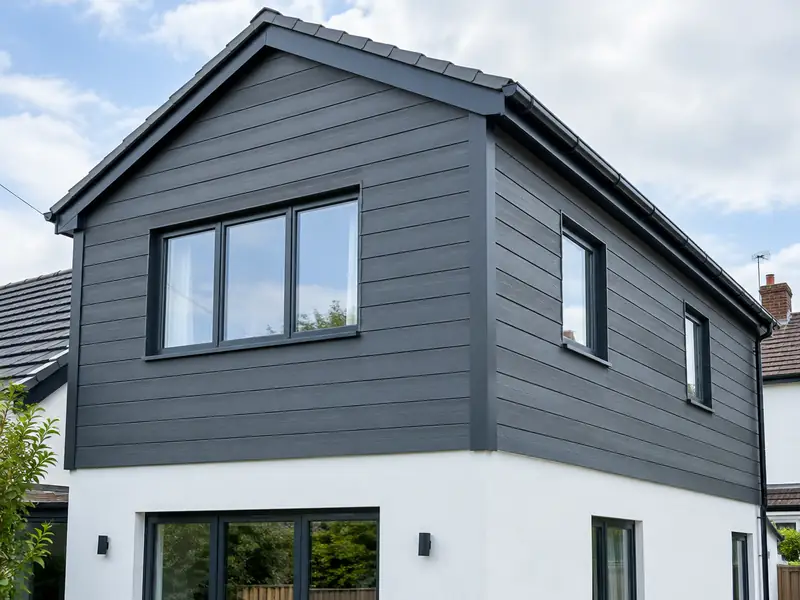
Cladding is a protective outer layer of boards or panels, such as timber, composite, fibre cement or uPVC, fixed to battens on the outside of a wall to change its appearance, shed rain and, where insulation is added, reduce heat loss.
Anyone planning cladding in Glenrothes wants three things: a clear price, a realistic timetable and a tidy job. We publish a guide of £4,800–£11,500 including VAT for Scotland up front, explain that work normally takes 3 days to 3 weeks depending on area, and confirm both in writing after a free survey of your property.
- Guide price
- £4,800–£11,500 inc VAT
- Time on site
- 3 days to 3 weeks depending on area
- Postcodes
- KY6 and KY7
- Planning rules
- Scotland
- Local area
- Fife
- Survey
- Free, with a written quote
How much does cladding cost in Glenrothes?
Here is how the guide price for cladding breaks down in Glenrothes. We start from national figures and adjust for Scotland, which comes out about 4% below the national guide. The resulting range, VAT included, is £4,800–£11,500, and a survey, at no cost to you, firms it up.
| Type of job | What it usually involves | Guide in Glenrothes |
|---|---|---|
| Feature area or dormer | A gable, dormer, bay or small feature wall in uPVC, timber or composite. | £1,450–£4,800 |
| Extension or upper storey | About 40–60m² of timber, composite or fibre cement with membrane and battens. | £4,800–£11,500 |
| Whole house | Cladding most elevations of a house, often with added insulation. | £11,500–£29,000 |
The main things that change the figure:
- Wall area to be clad and the height of the building
- Cladding material and board profile
- Insulation behind the cladding
- Scaffolding, access and distance from boundaries
Scope of the work
- Scaffolding or access towers as needed
- Breather membrane and treated battens fixed to the wall
- Cavity barriers and fire-stopping where regulations require
- Cladding boards fixed with suitable stainless or coated fixings
- Corner trims, window reveals and ventilated top and bottom edges
- Waste removal and a clean site on completion
Local housing and cladding
Fife's East Neuk fishing villages are known for pantiled roofs and crow-stepped gables, and St Andrews has historic stone streets. Kirkcaldy and Dunfermline have Victorian sandstone housing and interwar estates, Glenrothes was built as a post-war new town, and former mining towns in central Fife have rows of cottages and post-war council housing.
Pantiled and stone homes need careful roof repairs and lime work. Post-war and new-town houses commonly take re-rendering, window replacement and extensions, while bungalows suit loft conversions.
If your house in Glenrothes fits one of these patterns, it helps us anticipate what cladding will involve, though we always confirm the details on site.
Permissions for cladding in Glenrothes
The notes below cover Scotland, which is where Glenrothes sits. Rules change and every property is different, so we speak to the council before pricing your job.
In Scotland, changing the external finish of a house in a conservation area or on a listed building needs consent; elsewhere, like-for-like re-rendering is usually treated as repair.
Large-scale re-cladding or external insulation can need a building warrant; like-for-like render repairs normally do not.
Rules change and every property is different, so we check the planning history and constraints for your address before we quote.
From survey to handover
Survey and measure
We arrange a free site survey on a date convenient to you. We measure up, look at the existing structure and access, and discuss your plans for cladding so the price reflects your home.
Price and scope agreed
You get the price in writing, itemised so you can see where the money goes. As long as the specification stays the same, that is the price you pay for cladding.
Plan and prepare
With the quote agreed, we book the work in and handle preparation: permissions where needed, building control notifications, material orders and access arrangements for your Glenrothes property.
On site to finish
On site, the agreed plan is followed and any change is put in writing first. At completion we do a final clean, go through the snagging list with you and leave you with the relevant documents.
What you can expect from us
Common questions
How much does house cladding cost?
Cladding around 40–60m² of wall, such as an extension or upper storey, costs £4,800–£11,500, including membrane, battens and trims. As a guide, allow roughly £80–£180 per square metre plus fixed costs for scaffolding and set-up. uPVC and softwood sit at the lower end, while hardwood, composite and fibre cement cost more. Adding insulation increases the price. We confirm a fixed figure after the survey.
Which postcodes in Glenrothes do you cover?
We cover KY6 and KY7, along with the rest of Fife. If your postcode is not listed, get in touch anyway: our coverage is UK-wide, and we can usually arrange a survey wherever you live. Enter your postcode in the guide-price tool or contact form and we will confirm.
Will timber cladding change colour?
Untreated timber cladding naturally weathers to a silver-grey over a year or two as sunlight breaks down the surface. The change can be uneven at first, especially under eaves where rain does not reach. If you want to keep the original colour, a UV-protective stain or oil is needed and must be renewed every few years. Pre-weathered and coated boards are also available.
Do I need planning permission to clad my house?
Whether cladding needs planning permission depends on the material and how it changes the look of the house, your home's location, whether it is listed or in a conservation area, and which UK nation you live in. In England, cladding is generally permitted development only if the materials look similar to the existing house, and it is not permitted development in conservation areas. We check before quoting.
How much will cladding cost in Glenrothes?
As a guide, expect to pay £4,800–£11,500 including VAT for cladding in Glenrothes. That range is adjusted for Scotland, which runs about 4% below the national guide. Where your project lands depends on size, materials, access and the condition of what is already there. We confirm a fixed price in writing after a free survey of your home.
Near Glenrothes
Coverage for Glenrothes spans KY6 and KY7. Close by, Kirkcaldy, Dunfermline and Edinburgh are covered too, and the rest of our UK-wide area follows the same survey-then-quote process from start to finish.