
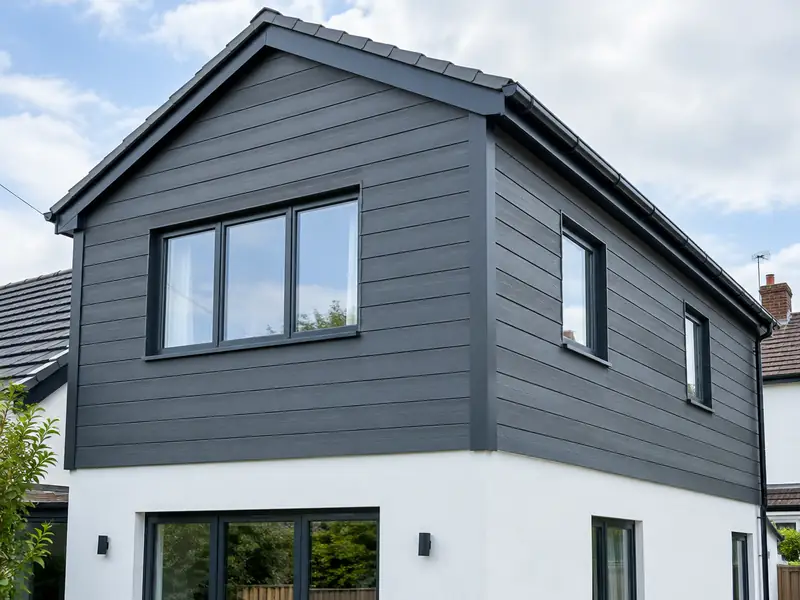
Cladding is a protective outer layer of boards or panels, such as timber, composite, fibre cement or uPVC, fixed to battens on the outside of a wall to change its appearance, shed rain and, where insulation is added, reduce heat loss.
In Aldershot, as anywhere in Hampshire, the price of cladding is driven mainly by size, materials and access. Across the South East our guide sits at £5,600–£13,500 with VAT, but restricted parking, a narrow side passage or extra preparation can move the figure either way. That is why every price we give follows a visit to the house.
- Guide price
- £5,600–£13,500 inc VAT
- Time on site
- 3 days to 3 weeks depending on area
- Postcodes
- GU11
- Planning rules
- England
- Local area
- Hampshire
- Survey
- Free, with a written quote
What should you budget for cladding in Aldershot?
The costs listed here are typical for cladding around Aldershot and include VAT. They reflect labour and material costs in the South East, about 12% above the national guide, giving a range of £5,600–£13,500. Exact pricing depends on your home, so we only fix it once a free site survey is done.
| Type of job | What it usually involves | Guide in Aldershot |
|---|---|---|
| Feature area or dormer | A gable, dormer, bay or small feature wall in uPVC, timber or composite. | £1,700–£5,600 |
| Extension or upper storey | About 40–60m² of timber, composite or fibre cement with membrane and battens. | £5,600–£13,500 |
| Whole house | Cladding most elevations of a house, often with added insulation. | £13,500–£33,500 |
Your price depends mostly on:
- Cladding material and board profile
- Insulation behind the cladding
- Window reveals, corners and roof junctions to detail
- Scaffolding, access and distance from boundaries
What does the job include in Aldershot?
- Survey of the wall, boundaries, damp and window details
- Scaffolding or access towers as needed
- Breather membrane and treated battens fixed to the wall
- Cavity barriers and fire-stopping where regulations require
- Corner trims, window reveals and ventilated top and bottom edges
- Waste removal and a clean site on completion
What are homes like around Aldershot?
Southampton and Portsmouth have dense Victorian terraces, with plenty of post-war rebuilding after wartime bombing. Winchester keeps Georgian and medieval streets, Basingstoke expanded rapidly with 1960s and 1970s estates, and New Forest villages feature cob, thatch and brick. Brick and flint is common on the chalk downs, and new estates ring most towns.
Terraces suit loft rooms and side-return extensions; post-war and expanded-town homes often need window, roofline and cladding renewal. Cottages in the Forest may call for lime repairs and planning-sensitive windows.
These patterns matter for cladding: older walls, roofs and floors in Aldershot can need different materials or extra preparation compared with newer homes.
Planning and building rules in Aldershot
Which rules apply depends on where you live. For Aldershot, the answer is England, and the points below reflect that; we verify them with the council before quoting.
In England, re-rendering or cladding a house is often allowed without planning permission, but stone, render, timber, plastic or tile cladding is not permitted development in conservation areas, and listed buildings need consent.
If you render or re-clad more than 25% of an external wall, Building Regulations usually require the wall’s insulation to be improved where that is practical, and building control should be notified.
Rules change and every property is different, so we check the planning history and constraints for your address before we quote.
From survey to handover
Survey and measure
Book a visit and we'll come to you. The survey covers measurements, the state of what's there now and any obvious constraints, so the price that follows is based on your actual home, not an average.
Quote in writing
We put everything into a written, fixed-price quote: the specification, what's excluded, staged payments and the expected time on site. Take whatever time you need to decide; there's no pressure to commit.
Getting ready
Once you accept, we agree start dates, order materials and deal with any planning, building control or neighbour notices the job needs. You'll know who is coming and when before work begins.
Build and hand over
The job proceeds in the order set out in the programme, with dust and debris kept under control. Finally we tidy away, inspect the work together and pass the finished project over to you with its paperwork.
Working with SK Home Improvements
Common questions
Will timber cladding change colour?
Untreated timber cladding naturally weathers to a silver-grey over a year or two as sunlight breaks down the surface. The change can be uneven at first, especially under eaves where rain does not reach. If you want to keep the original colour, a UV-protective stain or oil is needed and must be renewed every few years. Pre-weathered and coated boards are also available.
Who do I deal with during the job?
One point of contact manages your project from survey to handover. They schedule the trades working under our contract, keep you updated on progress, and are the person to call with any question. You don't need to coordinate builders, electricians or decorators separately, because that is part of what we do.
How much does house cladding cost?
Cladding around 40–60m² of wall, such as an extension or upper storey, costs £5,600–£13,500, including membrane, battens and trims. As a guide, allow roughly £80–£180 per square metre plus fixed costs for scaffolding and set-up. uPVC and softwood sit at the lower end, while hardwood, composite and fibre cement cost more. Adding insulation increases the price. We confirm a fixed figure after the survey.
Can you combine cladding with other work?
Yes. Because we manage several trades under one contract, we can plan cladding alongside other work on your Aldershot home, such as new windows with rendering, or a kitchen refit with an extension. Combining jobs can reduce repeat set-up such as scaffolding, skips and access, and every element is listed and priced in the same written quote.
Are there fire-safety rules for cladding?
Building regulations limit the fire-spread performance of cladding on walls close to a boundary and on taller buildings, which can rule out some timber or composite products in those positions. Cavity barriers behind the cladding also help stop fire spreading through the gap. Fibre cement is non-combustible. We check boundary distances and product data before recommending a material.
Near Aldershot
Coverage for Aldershot spans GU11. Close by, Farnham, Farnborough and Fleet are covered too, and the rest of our UK-wide area follows the same survey-then-quote process from start to finish.