
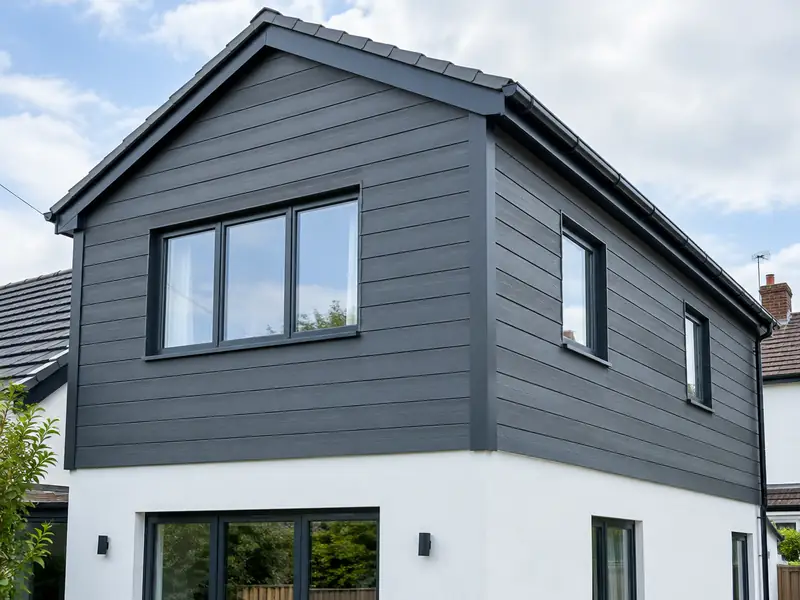
Cladding is a protective outer layer of boards or panels, such as timber, composite, fibre cement or uPVC, fixed to battens on the outside of a wall to change its appearance, shed rain and, where insulation is added, reduce heat loss.
If you live in Havant and are weighing up cladding, the starting point is a visit to measure up and talk through what you want, which costs nothing. We cover homes across PO9, and a typical project of this kind in the South East lands somewhere in the £5,600–£13,500 bracket, including VAT. The exact figure depends on size, access and the finish you choose.
- Guide price
- £5,600–£13,500 inc VAT
- Time on site
- 3 days to 3 weeks depending on area
- Postcodes
- PO9
- Planning rules
- England
- Local area
- Hampshire
- Survey
- Free, with a written quote
Cladding prices in Havant
Use the table to gauge the cost of cladding in Havant before we visit. Figures include VAT and are scaled for the South East, coming out about 12% above the national guide, which gives £5,600–£13,500 overall. After a free survey, you receive a fixed written price.
| Type of job | What it usually involves | Guide in Havant |
|---|---|---|
| Feature area or dormer | A gable, dormer, bay or small feature wall in uPVC, timber or composite. | £1,700–£5,600 |
| Extension or upper storey | About 40–60m² of timber, composite or fibre cement with membrane and battens. | £5,600–£13,500 |
| Whole house | Cladding most elevations of a house, often with added insulation. | £13,500–£33,500 |
What moves the price up or down:
- Cladding material and board profile
- Insulation behind the cladding
- Window reveals, corners and roof junctions to detail
- Scaffolding, access and distance from boundaries
What does the job include in Havant?
- Survey of the wall, boundaries, damp and window details
- Breather membrane and treated battens fixed to the wall
- Insulation behind the cladding where agreed
- Cavity barriers and fire-stopping where regulations require
- Cladding boards fixed with suitable stainless or coated fixings
- Corner trims, window reveals and ventilated top and bottom edges
Homes in Hampshire
Southampton and Portsmouth have dense Victorian terraces, with plenty of post-war rebuilding after wartime bombing. Winchester keeps Georgian and medieval streets, Basingstoke expanded rapidly with 1960s and 1970s estates, and New Forest villages feature cob, thatch and brick. Brick and flint is common on the chalk downs, and new estates ring most towns.
Terraces suit loft rooms and side-return extensions; post-war and expanded-town homes often need window, roofline and cladding renewal. Cottages in the Forest may call for lime repairs and planning-sensitive windows.
Building traditions across Hampshire also raise conservation and planning questions, so we check those for cladding in Havant at the survey stage.
Permissions for cladding in Havant
For anyone in Havant, the relevant framework is England's. The summary below is general, so we always contact the council about your address before putting a price in writing.
In England, re-rendering or cladding a house is often allowed without planning permission, but stone, render, timber, plastic or tile cladding is not permitted development in conservation areas, and listed buildings need consent.
If you render or re-clad more than 25% of an external wall, Building Regulations usually require the wall’s insulation to be improved where that is practical, and building control should be notified.
Rules change and every property is different, so we check the planning history and constraints for your address before we quote.
The four stages
Free site survey
We arrange a free site survey on a date convenient to you. We measure up, look at the existing structure and access, and discuss your plans for cladding so the price reflects your home.
Written quote
Next you receive a written quote with a fixed price for the agreed specification. It lists what is included, what is not, and how payments are staged, so you can compare it properly.
Dates and permissions
Next comes planning the work itself. We set a start date that suits you, line up the right trades, and make sure any approvals for cladding are in place before the first day on site.
On site to finish
The work is carried out to the agreed specification, with floors and furniture protected and the site kept tidy. At the end we clean up, walk through the finished job with you and hand over any certificates.
What you can expect from us
Questions about cladding in Havant
Which postcodes in Havant do you cover?
We cover PO9, along with the rest of Hampshire. If your postcode is not listed, get in touch anyway: our coverage is UK-wide, and we can usually arrange a survey wherever you live. Enter your postcode in the guide-price tool or contact form and we will confirm.
Which cladding material needs the least maintenance?
Fibre cement, composite and uPVC cladding need the least upkeep, usually just an occasional wash. Thermally modified and hardwood timber can be left to weather naturally to a silver-grey, which needs no treatment, but keeping the original colour means re-staining every few years. Painted timber needs repainting regularly. We explain the long-term care of each option.
How long does cladding take to install?
Cladding a small dormer or gable usually takes a few days, an extension or upper storey around one to two weeks, and a whole house two to three weeks or more. Scaffolding, insulation and detailing around many windows add time. Timber boards may need to acclimatise on site first. We give you a programme with the written quote.
Who do I deal with during the job?
One point of contact manages your project from survey to handover. They schedule the trades working under our contract, keep you updated on progress, and are the person to call with any question. You don't need to coordinate builders, electricians or decorators separately, because that is part of what we do.
Can cladding improve insulation?
Cladding can improve insulation if insulation boards are fixed to the wall behind the battens, which reduces heat loss and can help with cold or damp internal walls. This adds thickness, so window reveals, sills and roof edges need careful detailing. Cladding alone, without insulation, adds very little warmth. We can price both options so you can compare.
Nearby towns
Coverage for Havant spans PO9. Close by, Emsworth, Waterlooville and Portsmouth are covered too, and the rest of our UK-wide area follows the same survey-then-quote process from start to finish.